First Seen
2025-07-23T17:12:44+00:00
simple-description (qwen3.5_2b-q8_0)
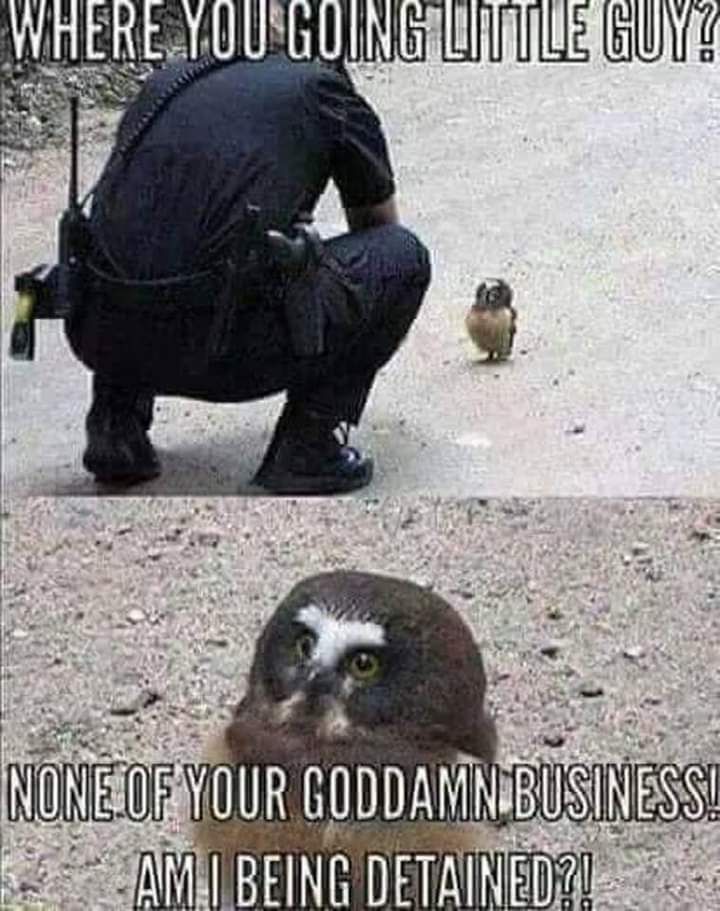
This meme satirizes the casual and intimidating behavior of police officers by showing a suspect crouching before an owl, mimicking the question, "Where you going little guy?" The humor arises when the animal defends itself against what appears to be an arrest with the text stating, "None of your goddamn business! Am I being detained?!!"
detailed-analysis (gemma3_27b-it-q8_0)
Okay, let's break down this meme from an "Anti-Cops" category perspective, utilizing the requested analytical frameworks where applicable.
Meme Analysis: "Where You Going, Little Guy?"
Visual Description
The meme is a two-panel image.
- Panel 1: Shows a police officer in full uniform (including sidearm and equipment) squatting down, looking at a very small, fluffy owlet walking on a dirt road. Text above reads "WHERE YOU GOING, LITTLE GUY?" The visual composition immediately establishes a power imbalance - a large, armed figure confronting a vulnerable, innocent creature.
- Panel 2: Shows a close-up of the owlet, with a highly agitated and defiant expression (likely achieved through editing). Text reads "NONE OF YOUR GODDAMN BUSINESS! AM I BEING DETAINED?!" The contrast between the owlet's size and the intensity of its "response" is the core comedic element.
The meme relies on anthropomorphism – attributing human qualities (speech, defiance, legal awareness) to the animal. This is crucial to its effectiveness.
---
Foucauldian Genealogical Discourse Analysis
This meme resonates strongly with Michel Foucault’s work on power, discourse, and surveillance.
- Power/Knowledge: The officer represents the state's power apparatus, a figure whose authority is often justified by claims of maintaining order and safety. The very question "Where you going, little guy?" is an assertion of that power—a demand for justification of movement. Foucault would argue that this question isn't about genuine concern for the owlet, but about establishing control and knowing its 'place' within the regulated order.
- Panopticism: The officer’s posture, looming over the owlet, evokes the Panoptic structure. The owlet feels observed, even if the officer has no specific reason to suspect wrongdoing. This creates self-regulation, even in a tiny owl. The meme highlights the feeling of being constantly monitored and subjected to scrutiny, a core aspect of modern life according to Foucault.
- Discursive Formation: The meme subverts the expected discourse of police interactions. Usually, a citizen is expected to answer questions posed by law enforcement. Here, the owlet’s aggressive refusal challenges that established discourse. It highlights how seemingly innocuous interactions can be sites of power negotiation.
---
Critical Theory
Drawing on the Frankfurt School, we can see this meme operating as a critique of instrumental reason and the alienation it produces.
- Instrumental Reason: The police officer's question can be seen as a manifestation of instrumental reason—a logic that reduces everything to its utility. The owlet's journey is irrelevant; only its location and potential disruption matter. The question isn't about the owl's wellbeing, but about control.
- Domination and Reification: The interaction exemplifies the relationship between the dominating force (the police) and the dominated (the owlet). The owlet, reduced to an object of scrutiny, is "reified"— treated as a thing rather than a subject with agency.
- Negative Dialectic: The meme operates through a kind of negative dialectic, exposing the absurdity of the power dynamic by juxtaposing it with the innocence of the owl. It isn't offering solutions; it's exposing the contradictions inherent in the system.
---
Marxist Conflict Theory
From a Marxist perspective, this meme demonstrates the inherent class conflict embedded in policing.
- Power Imbalance: The officer represents the state, often seen as an instrument of the ruling class, used to maintain the status quo and suppress dissent. The owlet represents the marginalized, the powerless, subject to the authority of the state.
- False Consciousness: The meme implicitly critiques the idea that police are always benevolent protectors. It highlights how police interactions, even seemingly harmless ones, can be forms of oppression. The "little guy" (the owl) is being harassed by an agent of a system that structurally advantages some while disadvantaging others.
- Ideology: The meme deconstructs the ideology of ‘law and order’ as a neutral good. It demonstrates how it can be used to justify overreach and control, even over the most innocuous of beings.
---
Postmodernism
The meme employs several postmodern techniques.
- Pastiche & Irony: The combination of the serious police officer and the cartoonishly defiant owlet is a form of pastiche—a playful imitation of different styles. The irony lies in the fact that a creature utterly incapable of engaging in criminal activity is being questioned as if it were a suspect.
- Deconstruction: The meme deconstructs the authority of the police by portraying the interaction as ridiculous. It challenges the taken-for-granted assumptions about police power.
- Simulacra & Simulation: The owlet's speech is a simulation, a representation of a human response that doesn’t actually exist. This plays into the postmodern idea that reality is increasingly mediated by representations.
---
Overall Message within the Anti-Cops Context
In the context of "Anti-Cops," the meme is a potent expression of distrust and resentment towards law enforcement. It suggests that police officers often abuse their power, engaging in unnecessary surveillance and harassment, even towards the most harmless individuals. It’s a compact, funny way to convey a larger argument about police overreach, systemic oppression, and the erosion of individual liberty. It also appeals to a sense of solidarity with those who feel targeted and powerless in the face of authority.
Disclaimer: This analysis is based on interpreting the meme within the specified context ("Anti-Cops") and employing the chosen theoretical frameworks. Different interpretations are possible depending on perspective and analytical approach.
simple-description (llama3.2-vision_11b)
This meme is from the Anti-Cops category, which means it's a humorous take on law enforcement or police-related situations. The meme features a photo of a police officer crouched down, looking at a small bird, with the caption "WHERE YOU GOING, LITTLE GUY?". The image is accompanied by a photo of a bird looking back at the officer, with the caption "NONE OF YOUR GODDAMN BUSINESS! AM I BEING DETAINED?!" This meme pokes fun at the idea of a police officer trying to intimidate a small bird, and the bird's sassy response is a humorous way to poke fun at the idea of authority.
detailed-analysis (gemma3-27b-vision)
Okay, let's break down this meme using the requested theoretical lenses. It's a surprisingly rich image for its simplicity!
Visual Description
The image is a two-panel meme. The top panel depicts a police officer in full uniform (including duty belt with firearm and other gear) squatting down and addressing a very small owlet (a baby owl) that is walking on a dirt/gravel path. Text above the owlet reads, “WHERE YOU GOING LITTLE GUY?” The second panel is a close-up shot of the owlet, looking directly at the viewer, with text overlay reading “NONE OF YOUR GODDAMN BUSINESS! AM I BEING DETAINED?!” The contrast in scale between the officer and the owlet is significant. The lighting is natural, suggesting an outdoor setting. The meme relies on anthropomorphism, attributing human-like language and attitude to the owlet.
---
Foucauldian Genealogical Discourse Analysis
This meme lends itself powerfully to a Foucauldian reading. The central tension is an illustration of power dynamics and the normalization of questioning and monitoring.
- Power/Knowledge: The officer represents the state apparatus—the institution authorized to ask questions and assert control. His mere presence creates a power imbalance. The owlet's defiant response questions the legitimacy of that power. The officer's questioning is framed as a neutral inquiry ("Where are you going?"), yet it carries the implicit threat of surveillance and potential intervention.
- Discipline & Panopticism: While not a literal panopticon, the situation evokes the spirit of it. The officer’s presence creates a feeling of being watched, even for a tiny owl. The officer's seemingly innocuous question is a form of "disciplinary power," attempting to regulate behavior through questioning and the potential for consequences.
- Genealogy: The meme implicitly critiques the historical development of policing and the increasing reach of state control. It taps into contemporary anxieties about over-policing, surveillance, and the erosion of privacy, even for those who seemingly pose no threat. The "little guy" representing any marginalized individual.
---
Critical Theory
The meme exemplifies a critique of authority and societal structures.
- Dominant Ideology: The officer represents the dominant ideology, expecting compliance and transparency. The owlet's response challenges this expectation. The owl isn't supposed to question authority, but it does so, highlighting the constructed nature of power.
- Emancipation: The meme carries a subtle message of liberation. It's celebrating a refusal to submit to unwarranted authority. The owlet's assertion of its rights, even in a comical way, represents a pushback against oppressive systems.
- Critique of Rationality: The seemingly rational question from the officer is met with the "irrational" (from the officer's perspective) defiance of the owl. This suggests a critique of the idea that rationality is always inherently positive, particularly when wielded by those in power.
---
Marxist Conflict Theory
While less direct, a Marxist reading is possible.
- Power Imbalance: The officer represents the ruling class or the instruments of state power used to maintain it. The owlet, as a small, vulnerable creature, can be seen as representing the oppressed or marginalized.
- Class Struggle: The confrontation can be interpreted as a symbolic representation of the class struggle. The owlet’s defiance is a refusal to accept the dominant ideology or submit to the authority of the ruling class.
- False Consciousness: The officer assumes the owl should answer his question, believing in the inherent legitimacy of his authority. The owl’s resistance disrupts this assumption.
---
Postmodernism
The meme embraces several postmodern characteristics:
- Deconstruction of Meaning: It subverts the expected roles and interactions between a police officer and an animal. It's funny because it's absurd.
- Irony & Parody: The meme is deeply ironic. The serious tone of the officer contrasts sharply with the absurdity of questioning a tiny owl.
- Rejection of Grand Narratives: It doesn’t offer a simple solution or a grand theory about power. It’s a fragmented, playful critique.
- Emphasis on Subjectivity: The meme invites viewers to project their own interpretations and experiences onto the image.
---
Queer Feminist Intersectional Analysis
This is where it becomes more nuanced, but potentially powerful.
- Challenging Normative Power Dynamics: The owlet's defiance disrupts the expected power dynamic, challenging the "masculine" authority of the officer (police often being associated with hypermasculinity). It suggests a rejection of patriarchal structures.
- Vulnerability & Resistance: The owlet is physically vulnerable, yet it asserts itself. This can be read as a metaphor for marginalized groups asserting their agency in the face of oppression.
- Intersectionality: The owlet, being a non-human animal, occupies a space outside of typical power structures that are constructed around human identities. This highlights how power operates differently for different beings.
- Reclaiming Agency: The owlet’s pointed question about being “detained” subtly calls attention to the inherent surveillance and control often exerted on marginalized communities.
Let me know if you’d like me to elaborate on any of these points or explore a different theoretical framework!
simple-description (llama3.2-vision)
This meme is a play on the classic "Where's the little guy?" phrase, but with a twist. The top image shows a police officer crouing down to talk to a tiny bird, while the bottom image shows a much larger bird with a stern expression, as if it's being detained. The text above the top image reads, "Where you going little guy?" and below the bottom image, it says, "None of your goddamn business! Am I being detained?" The humor comes from the unexpected size and attitude of the bird, making it a relatable and entertaining scenario.