First Seen
2025-04-23T00:58:42.614251+00:00
detailed-analysis (gemma3_27b-it-q8_0)
Okay, let's break down this meme from the perspective of the "Anti-Cops" category, utilizing the requested theoretical frameworks where applicable.
Understanding the Core Argument
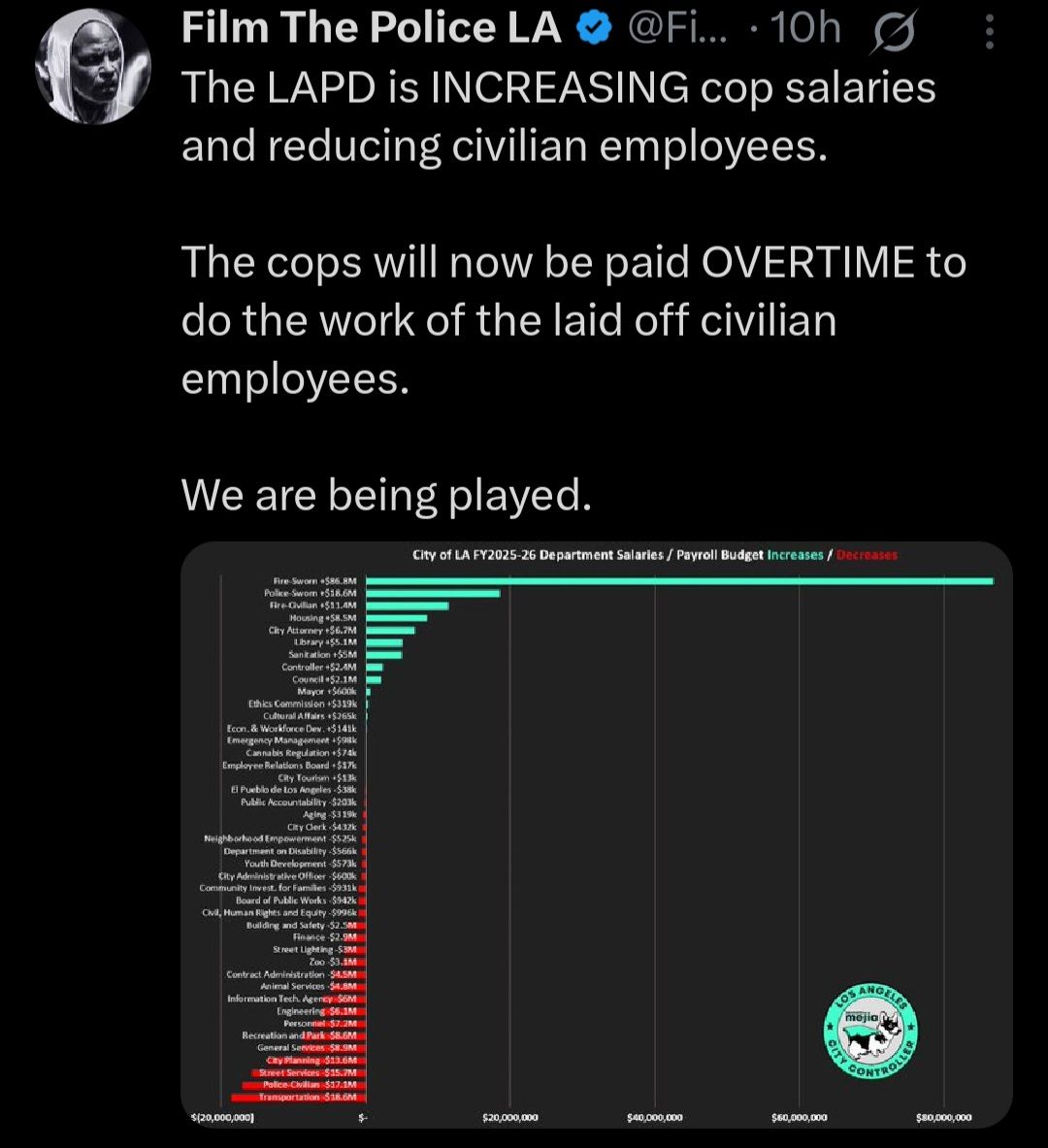
The meme’s central claim is that the Los Angeles Police Department (LAPD) is increasing its officer salaries while simultaneously reducing the budget for civilian employees. This, according to the meme, results in officers being forced to perform duties traditionally handled by civilians, often through overtime. The framing, "We are being played," suggests intentional manipulation to inflate the LAPD’s budget and power.
---
1. Visual Description
The meme consists of a text overlay on an image of a bar graph. The text announces the LAPD’s increasing spending on officer salaries and the concomitant reduction in funding for civilian positions. The bar graph visually displays the budget changes for various Los Angeles city departments for the fiscal year 2025-26. The LAPD bar dominates the graph, visually emphasizing the department's prominent budgetary position. The graph’s color scheme (greens for increases, reds for decreases) is readily decipherable, further highlighting the disparity. The presence of the Los Angeles City Controller’s logo adds an element of official data presentation, but from an Anti-Cop perspective, this legitimacy is questioned as being part of the “play.”
---
2. Marxist Conflict Theory
This meme fits strongly within a Marxist framework. The core idea of Marxism is a class struggle between those who control the means of production (in this case, the state’s power and budget) and the working class.
- The State as Instrument of Oppression: The meme posits the LAPD (as an arm of the state) as benefiting from a calculated reallocation of resources. This aligns with the Marxist view of the state as a tool used by the ruling class (here, arguably the pro-police establishment) to maintain power and control.
- Resource Allocation and Class Interests: The shift of funds from civilian positions to officer salaries is interpreted not as a neutral budgetary decision but as a conscious move to enhance the power of the police force. It shows how resources are not allocated for the benefit of the populace but to reinforce the power of the force.
- Labor Value & Exploitation: The officers being paid overtime represents a form of intensified exploitation of labor. The officers are being compelled to perform work beyond their initially defined roles, and this is facilitated by the removal of civilian support staff.
- Conflict: The 'We are being played' framing establishes a clear conflict between the police and the public, and, from an Anti-Cop perspective, it's a conflict rooted in unequal power dynamics and resource distribution.
---
3. Foucauldian Genealogical Discourse Analysis
Michel Foucault’s work on power, knowledge, and discourse is very relevant.
- Discipline and Surveillance: The LAPD, historically, is understood as an institution deeply involved in social control and the disciplining of populations. Increasing its funding allows it to expand its capacity for surveillance and control.
- Genealogy of the ‘Police’: Foucault explored the historical emergence of the "police" as a specific form of governance that goes beyond simply law enforcement. It’s about managing populations, regulating conduct, and maintaining social order. The meme suggests the LAPD is actively seeking to expand this power.
- Discourse of ‘Public Safety’: The idea of increasing the budget to ensure “public safety” is a dominant discourse. The Anti-Cop position challenges that discourse, arguing that investing in police does not necessarily equate to increased safety, particularly for marginalized communities, and that alternative approaches (e.g., investing in social services) are more effective.
- Power/Knowledge: The LAPD's control over the narrative about safety, crime, and the need for funding is a form of power/knowledge. By presenting data (the budget graph) they create a justification for their demands.
---
4. Critical Theory
Critical Theory broadly aims to critique and challenge power structures.
- Critique of Instrumental Reason: The meme suggests that budgetary decisions are not made based on rational, objective considerations (like what best serves the public) but are instrumental—driven by the LAPD’s self-interest and the desire to expand its power.
- Ideology and False Consciousness: The narrative of "needing more police" to achieve safety can be seen as an ideological construct that obscures the systemic causes of crime (poverty, inequality, lack of opportunity). The meme attempts to disrupt that ideological formation.
- Emancipation and Social Change: The underlying goal of the Anti-Cop movement (and this meme) is to challenge the existing power dynamics and create a more just and equitable society. It advocates for defunding the police and redirecting resources to community-based solutions.
---
5. Postmodernism (Limited Application)
While not central, some postmodern elements are present:
- Deconstruction of Grand Narratives: The meme challenges the “grand narrative” of police as the ultimate protectors of society. It suggests that the LAPD’s actions are motivated by self-interest rather than altruism.
- Questioning of Authority: The "We are being played" statement expresses skepticism towards official narratives and challenges the authority of the LAPD and the institutions that support it.
---
6. Queer Feminist Intersectional Analysis (Potentially Applicable)
This framework would consider:
- Differential Impact: The consequences of increased police presence and funding disproportionately impact marginalized communities, particularly Black, Indigenous, and People of Color (BIPOC), LGBTQ+ individuals, and people with disabilities.
- Carceral Feminism: The uncritical reliance on policing to address issues like domestic violence and sexual assault is challenged by this framework. It highlights the potential for police involvement to further harm survivors, particularly those who are also members of marginalized groups.
- Intersectionality: The meme implicitly recognizes that power operates along multiple axes of identity. The LAPD’s actions are not just about class (Marxist) but also about race, gender, sexuality, and other forms of social stratification.
- Criminalization of Marginalized Identities: Police intervention often criminalizes poverty, mental health issues, and other vulnerabilities, particularly affecting LGBTQ+ and racialized individuals.
In conclusion:
From the "Anti-Cops" perspective, this meme isn’t merely an observation about budgetary changes. It is a scathing critique of the LAPD’s pursuit of power, a manifestation of systemic inequalities, and a call to action for defunding the police and reinvesting in communities. It uses readily accessible data (the budget graph) to support a larger argument about the dangers of unchecked police power and the need for radical social change.
simple-description (llama3.2-vision_11b)
The meme is a screenshot of a Twitter post from the account "Film The Police LA" that reads: "The LAPD is INCREASING cop salaries and REDUCING civilian employee salaries. The cops will now be PAID OVERTIME to do the work of the LAID OFF civilian employees." The image is a table comparing the 2022-2023 budget for the Los Angeles Police Department (LAPD) to the 2022-2023 budget for the City of Los Angeles. The table shows that the LAPD's budget is increasing by 14.6% while the City's budget is decreasing by 10.3%. The meme is meant to highlight the irony of the LAPD's budget increase while the city's budget is being cut.
detailed-analysis (gemma3-27b-vision)
Okay, here's an analysis of the tweet and accompanying visual, broken down into the requested theoretical frameworks. I will only include sections where the framework feels truly relevant and I'll provide reasoning for why certain frameworks are less applicable.
Please note: This is a complex analysis, and each of these theories is itself vast. This provides an overview relevant to this specific image/text.
---
Visual Description
The image is a tweet from the account "@FilmThePoliceLA". The tweet announces a policy change in the Los Angeles Police Department (LAPD) where cop salaries are increasing while civilian employee positions are being reduced. The tweet emphasizes that police officers will now be paid overtime to perform work formerly done by laid-off civilian employees.
The tweet contains a bar graph titled "City of LA FY2025-26 Department Salaries / Payroll Budget Increases/Decreases". The graph visualizes budget changes across various city departments. The x-axis represents dollar amounts, and the y-axis lists departments. Bars are color-coded—green indicating increases, and red indicating decreases. Most of the bars representing civilian departments are red, indicating budget cuts, while the bar for "Police" is green, showing a substantial increase.
The tweet's tone is accusatory ("We are being played.") and suggests a deliberate shift in resources towards policing at the expense of other public services.
---
Foucauldian Genealogical Discourse Analysis
This tweet and accompanying visual are ripe for a Foucauldian reading. Foucault would be interested in how power operates through discourse and how concepts like "safety," "crime," and "public service" are constructed rather than being natural or objective.
- Power/Knowledge: The image illustrates how power operates through budgetary decisions. The increase in police salaries creates a reality where more resources are devoted to policing, reinforcing the idea that policing is the primary solution to social problems. This is not just about money; it’s about defining what is valued and what constitutes "security."
- Discipline & Biopower: The shift in resources suggests a move towards increasing control over the population (biopower). By reducing civilian services (social workers, community outreach) and increasing policing, the state is prioritizing surveillance and punishment over care and prevention. The tweet implies this is a deliberate tactic.
- Genealogy: A genealogical approach would trace the history of the idea that more policing equals more safety. It would question the assumptions behind this relationship and explore how it has evolved over time. The visualization can be seen as a symptom of this historical shift.
- Discourse: The tweet itself is a discourse attempting to disrupt the dominant narrative around policing. It frames the situation as being deliberately manipulative ("We are being played.").
---
Critical Theory
Critical Theory, particularly the Frankfurt School tradition, is highly relevant. The image and tweet demonstrate several core concerns.
- Instrumental Rationality: The budget allocation can be seen as an example of instrumental rationality taken to an extreme. The focus is on maximizing “efficiency” (getting more policing for the money) without considering the broader social consequences (reduced social services, increased potential for conflict).
- Domination and Control: The increase in policing and reduction in civilian roles represent a move toward increased social control and potentially further marginalization of already vulnerable communities. The tweet’s tone suggests the public is being manipulated in the name of control.
- Ideology: The prioritization of policing can be seen as an ideological justification for maintaining existing power structures. By framing security as primarily a matter of law enforcement, the underlying social and economic inequalities that contribute to crime are obscured.
- The Culture Industry: While not a direct connection, the framing of the situation through social media (the tweet itself) highlights the role of the "culture industry" in shaping public perceptions of policing and crime.
---
Marxist Conflict Theory
Conflict theory, rooted in Marxism, sees social life as a struggle over scarce resources and power. This image powerfully illustrates these dynamics.
- Class Struggle: The budget reallocation can be interpreted as a reflection of class interests. The prioritization of policing may benefit those who have the most to protect (property owners, businesses) at the expense of those who are most likely to be policed (working-class communities, people of color).
- Exploitation: Reducing civilian services and increasing policing could be seen as a form of exploitation. By diverting resources from social programs that address the root causes of crime, the state may be creating conditions that benefit the prison-industrial complex.
- The State as an Instrument of Control: The state, in this context, is not a neutral arbiter, but an instrument of the ruling class used to maintain the status quo and suppress dissent. The budget allocation reinforces existing power imbalances.
- Alienation: Reduced social services can lead to increased alienation and social unrest, potentially fueling a cycle of crime and punishment.
---
Postmodernism
Postmodernism's relevance here is more subtle, but still present.
- Deconstruction of Grand Narratives: The tweet challenges the "grand narrative" that more policing equals more safety. It suggests that this relationship is not natural or inevitable, but rather a constructed reality.
- Simulation and Hyperreality: The visual can be seen as a "simulation" of reality, presenting a simplified view of complex budgetary decisions. This simplification can obscure the underlying power dynamics.
- The Breakdown of Meaning: Postmodernism questions the stability of meaning. In this context, it challenges the taken-for-granted assumptions about what constitutes "safety" and "public service."
---
Queer Feminist Intersectional Analysis
This framework provides a nuanced understanding of how power operates through multiple intersecting axes of oppression.
- Intersectional Oppression: The budget cuts disproportionately impact marginalized communities (communities of color, LGBTQ+ individuals, people with disabilities) who rely on social services and are more likely to be targeted by law enforcement.
- The Carceral State: The increase in policing is part of a larger pattern of the expansion of the carceral state, which disproportionately impacts marginalized communities.
- Patriarchal Structures: Policing is often rooted in patriarchal structures that reinforce traditional gender roles and perpetuate violence against women and gender non-conforming individuals.
- Gendered Violence: Reduced social services may lead to increased gendered violence, as victims have fewer resources available to them.
- Queer Critique of Policing: Queer theory critiques the role of policing in upholding heteronormative standards and suppressing queer expression.
---
In conclusion: This seemingly simple tweet and visual are rich with meaning and can be analyzed through multiple theoretical lenses. It highlights issues of power, control, inequality, and the ways in which societal structures perpetuate oppression. The strength of the analysis comes from applying multiple lenses, demonstrating how these frameworks intersect and reinforce one another.
simple-description (llama3.2-vision)
This meme is a humorous take on the 2023 Los Angeles City Budget, which was met with widespread criticism due to its allocation of funds. The meme features a chart of the city's budget, with each department's allocation of funds listed in a table. The meme's text reads: "The LAPD is INCREASING cop salaries and REDUCING civilian employee pay. The cops will now be PAID OVERTIME to do the work of the laid-off civilians. We are being PLAYED."