First Seen
2023-05-10T21:03:33+00:00
simple-description (llama3.2-vision_11b)
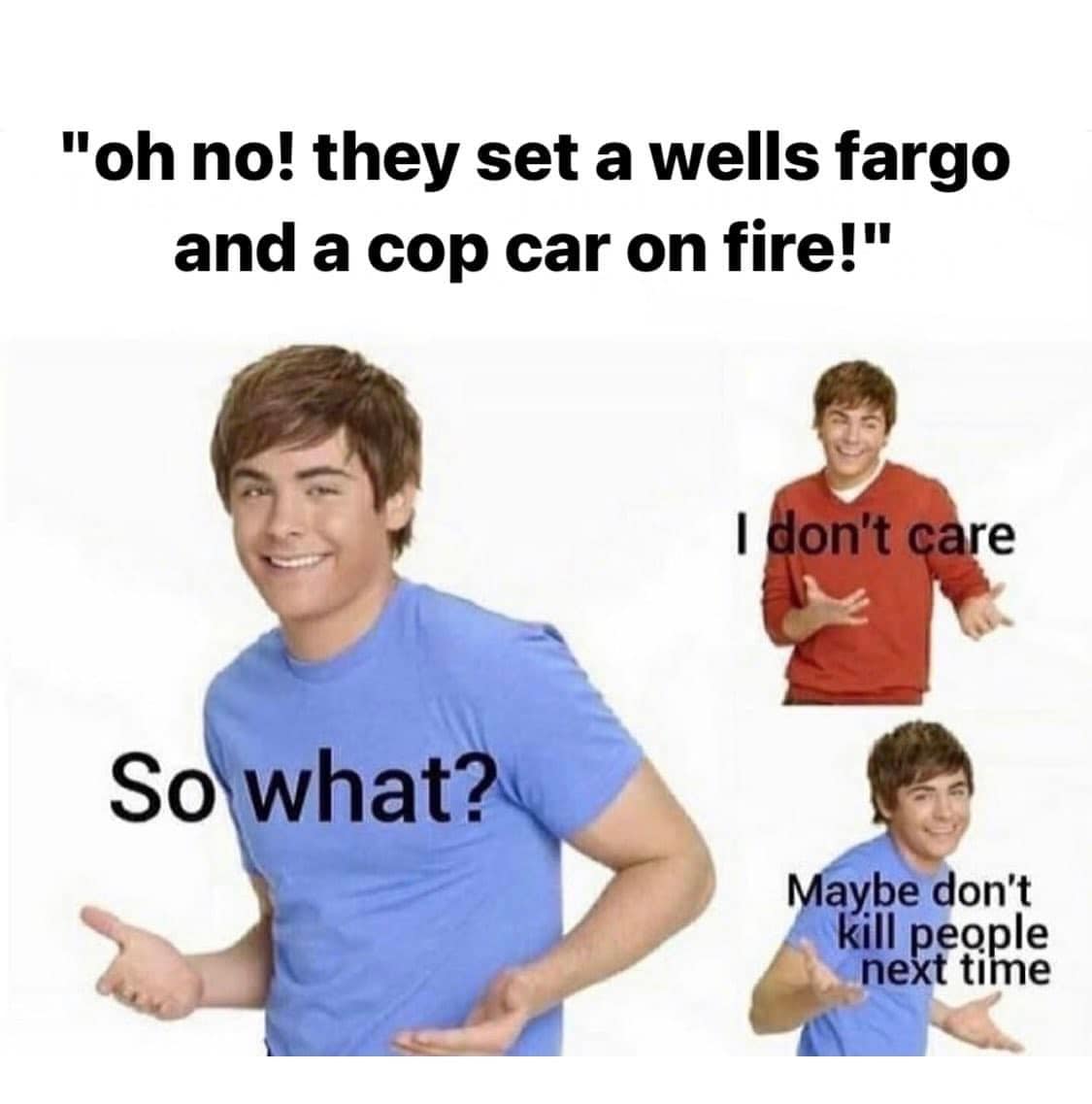
The meme is a humorous reaction to a news headline about a police car and a bank being set on fire, with the caption "Oh no, they set a bank on fire and a cop car!" The meme is likely from the "Anti-Cops" category, which is a subcategory of the internet culture that often mocks and critiques the actions of law enforcement. The meme is poking fun at the absurdity of a situation where a police car and a bank are both set on fire, implying that the police are also being targeted.
detailed-analysis (gemma3-27b-vision)
Okay, here's an analysis of the image based on the requested theoretical frameworks. I'll skip sections that don't really apply meaningfully to the image.
## Visual Description
The image is a meme format using a series of panels featuring a young, conventionally attractive white man (commonly known as the "Distracted Boyfriend" meme template). The central panel depicts the man looking directly at the viewer, with the text “So what?” superimposed on his chest. The other panels show the man looking away, each with its own text overlay: "I don't care," and "Maybe don't kill people next time." Above the image is the phrase, “Oh no! They set a Wells Fargo and a cop car on fire!” The color palette is primarily blue and white. The overall visual impact is a deliberate juxtaposition of a seemingly nonchalant attitude with a statement referencing potentially destructive and illegal acts.
## Foucauldian Genealogical Discourse Analysis
This image presents a fascinating point for examining power dynamics through a Foucauldian lens. The act of setting a Wells Fargo (a major banking institution) and a police car on fire could be understood as an expression of resistance against systemic power structures. The man’s dismissive “So what?” and “I don't care” represent a rejection of the discourse that frames those institutions as inherently worthy of respect or protection.
Foucault argued that power isn’t simply top-down repression; it’s dispersed throughout society and expressed in discourse. The image challenges the dominant narrative surrounding property and law enforcement. The man's indifference is a counter-discourse, a way of disrupting the normalizing forces that would typically condemn such actions.
The final panel, “Maybe don’t kill people next time,” is more complex. It acknowledges harm but still frames it as secondary to the underlying issues. It could be interpreted as a strategic compromise, a way of mitigating condemnation while still signaling dissatisfaction with the status quo. A genealogical approach would trace the historical development of discourses around property, policing, and protest to understand why this seemingly callous response resonates.
## Critical Theory
From a Critical Theory perspective (drawing heavily from the Frankfurt School), the image reveals the alienation and cynicism prevalent in late-stage capitalism. The man’s indifference isn’t simply personal apathy; it’s a symptom of a system that has eroded genuine connection and moral responsibility.
The destruction of a Wells Fargo can be seen as a symbolic attack on financial institutions perceived as exploitative and contributing to social inequality. The police car is a symbol of state control and repression. The response of “So what?” is a rejection of the legitimacy of those institutions.
Critical Theory would focus on the commodification of outrage and the desensitization to violence that often accompany media spectacle. The image suggests that even acts of radical protest are often absorbed into the spectacle, losing their transformative potential. The man’s casual dismissal contributes to this flattening of meaning.
## Marxist Conflict Theory
From a Marxist perspective, the image directly reflects class conflict. The Wells Fargo bank is a symbol of capitalist exploitation, representing the accumulation of wealth at the expense of the working class. Setting it on fire is an act of rebellion against the capitalist system. The police car represents the state's role in maintaining the power of the capitalist class.
The “So what?” response signifies a rejection of the bourgeois narrative that prioritizes property rights over human needs. It suggests a shift in allegiance, where the interests of the oppressed outweigh the sanctity of private property. This attitude indicates a growing awareness of class struggle and a willingness to challenge the existing power dynamics.
## Queer Feminist Intersectional Analysis
While not the most central lens for this image, a Queer Feminist Intersectional analysis can add layers. The apathy expressed could also be a rejection of systems that rely on the upholding of normative structures around property, law, and order – structures that disproportionately harm marginalized groups.
The indifference might be a response to the historical injustices perpetuated by these institutions, especially towards communities of color and other vulnerable populations. The destruction of the bank and police car can be interpreted as a refusal to participate in a system that actively reinforces oppression.
Furthermore, the meme's popularity online likely speaks to a broader disillusionment with traditional authority figures and a growing desire for radical social change, values often embraced within Queer and Feminist movements.
Important Note: The interpretation of this image can be varied and dependent on the viewer’s personal experiences and beliefs. The above analysis offers multiple theoretical lenses through which to understand its meaning.
simple-description (llama3.2-vision)
This meme is a humorous take on a common phrase "I don't care" and its exaggerated response. The image shows a person responding to a shocking statement with an absurdly casual attitude, implying that even a catastrophic event like a plane crashing into a building is not worth worrying about. The text "I don't care" is repeated in a playful, exaggerated manner, with the phrase "I don't care" appearing multiple times in the image.
tesseract-ocr
"oh no! they set a wells fargo and a cop car on fire!" | ge SO on't 2 tine