First Seen
2023-05-10T21:03:33+00:00
simple-description (llama3.2-vision_11b)
The meme is a satirical commentary on the absurdity of police culture. It presents a humorous and ironic take on the idea of a police car, using the phrase "I can see your house is made of cheese" to poke fun at the idea of a police vehicle being a futuristic, high-tech car. The meme is likely to be popular among those who enjoy dark humor and satire.
detailed-analysis (gemma3-27b-vision)
Okay, let's break down this Twitter exchange through several theoretical lenses. It's important to remember that applying these frameworks is interpretive, and there are multiple valid readings. I will only provide sections where the theory is applicable to the content.
---
1. Visual Description
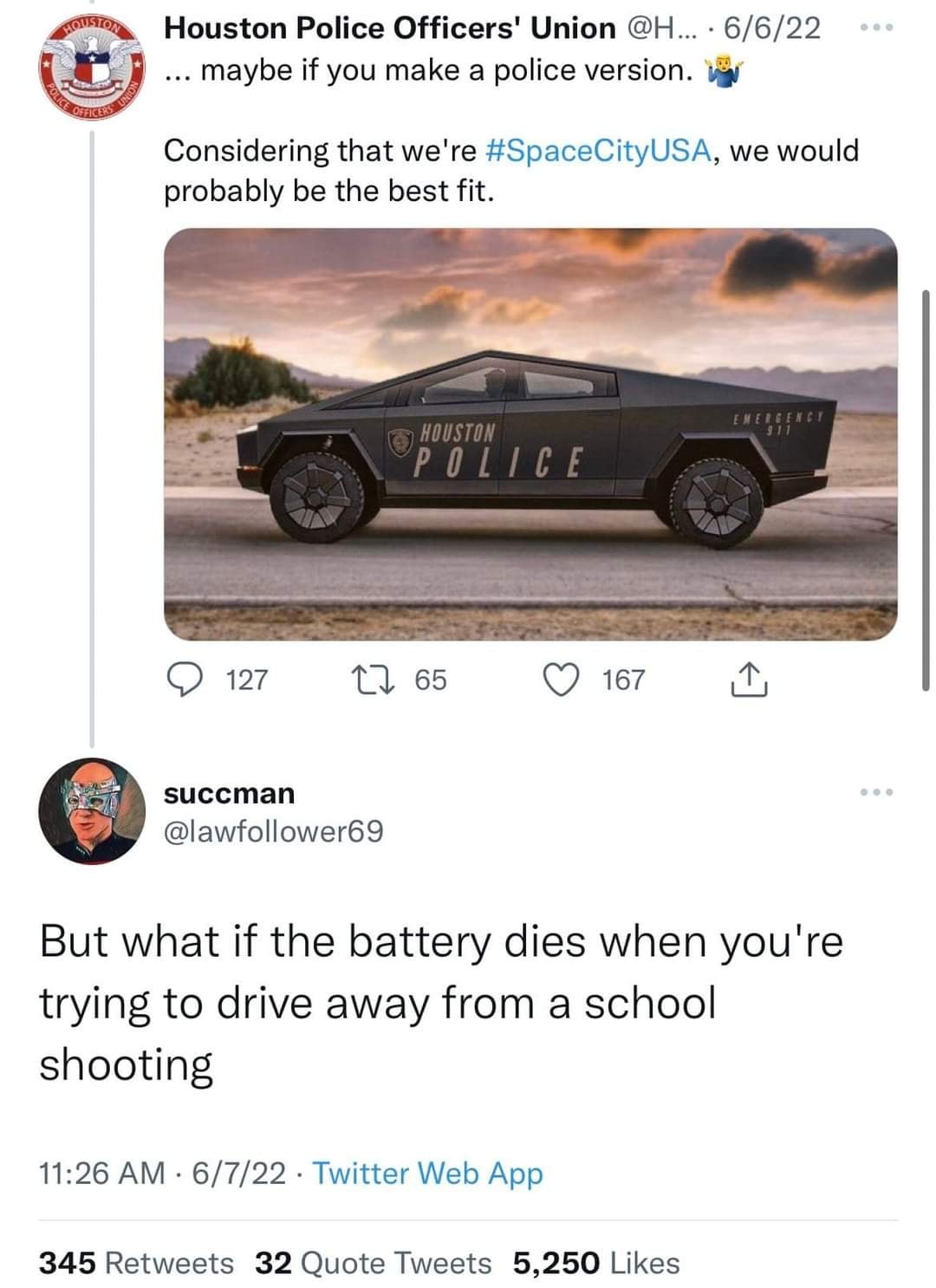
The first post features a digitally rendered image of an electric vehicle (specifically, a Rivian R1S) modified to resemble a police vehicle. It’s depicted on a dirt or gravel road, suggesting an outdoor, perhaps rural, setting. The vehicle is clearly branded with "HOUSTON POLICE" across the hood and has emergency lights mounted on the roof. The image is positioned with a Twitter post made by the Houston Police Officers' Union. The accompanying text suggests a desire for this vehicle model for police use, linking it to a hashtag #SpaceCityUSA (a nickname for Houston due to its association with NASA).
The second post features a profile picture of a cartoon character and a tweet commenting on the situation.
2. Foucauldian Genealogical Discourse Analysis
This exchange is ripe for a Foucauldian reading.
Discourse & Power/Knowledge: The Houston Police Officers’ Union's post isn't simply about a vehicle; it's about asserting police power and its modernization. The adoption of "green" technology (electric vehicles) is framed as a way to enhance police effectiveness and legitimacy, linking it to civic branding ("SpaceCityUSA"). It's a performance of authority designed to normalize and justify police presence and control. The focus is not on the actual need for the vehicle but on constructing a narrative of police as always* needing to be ahead of the curve, technologically advanced, and integral to the city’s identity.
Genealogy: Examining the history* of police vehicles (from horses to patrol cars to specialized units) reveals how policing has constantly adapted its technology to expand its reach and control. The desire for an electric vehicle isn't about sustainability (though that might be rhetorically claimed); it's another step in the ongoing historical process of police forces incorporating new technologies to reinforce their authority.
Discipline & Surveillance: The vehicle, while appearing "modern," ultimately functions as a tool of discipline. It represents* increased surveillance capacity. The implicit message is "we can reach you, we can monitor you, and we can respond quickly," fostering a climate of self-regulation through the threat of police intervention.
The second tweet acts as a point of disruption, pointing to a potential failure point that could put people in danger.
3. Critical Theory
This exchange can be seen through the lens of critical theory, particularly concerning ideology and the reproduction of power structures.
Ideology: The post presents the idea that a modern, technologically advanced police force is inherently* a positive thing. This reinforces the prevailing ideology that policing is necessary for social order and that more technology equals more safety. It obscures the ways in which policing can be oppressive, discriminatory, and contribute to social inequalities.
Hegemony: The union's post subtly seeks to establish hegemony* – a dominant position in the public's consciousness. By framing the electric vehicle as a natural and desirable addition to the police fleet, they are normalizing and legitimizing police power.
* Commodification of Safety: The focus on a "state-of-the-art" vehicle contributes to the commodification of safety. Safety isn't achieved through addressing root causes of crime (poverty, inequality, lack of opportunity); it's achieved through purchasing and deploying more sophisticated technology.
The second commenter acts as a dissenter, potentially disrupting the flow of ideological acceptance.
4. Marxist Conflict Theory
While not a dominant reading, a Marxist perspective can be applied.
* Power & Control: The police force, as an instrument of the state, serves to maintain the existing power structure and protect the interests of the ruling class. The acquisition of new technology – like this electric vehicle – is a way to strengthen that control and suppress dissent.
* Capitalist Accumulation: The purchase of the vehicle benefits the manufacturer (Rivian) and contributes to capitalist accumulation. The focus on technological "solutions" diverts resources from addressing systemic issues that fuel conflict and inequality.
* Class Conflict: The vehicle, while presented as a benefit to the community, primarily serves to protect the property and interests of those in power, potentially at the expense of marginalized communities. The second commenter is essentially pointing to a vulnerability that could put vulnerable populations in danger.
5. Queer Feminist Intersectional Analysis
This is less directly applicable, but certain elements can be examined.
* Control & Surveillance: The increased surveillance capabilities of the vehicle have disproportionate impacts on marginalized groups, particularly LGBTQ+ individuals and people of color, who are already subject to heightened policing and scrutiny.
Intersectional Vulnerability: The second commenter's observation about the battery dying highlights how technological "solutions" can increase* vulnerability for people in emergency situations, particularly those lacking reliable access to resources or support networks.
* Reclaiming Space: The post represents the police attempting to exert control over public space (the “Space City”) – a common tactic that limits the freedom and agency of marginalized communities.
---
Important Note: These analyses are interpretive and can be approached from multiple angles. Different theorists within each framework might offer different readings. It's also crucial to recognize that social media posts are complex artifacts that require nuanced analysis.
simple-description (llama3.2-vision)
The meme is a play on words that combines the idea of a police car with the futuristic vehicle from the movie Blade Runner. The text "In space, no one can hear you scream" is replaced with "In space, no one can hear you crash" to make a humorous reference to the classic movie quote. The meme is likely a joke about the absurdity of a police car in space, and the humor comes from the unexpected twist on the classic quote.
tesseract-ocr
em Houston Police Officers' Union @H... - 6/6/22 (ey ... maybe if you make a police version. vm Considering that we're #SpaceCityUSA, we would probably be the best fit. ~~. ©) 127 Tl 65 © 167 i, » succman iy @lawfollower69 But what if the battery dies when you're trying to drive away from a school shooting 11:26 AM - 6/7/22 - Twitter Web App 345 Retweets 32 Quote Tweets 5,250 Likes