First Seen
2023-05-10T21:03:33+00:00
simple-description (llama3.2-vision_11b)
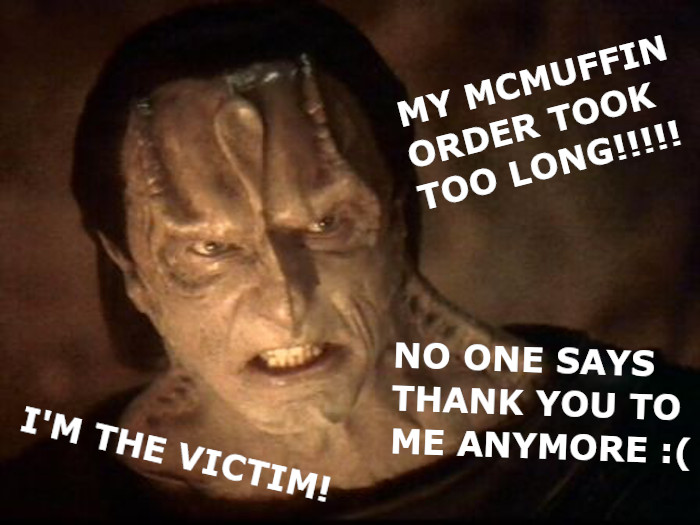
This meme is a still image from the TV show "Star Trek: Deep Space Nine" featuring the character Gul Dukat, with a sarcastic and annoyed expression. The image is captioned with a series of humorous and sarcastic statements, including "I'm the victim", "I'm the victim", "I'm the victim", and "I'm the victim", which are all repeated in a mocking and ironic tone. The image is likely used to express frustration or annoyance in a humorous or ironic way.
detailed-analysis (gemma3-27b-vision)
Okay, here's an analysis of the image, broken down into relevant sections. It’s important to note that this is inherently interpretive – different approaches will highlight different things. Given the image, several of these theoretical frameworks do apply, while others are less relevant.
Visual Description
The image is a close-up, digitally manipulated portrait of Darth Vader, the iconic villain from the Star Wars franchise. The lighting is dramatic, with strong shadows emphasizing the contours of his mask. He is looking directly at the viewer with an angry, pained expression. The mask appears to be cracked in places, revealing what could be skin underneath. Overlaid on the image are digitally added text phrases in all caps and with excessive exclamation points. They read: "MY MCMUFFIN ORDER TOOK TOO LONG!!!!", "NO ONE SAYS THANK YOU TO ME ANYMORE :(", and "I'M THE VICTIM!". The overall effect is one of absurdity, juxtaposing the menacing figure of Darth Vader with a trivial complaint (a slow fast food order) and a self-pitying declaration of victimhood. The use of emoticons (the sad face) further enhances the sense of irony.
---
Foucauldian Genealogical Discourse Analysis
This image lends itself well to a Foucauldian analysis. The "discourse" at play isn’t just about the literal text, but the entire setup of the image and how it reframes power dynamics.
Power/Knowledge: Darth Vader is a symbol of absolute power, control, and domination. Yet, the text reduces him to a complaining customer, frustrated by a minor inconvenience. This decenters the expected meaning of Darth Vader’s power, revealing how power is constructed through discourse. The complaint about the McMuffin isn't about the food itself; it’s a deployment of power – an attempt to assert control* over a situation where the speaker feels powerless.
Genealogy of Victimhood: The claim "I’M THE VICTIM!" is crucial. Foucault would be interested in the history* of this claim. How has the concept of "victimhood" been constructed, categorized, and utilized in society? The image plays with the idea of a traditionally “powerful” figure claiming to be a victim, suggesting a contemporary trend of performative victimhood or the blurring of lines between oppressor and oppressed. The genealogy would trace how the discourse around victimhood has evolved and been used to justify certain behaviors or claim moral high ground.
Panopticism and Surveillance: While subtle, the direct gaze of Darth Vader can be connected to the concept of the Panopticon. He is watching*, even if in a ridiculous context. This evokes a sense of being under surveillance and judgment, even in a mundane scenario.
---
Critical Theory
The image taps into several concerns within Critical Theory.
Commodification of Emotion: The text expresses frustration and a sense of entitlement (demanding thanks). This can be read through a Critical Theory lens as a symptom of a consumerist culture where even basic human interactions are framed as transactions. Darth Vader expects* gratitude for simply being a customer, reflecting a culture where individuals believe they are entitled to recognition and satisfaction.
The Spectacle: (Drawing on Debord) The image is the spectacle. It takes a powerful symbol and turns it into a trivial meme, emphasizing the superficiality and fragmentation of contemporary culture. It is about* being seen, not about any real substance. The absurdity is the point.
* Deconstruction of Authority: The image actively subverts the authority of Darth Vader. By presenting him as petty and self-pitying, it challenges the established hierarchy of power and meaning. This fits into the broader Critical Theory goal of dismantling dominant ideologies.
---
Marxist Conflict Theory
While not the primary lens, a Marxist reading is possible.
* Alienation: Darth Vader, despite his immense power, expresses a sense of disconnect and unfulfilled expectation. This can be seen as a metaphor for alienation under capitalism, where individuals are alienated from their labor, from each other, and from their own potential.
Class Conflict (Subverted): The complaint about the McMuffin, while trivial, touches on the unequal relationship between consumer and service worker. Darth Vader, as a figure of authority, expects deference, even in a fast-food setting, highlighting a power imbalance. However, this is parodied* - it’s a ridiculous extension of that power dynamic.
---
Postmodernism
This image is strongly postmodern.
Pastiche & Intertextuality: The image is a mashup of high and low culture – the iconic Darth Vader juxtaposed with the mundane reality of fast food. It intentionally mixes genres and contexts, creating a self-aware and ironic effect. It relies on the viewer’s knowledge of both Star Wars* and fast food culture.
Simulacra & Simulation: The image is a simulation of an emotion (frustration) expressed by a simulated character. It’s a representation of* a representation, divorced from any authentic experience. The image is “more real than real” in the sense that it is a hyperreal exaggeration of a common feeling.
* Deconstruction of Meaning: The absurdity of the image challenges the idea of fixed meaning. It forces the viewer to question the conventional associations with Darth Vader and the meaning of a simple complaint.
---
Queer Feminist Intersectional Analysis (Less Direct, but Possible)
This one is less direct, but can be approached through a lens of performativity and challenging traditional power structures.
* Challenging Masculinity: Darth Vader is a traditionally hypermasculine figure. The image subverts this by presenting him as emotionally vulnerable and complaining about trivial matters. This challenges traditional notions of masculinity and emotional expression.
Performativity: The entire image is an act* – Darth Vader is performing a victim. This can be connected to Judith Butler’s concept of performativity, where gender (and other identities) are constructed through repeated acts. In this case, the act of complaining and claiming victimhood is a performance that reinforces certain power dynamics.
* Intersectional Critique of Entitlement: The image can be read as a critique of the entitlement often associated with power – and how that entitlement can manifest in seemingly minor ways. This connects to broader feminist critiques of patriarchal systems and the expectation of deference towards those in positions of power.
Let me know if you'd like any of these sections expanded further, or if you'd like me to focus on a specific theoretical approach!
simple-description (llama3.2-vision)
This meme is an image of the character Garth from the TV show "Star Trek: Deep Space Nine". The text "I'm the victim" is written on Garth's chest, with his mouth open in a scream. The text "I'm the victim" is a humorous reference to a scene from the show where Garth is actually the victim of a plot to kill him, and he is screaming because he is being attacked.
tesseract-ocr
NY - Nate ’ + | PSs recy hhae a y > ~~ NO ONE SAYS ; E he YOU TO BRL UNL