First Seen
2023-07-01T13:06:34+00:00
simple-description (llama3.2-vision_11b)
The meme appears to be a screenshot of a tweet from Elon Musk, where he responds to a question about his thoughts on the concept of "nothing" with a seemingly philosophical and existential answer. The meme is likely being used to poke fun at the idea that Elon Musk, known for his eccentric and sometimes humorous tweets, would respond to a question about the nature of nothing with a cryptic and abstract answer.
detailed-analysis (gemma3-27b-vision)
Here's an analysis of the Twitter exchange between Ben Shapiro and Jordan Peterson, as requested, categorized into relevant theoretical frameworks. It's important to note that applying these frameworks can be somewhat interpretive, and not every category will necessarily fit neatly.
Visual Description
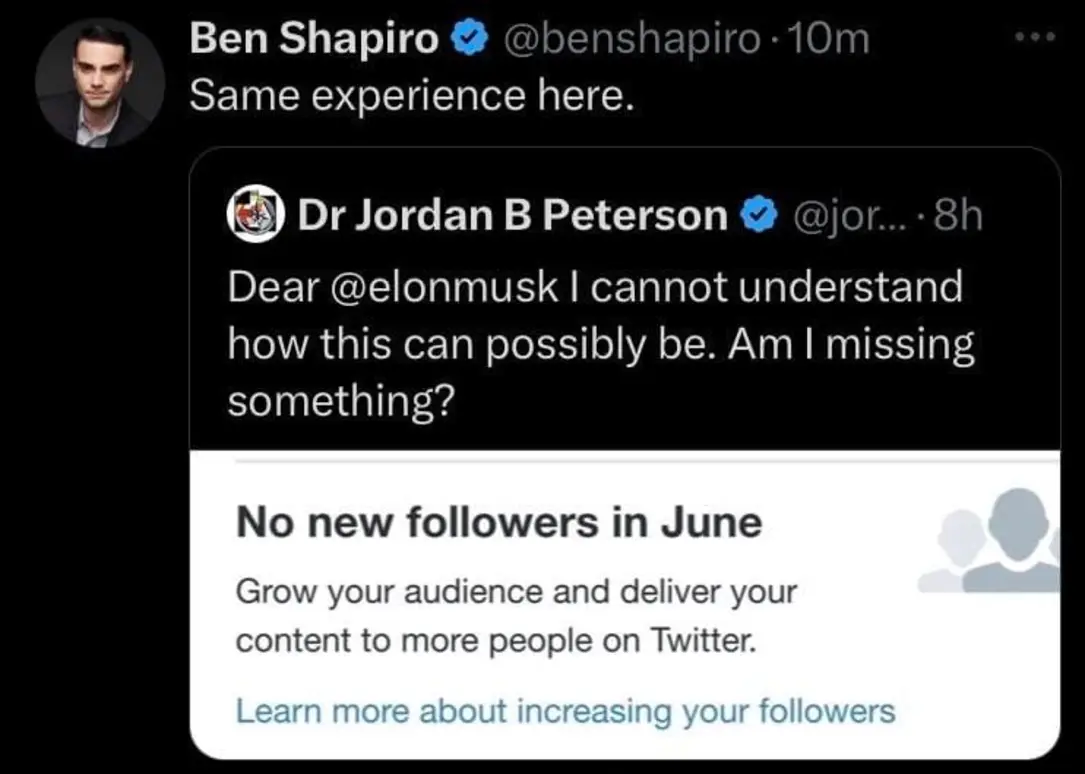
The image is a screenshot of a Twitter exchange. Ben Shapiro’s profile picture (a professional, posed headshot) is at the top, followed by his post, “Same experience here.” Below that is a screenshot of a tweet from Jordan Peterson, whose verified profile photo is displayed. He writes, “Dear @elonmusk I cannot understand how this can possibly be. Am I missing something?” Underneath that is an advertisement from Twitter. It states "No new followers in June" and urges the reader to "Grow your audience" and "learn more about increasing your followers."
Foucauldian Genealogical Discourse Analysis
This exchange is deeply implicated in power dynamics manifested through the platforms themselves and the very concept of "followers". From a Foucauldian perspective, the number of followers isn't a neutral metric; it produces certain kinds of authority and visibility.
- Discourse of "Influence": The underlying discourse here is the assumption that more followers = more influence. This is a modern power/knowledge regime; it establishes a system where being "seen" and "heard" (as measured by follower counts) correlates with perceived authority. Shapiro’s terse “Same experience here” tacitly confirms that he, too, is concerned with this metric.
- Platform as a Site of Power: Twitter (and social media in general) isn’t a neutral platform; it is a technology that shapes how we communicate, what is valued, and who gains prominence. The advertisement within the exchange is crucial. It highlights the platform’s own investment in quantifying and commodifying influence. The platform actively profits off user concerns about visibility.
- Genealogy of "Influence": We could trace the genealogy of the idea of "influence" – how it shifted from traditional forms of authority (e.g., aristocratic lineage, religious doctrine) to the metrics-driven authority of social media.
Critical Theory
From a Critical Theory perspective, the exchange highlights the functioning of the “culture industry” and the commodification of identity and thought.
- Commodification of Self: The focus on follower counts turns individuals (like Peterson and Shapiro) into brands. Their "influence" becomes a commodity, and follower counts are a measure of that commodity's value.
- Manufactured Consent: This concern about follower counts hints at a broader anxiety – that the “natural” spread of ideas is being manipulated by algorithmic gatekeeping. Peterson’s questioning of “how this can possibly be” suggests a suspicion that something is fundamentally broken in the system.
- The Illusion of Autonomy: The advertisement on the platform encourages users to "Grow Your Audience," subtly implying that success on the platform depends on conforming to its mechanisms and advertising its tools. This can be seen as an erosion of genuine agency.
Marxist Conflict Theory
While less directly applicable than the frameworks above, a Marxist lens can illuminate certain aspects of the exchange.
- Class Struggle (of Attention): There's a struggle for attention in the digital sphere. The exchange highlights a competition for visibility and influence. Those who can cultivate a large following gain a form of cultural and potentially economic capital.
- Commodification of Ideas: The focus on numbers suggests a quantification of ideas. The "value" of a thought is increasingly determined by its popularity (as measured by likes, shares, and followers), rather than its intrinsic merit.
- Ideological Control: Though subtle, the platform’s advertisement (promoting tools to increase followers) could be seen as an attempt to maintain the status quo. By encouraging engagement with its tools, it reinforces the system that benefits the platform itself.
Postmodernism
A postmodern reading would focus on the instability of meaning and the fragmentation of authority.
- Simulation of Influence: The number of followers is a simulacrum – a copy without an original. It appears to signify influence, but it's a constructed metric that lacks inherent meaning.
- Deconstruction of Authority: The exchange reveals a questioning of traditional authority. Peterson, a figure who often presents himself as a traditionalist, is baffled by a simple metric, suggesting that even those who try to uphold established hierarchies are vulnerable to the destabilizing forces of the digital age.
- The Hyperreal: The relentless focus on "metrics" and "engagement" creates a hyperreal experience – a world where representations of reality (like follower counts) become more real than the underlying substance.
Queer Feminist Intersectional Analysis
This framework is the least directly applicable, but can offer some interesting observations:
- Algorithmic Bias & Exclusion: It's important to consider how Twitter’s algorithms might disproportionately impact certain groups, leading to lower follower counts and diminished visibility for marginalized voices. This isn't explicit in the exchange, but it’s a crucial contextual factor.
- Performance of Masculinity and Intellectual Authority: Shapiro and Peterson both present themselves as intellectual authorities. The exchange could be interpreted as a subtle performance of (often problematic) masculinity, as they express anxiety about losing their perceived status in the digital sphere.
- The Digital Public Sphere & Exclusion: The emphasis on follower counts reinforces the idea that visibility in the digital public sphere is contingent on conforming to certain norms. This can create barriers for those who challenge the status quo or don’t fit neatly into dominant narratives.
It's important to reiterate that these are just interpretations. Each theoretical framework offers a unique lens through which to analyze the exchange.
simple-description (llama3.2-vision)
The meme is a screenshot of a Twitter conversation between Ben Shapiro and Dr. Jordan Peterson. Ben Shapiro posts a question to Dr. Peterson, asking if he can understand how Elon Musk's behavior is possible. Dr. Peterson responds with a joke, saying he's missing something, and Ben Shapiro responds with a sarcastic comment saying "same experience here".
tesseract-ocr
= Ben Shapiro Ta 0-10 rf ° ye Tanlom => Olcl aoa leoM acl ice wy ey) Dr Jordan B Peterson lamers) Dear @elonmusk | cannot understand how this can possibly be. Am | missing something? No new followers in June Grow your audience and deliver your content to more people on Twitter. Learn more about increasing your followers