First Seen
2023-05-10T21:03:33+00:00
simple-description (llama3.2-vision_11b)
The meme is a play on the concept of "exit" vs. "dramatic exit" in a comedic, anti-conservative context. The image shows a person in a pink robe, likely a stereotypical "liberal" or "leftist" character, standing in front of two doors labeled "Exit" and "Dramatic Exit". The text "I'm leaving" appears in a speech bubble above the character's head, implying that they're making a dramatic, over-the-shoulder exit from a conversation or situation.
detailed-analysis (gemma3-27b-vision)
Okay, let's break down this cartoon through the lenses you've requested.
Visual Description
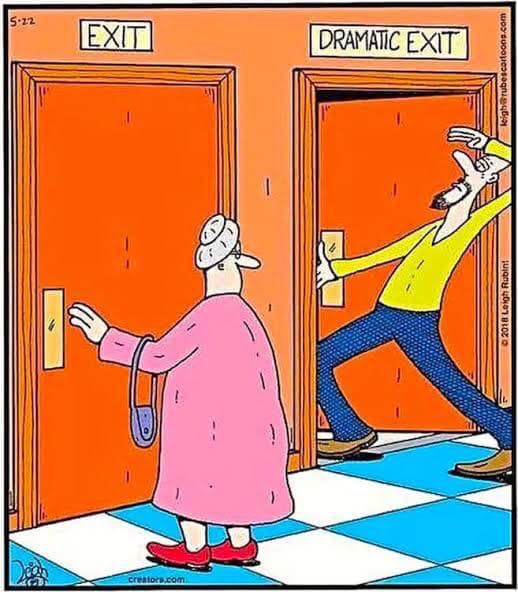
The cartoon is a single-panel drawing depicting two doorways side-by-side. On the left is a door labeled "EXIT," with an elderly woman calmly attempting to open it. She's wearing a pink coat, a hat, and carries a handbag. On the right is a door labeled “DRAMATIC EXIT,” with a man striking a highly theatrical pose, seemingly attempting to burst through the door with exaggerated gestures, complete with flailing arms and a distressed expression. The floor is tiled, and both doorways appear to lead to the same hallway, and the color scheme uses warm oranges and reds. The cartoon has a dry, understated humor.
Foucauldian Genealogical Discourse Analysis
This cartoon speaks to how we discourse around exits – the ways we talk about leaving a situation. Foucault’s work on power/knowledge helps us see how the concept of an “exit” is not simply a physical act, but a constructed category. The cartoon establishes a binary: a pragmatic, everyday exit versus a “DRAMATIC EXIT.” The label "DRAMATIC EXIT" creates the possibility of performing the exit in a specific way, and the man is performing the performance of a dramatic exit. This suggests power at play – the man feels compelled to fulfill the expectation (or construct) of a dramatic exit. It highlights the way language (the label) shapes behavior. The genealogy could trace how the idea of a "dramatic exit" emerged, likely intertwined with theatrical conventions and a culture that values spectacle or attention-seeking. It could also be tied to the performance of masculinity, a theme suggested by the man’s exaggerated actions.
Critical Theory
From a critical theory perspective, the cartoon critiques societal expectations around performance and authenticity. The elderly woman embodies a quiet, unostentatious departure, while the man’s “dramatic exit” reveals a desire for attention, a need to perform leaving. This can be analyzed through the lens of the "spectacle" as theorized by Guy Debord. The man is staging his exit, prioritizing how it appears to others over the simple act of leaving. The cartoon subtly suggests a critique of a culture that rewards performance over genuine experience and can be understood as alienation. The man is alienating himself from the actual experience of simply leaving, in favor of projecting a constructed narrative.
Postmodernism
This cartoon aligns with postmodern themes by highlighting the constructed nature of reality and the blurring of boundaries. There’s no inherent reason why an exit needs to be “dramatic” – it’s a label, a performance, a construct that exists only within a specific discourse. The cartoon mocks the idea of essential meaning or authenticity. There isn't a 'real' exit; there are only performances of exiting. It also plays with irony – the man is trying to be dramatic, and this very attempt is what makes the scene humorous. This self-awareness and playfulness are hallmarks of postmodern art. The cartoon's reliance on a binary opposition (normal exit vs. dramatic exit) is also typical of postmodern thought, as it exposes the arbitrary nature of such classifications.
Queer Feminist Intersectional Analysis
While not immediately obvious, a queer feminist intersectional reading can be applied. The man's performativity and exaggeration of emotion could be seen as a subversion of traditional masculine norms. He's embracing a theatricality that is often discouraged in men. However, the cartoon doesn't necessarily celebrate this subversion. It could be seen as a mocking portrayal of a man trying too hard, potentially reinforcing gender stereotypes. Further, the quiet dignity of the woman can be seen as a traditionally feminine trait that is often undervalued in a patriarchal society. The contrast highlights how different expressions of agency are often gendered and subject to different forms of evaluation. An intersectional reading would recognize that the man’s performance is shaped not just by gender, but also by other social factors, such as class, race, and age (although these are not explicitly depicted).
I hope this breakdown provides a thoughtful exploration of the cartoon through the lenses you requested. Let me know if you would like me to elaborate on any particular aspect or apply other theoretical frameworks.
simple-description (llama3.2-vision)
The meme is a comic strip featuring two elevator doors with labels "Exit" and "Dramatic Exit". A person is standing in front of the "Exit" door, while another person is bursting out of the "Dramatic Exit" door, flailing his arms and legs in a dramatic fashion. The text above the doors reads "Exit" and "Dramatic Exit", highlighting the humorous contrast between a normal exit and a dramatic one.
tesseract-ocr
7 I eel Py Yall hs u | oa —— HI e. i