First Seen
2025-04-11T04:21:13.994121+00:00
detailed-analysis (gemma3_27b-it-q8_0)
Okay, let's break down this meme from an "Anti-Conservative" perspective, leveraging relevant theoretical frameworks where applicable. It's a dense image with layered meaning, so we'll address each section separately.
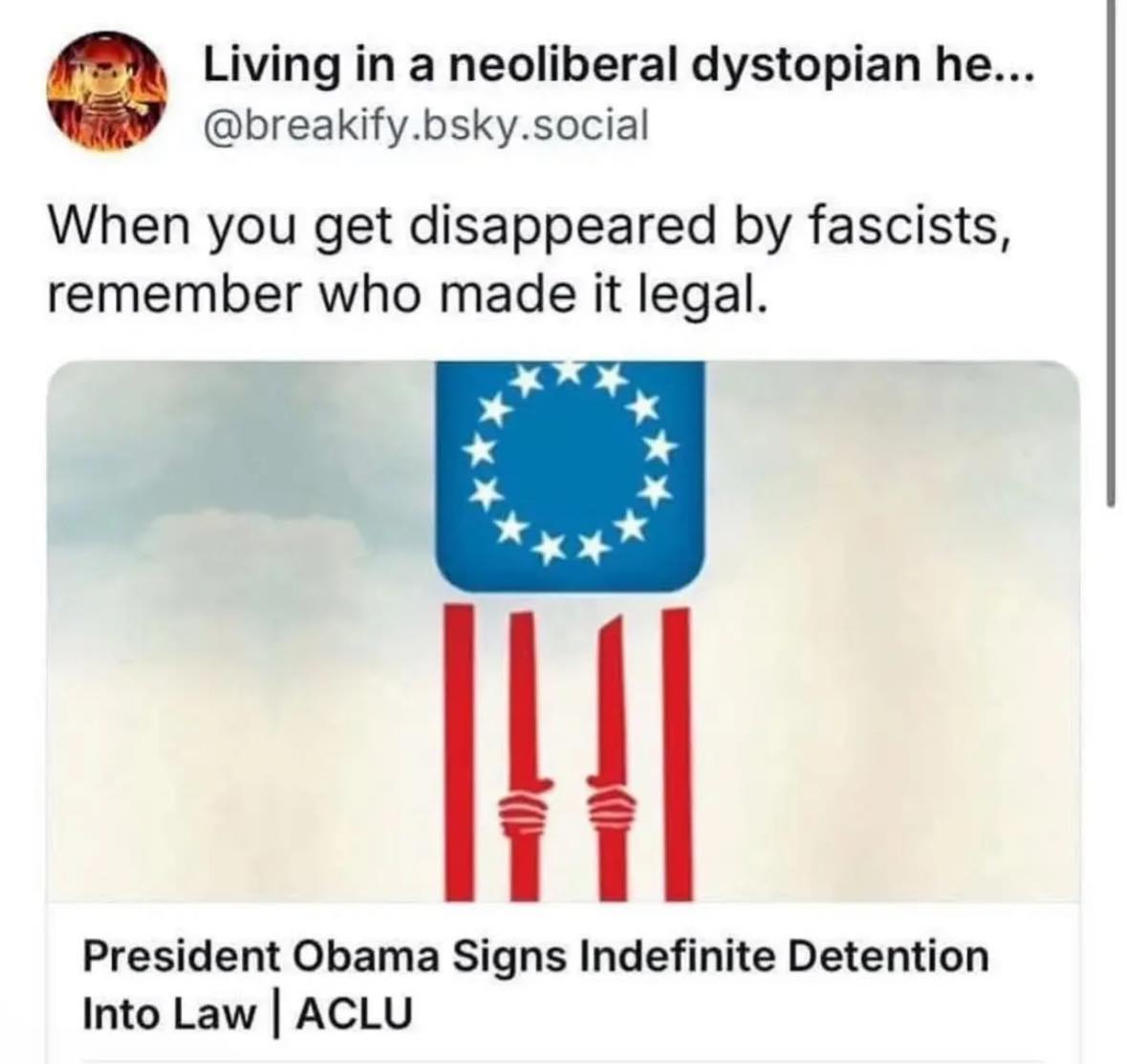
Overall Interpretation: The meme fundamentally asserts that policies enacted under ostensibly liberal or centrist leadership (specifically referencing Obama signing indefinite detention into law) laid the groundwork for, or directly contributed to, the rise of perceived "fascism" and oppressive state power. It's a critique that targets what this political outlook perceives as the hypocrisy and ultimately harmful consequences of mainstream political actions. The phrase “disappeared” suggests a situation where individuals are secretly imprisoned or killed by a state apparatus – a concept directly linked to authoritarian regimes.
1. Visual Description
The meme utilizes a stark visual contrast.
- Top: A blue field with a circle of 12 stars, reminiscent of the European Union flag, but slightly distorted. Inside the circle are three red pillars arranged vertically.
- Bottom: Text: “President Obama Signs Indefinite Detention Into Law | ACLU”.
The EU flag allusion is key. For an anti-conservative audience, it can represent a broader system of Western power structures, often criticized for imperialism, neoliberal economic policies, and complicity in global injustice. The red pillars are likely a stylized depiction of prison bars, visually representing confinement and loss of freedom. The direct association with Obama signing indefinite detention acts as the central claim.
2. Foucauldian Genealogical Discourse Analysis
Michel Foucault's work on power, discourse, and the "panopticon" is extremely relevant here.
- Genealogy: This meme is enacting a genealogical inquiry. It isn’t searching for an ‘original’ instance of fascism, but rather tracing the historical emergence of power relations that enable what the poster sees as fascist tendencies. It's not saying Obama is a fascist, but that his actions contributed to the building of disciplinary mechanisms and legitimization of practices that are compatible with fascism.
- Discipline & Punish: The visual of the prison bars and the text referencing indefinite detention points to the shift Foucault describes from sovereign power (the right to take life) to disciplinary power (the power to regulate life, control bodies, and create ‘docile’ subjects). Indefinite detention is a prime example of this shift - a mechanism of control that bypasses due process and allows for the indefinite management of populations.
- Normalisation: The act of signing indefinite detention into law, even under a president perceived as progressive, normalizes these kinds of power dynamics. The meme argues that this normalization makes it easier for more overtly authoritarian policies to be implemented later.
- Discourse: The meme intervenes in the discourse around fascism, challenging the idea that it's solely a phenomenon of the far-right. It argues that elements contributing to fascist structures can be found within mainstream liberal and centrist politics.
3. Critical Theory
The meme aligns with core tenets of Critical Theory, particularly the Frankfurt School.
- Instrumental Reason: Critical theorists argued that "instrumental reason" - the prioritization of efficiency and control over ethical considerations - paved the way for totalitarianism. Indefinite detention represents a prime example of this: the ‘efficiency’ of being able to hold someone without trial overrides fundamental legal and ethical principles.
- The Culture Industry: The normalization of surveillance, control, and the erosion of civil liberties through legislation (like the one mentioned) contributes to a “culture industry” that reinforces and legitimizes oppressive systems.
- False Consciousness: The meme suggests that many people may have a "false consciousness" regarding the true nature of power, believing that liberal institutions are inherently protective of freedom while ignoring the ways in which they also contribute to control.
4. Marxist Conflict Theory
While not the dominant lens, a Marxist reading is present.
- State as an Instrument of Class Rule: Marxists view the state as an instrument of the ruling class. The meme implies that the laws enacted (indefinite detention) serve to protect the interests of the capitalist class by suppressing dissent and controlling the population.
- Repression of Dissent: The threat of "disappearance" directly relates to the repression of opposition to the dominant system, a key function of the state in a class-based society.
- Crisis of Legitimacy: By exposing what it sees as the hypocrisy of liberal politics, the meme aims to erode the legitimacy of the current order, furthering a revolutionary consciousness.
5. Postmodernism
The meme subtly touches upon postmodern themes.
- Deconstruction of Grand Narratives: It challenges the grand narrative of "liberal democracy" as inherently good or protective of freedom. It exposes a contradiction within the system, undermining the idea of a consistent ideological framework.
- Power/Knowledge: Drawing from Foucault, it highlights the relationship between power and knowledge. The laws enacted create knowledge about who is deemed dangerous and deserving of indefinite detention, reinforcing the power of the state.
In Conclusion:
This meme is a pointed critique, aiming to awaken audiences to perceived dangers lurking within mainstream political systems. It functions as a warning about the insidious creep of authoritarianism, arguing that it isn't simply an external threat, but one that can be fostered by policies enacted under seemingly progressive leadership. It draws on multiple theoretical frameworks to build a complex argument about power, control, and the erosion of freedom. Its power derives from its ability to link seemingly disparate events (Obama's policies and the rise of authoritarianism) in a provocative and challenging way.
simple-description (llama3.2-vision_11b)
This meme is a satirical commentary on the current state of politics, particularly in the US. It features a picture of a "Not My President" sign with a modified image of a President Trump sign, but with a "Not My President" sign in the middle, and the text "When you get caught in your own lies, remember who made it legal" appears above the image. The meme is a commentary on the current state of politics, particularly in the US, and the ways in which politicians can get away with lying and making laws that benefit themselves, but not their constituents.
detailed-analysis (gemma3-27b-vision)
Okay, let's break down this image/post through several theoretical lenses. It's a complex piece, ripe for analysis.
Visual Description
The image is a digitally constructed flag combining elements. At the top is a field of navy blue featuring a circle of golden stars reminiscent of the European Union flag. Below that is a horizontal tricolor of red, white, and red, closely mirroring the American flag but with modifications. Instead of stripes, the red fields contain evenly spaced, vertically-oriented red objects resembling rifles or other firearms. The text above the flag reads, "When you get disappeared by fascists, remember who made it legal.” Below the flag is a headline stating, “President Obama Signs Indefinite Detention Into Law | ACLU.” The image is part of a social media post from the account "@breaky.bsky.social".
Foucauldian Genealogical Discourse Analysis
This post powerfully demonstrates Foucault’s ideas about power, knowledge, and discourse. The text highlights how seemingly neutral legal processes can become tools of control and oppression. The phrase "made it legal" is key; it doesn't focus on who the "fascists" are, but on the legality of their actions. This emphasizes that power isn’t simply exerted through brute force, but also through the construction of rules, norms, and legal frameworks that normalize what would otherwise be considered unacceptable.
The "disappearance" alluded to isn’t a spontaneous act of violence but one enabled by the legitimizing effect of law. Foucault would argue this isn't a deviation from the system, but produced by the system. The ACLU headline is crucial here. The ACLU, traditionally a defender of civil liberties, is invoked to demonstrate that even liberal institutions can be complicit in power dynamics that lead to oppression. The image, in essence, is a genealogy of how the conditions for "disappearance" (a form of state violence) came into being through specific legal changes. The genealogy traces the power/knowledge relationship that enables this practice.
Critical Theory
This image resonates strongly with Critical Theory, particularly the Frankfurt School's concern with the "instrumental rationality" of modern society. The seemingly rational act of passing a law (allowing indefinite detention) is presented as enabling irrational and violent outcomes ("disappearance"). This speaks to the critique of enlightenment reason as potentially serving power structures rather than promoting liberation.
The image challenges the notion of a neutral or objective legal system. The blending of the EU and US flags suggests a critique of Western political structures more broadly, suggesting that power operates through seemingly democratic institutions. The suggestion that “disappearance” happens, despite (or because of) a liberal legal system, is a strong indictment of the ways in which power is concealed and maintained. The image questions if the US and EU have been compromised as “enlightened” powers and if they are operating more as instruments of control.
Marxist Conflict Theory
From a Marxist perspective, this image can be understood as a representation of class conflict and state repression. Indefinite detention, as a tool, is used to suppress dissent and maintain the existing power structure. The “fascists” enacting the disappearances represent the forces of capital seeking to preserve the status quo. The image doesn’t necessarily focus on economic exploitation directly, but it implies that the suppression of political opposition is a key component of maintaining economic dominance.
The image subtly suggests a power dynamic where the state, acting as an instrument of the ruling class, can legally sanction actions that violate basic human rights in order to protect the interests of capital. The fact that a law is involved is significant; it signifies that the ruling class has successfully captured the legal system to justify its oppressive practices.
Postmodernism
This image embodies some key tenets of postmodernism. The blending of the EU and US flags can be interpreted as a rejection of grand narratives and the breakdown of fixed national identities. It also questions the possibility of a singular, objective truth. The term "fascist" itself isn’t a straightforward descriptor, and the image implies that “fascism” can operate within apparently democratic systems.
The image deconstructs the notion of a neutral legal system. It reveals how language and legal frameworks are not objective but constructed and used to serve specific power interests. The message is fragmented and relies on visual symbolism, which is a characteristic of postmodern aesthetics. The image implies that meaning is not inherent but constructed through discourse and interpretation.
Queer Feminist Intersectional Analysis
While not overtly focused on gender or sexuality, an intersectional analysis can illuminate the image. "Disappearance" as a form of state violence disproportionately affects marginalized communities – racial minorities, political dissidents, LGBTQ+ individuals, and others. The image can be read as a warning to these groups, indicating that legal frameworks can be weaponized against them.
The power structures that enable “disappearance” often rely on and reinforce patriarchal and heteronormative systems of control. The ability of the state to control bodies and movements is fundamentally tied to gender and sexuality. The image's message of state violence is particularly relevant to queer and feminist struggles against repression and control.
It's important to note that these theoretical lenses aren't mutually exclusive. Many of them overlap and can be used to provide a richer understanding of the image and its underlying message.
simple-description (llama3.2-vision)
This meme is a commentary on the current state of politics and the rise of authoritarianism. It features an image of the American flag with 13 stripes, but the stripes are actually bars, implying a prison or detention facility. The text above the image reads: "When you get disappeared by fascists, remember who made it legal."