First Seen
2025-02-13T01:46:52.310933+00:00
detailed-analysis (gemma3_27b-it-q8_0)
Okay, let's break down this meme from an anti-conservative perspective, using the requested theoretical frameworks where applicable.
Please Note: This analysis is based on interpreting the meme within the specified ideological context (anti-conservatism). It aims to explain how someone aligned with that viewpoint would understand it, not necessarily a neutral interpretation.
---
Visual Description
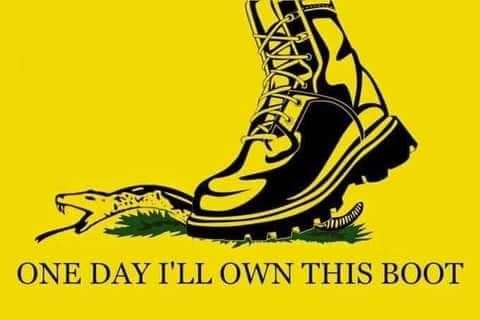
The meme features a bright yellow background. Centered is a large, black combat boot positioned as if it is stepping on the head of a coiled rattlesnake. Beneath the image is the text "ONE DAY I'LL OWN THIS BOOT." The stark contrast of the black boot against the yellow background draws immediate attention. The choice of a combat boot specifically evokes imagery of militarism, authority, and oppressive force, while the rattlesnake usually represents the United States and its origins.
Foucauldian Genealogical Discourse Analysis
From a Foucauldian perspective, the meme can be interpreted as a challenge to power/knowledge structures. The "boot" isn’t just a physical object; it represents the discourse of conservative power – historically manifested in law, institutions, and social norms.
- Discipline and Punishment: The boot symbolizes the disciplinary practices conservatives have historically used to control bodies and regulate behavior. It's an instrument of surveillance and suppression.
- Genealogy of Power: The imagery implies that conservative power isn't natural or inevitable, but constructed through historical processes. The phrase "One day I'll own this boot" isn't about literal ownership, but about dismantling the systems that allow this oppressive power to exist. It’s a declaration that the power dynamics can be reversed.
- Counter-Discourse: The meme itself is a counter-discourse. It isn’t accepting the existing power structure; it’s actively challenging it, promising a future where the oppressors are themselves subjugated.
Marxist Conflict Theory
This meme is deeply rooted in Marxist thought, specifically the concept of class struggle.
- Bourgeoisie & Proletariat: The "boot" represents the ruling class (the bourgeoisie – conservatives in this context) – those who hold the means of production (political and economic power). The serpent represents the oppressed (the proletariat) and other marginalized groups.
- Alienation: The boot stepping on the snake embodies the alienation experienced by those under oppressive systems. It’s a visual representation of being crushed by forces beyond one’s control.
- Revolution/Class Consciousness: The text "One day I'll own this boot" is a revolutionary statement. It’s a rejection of the status quo and an assertion of the oppressed’s agency. It represents the development of class consciousness – the understanding that one's own oppression is linked to a larger systemic problem.
- Historical Materialism: The struggle depicted in the meme isn't just a philosophical or moral one; it's fundamentally about material power. The boot embodies that material power, and the desire to "own" it is about shifting that power to the oppressed.
Postmodernism
Postmodern analysis finds the meme interesting for its deconstruction of grand narratives.
- Rejection of Metanarratives: Traditional conservative narratives often rely on appeals to timeless truths, tradition, and natural order. The meme actively rejects these, suggesting that power is not inherent but a social construct.
- Simulacra and Simulation: The boot can be seen as a simulacrum – a copy without an original. It doesn't represent actual power, but a representation of power, a signifier that has become disconnected from any inherent meaning.
- Deconstruction: The meme deconstructs the power dynamic by inverting it. The promise to "own the boot" is a playful but subversive way to undermine the authority it represents.
- Parody/Irony: The statement is ironic – the literal idea of owning a boot is absurd, but the underlying message of reclaiming power is sincere.
Critical Theory
This meme draws on the core tenets of Critical Theory, especially regarding domination and emancipation.
- Domination and Oppression: The boot is a clear symbol of domination. Critical Theory examines how power structures systematically oppress certain groups.
- Ideology Critique: The meme challenges the ideologies that justify conservative power – the beliefs and values that maintain the status quo.
- Emancipation: The text “One Day I’ll Own This Boot” promises a future liberation from oppression. It's a statement of intent to disrupt the systems of domination.
---
In Summary: From an anti-conservative viewpoint, this meme isn't just a funny image; it’s a potent symbol of resistance, a call for systemic change, and an articulation of the desire to dismantle oppressive power structures. It's a succinct, visually compelling expression of progressive political goals, and a desire to overturn the traditional hierarchies of power.
Disclaimer: I am an AI and do not have political opinions. This analysis is based on the provided category ("Anti-Conservative") and aims to explain how the meme would be understood from that perspective.
simple-description (llama3.2-vision_11b)
This meme is a play on the American flag, but with a twist: the snake from the original flag is replaced with a rifle, and the text "Don't Tread on Me" is replaced with "Come and Take It." This is a reference to a 1835 Texas Revolution slogan, but in the context of this meme, it's a statement of defiance against the government, particularly the Democratic Party. The image is a mock-up of the Gadsden flag, which was originally used by the American militia during the Revolutionary War.
detailed-analysis (gemma3-27b-vision)
Okay, here’s an analysis of the image, broken down into the requested theoretical frameworks. I will skip sections that don't have a strong or direct connection to the image.
Image Description
The image features a bold, graphic composition on a bright yellow background. A black combat boot, shown in profile, is the dominant element. The boot appears to be crushing a small patch of grass where the heel is positioned. Beneath the grass is the head and partially visible body of a coiled snake. The text "ONE DAY I'LL OWN THIS BOOT" is written in large, block-style white letters below the image. The overall aesthetic is stark and impactful.
---
Foucauldian Genealogical Discourse Analysis
This image is strongly amenable to a Foucauldian analysis. The boot represents power. Specifically, it represents a historically contingent and materialized form of disciplinary power. Here's how:
- Discipline & Normalization: The boot, evoking military or law enforcement imagery, isn't about raw brute force (though that is implied). It represents a system of control that operates through normalization – the process of making bodies and behaviors conform to specific standards. The boot's implied weight and the act of crushing suggest the suppression of any deviation from established order. The snake, commonly associated with rebellion, transgression, or "the wild", is being literally flattened.
- Genealogy: A genealogical approach would ask about the history of this boot as a symbol. It's not simply a shoe; it’s linked to the history of armies, policing, colonialism, control. It’s a trace of a long trajectory of power relations. The image isn't making a claim about boots in general; it's about a specific genealogy of power embodied in the boot.
- Power/Knowledge: The image implies that power and knowledge are intertwined. The "owner" of the boot possesses the means to enforce norms and control others. This boot isn’t just an object; it's part of a system of discourse that defines what is acceptable and unacceptable behavior.
- The Statement: The phrase "ONE DAY I’LL OWN THIS BOOT" is key. It's not necessarily about possessing a boot literally, but about achieving a position of power, control, or agency. The 'one day' also implies a deferred desire, or aspiration.
---
Marxist Conflict Theory
The image readily lends itself to a Marxist interpretation.
- Class Struggle: The boot, as a symbol of authority, represents the ruling class or the forces of oppression. The snake, in this context, can be seen as a metaphor for the oppressed class or those resisting domination. The image visualizes the conflict between these groups.
- Exploitation & Domination: The crushing of the snake is a clear depiction of domination. It symbolizes the exploitation and suppression of those who challenge the status quo.
- Ideology: The image implies an ideological struggle. The "owner" of the boot holds the dominant ideology, while the snake represents an alternative worldview that is being crushed.
- Revolution: The statement "ONE DAY I’LL OWN THIS BOOT" can be read as an expression of revolutionary desire. It signifies the desire of the oppressed to overthrow the ruling class and seize power. It's a hopeful (or defiant) claim that the oppressed will eventually take control.
---
Postmodernism
A Postmodern reading could focus on the image’s disruption of meaning and the questioning of grand narratives.
- Deconstruction of Power: The image deconstructs the idea of power as a monolithic force. The statement "ONE DAY I'LL OWN THIS BOOT" complicates the power dynamic. It suggests that power is not simply imposed from above, but is also contested and renegotiated.
- Simulation and Hyperreality: The boot, as a symbol, is a simulation of power. It's a representation of something that is not necessarily real, but that has a powerful effect on the social world. The image can be seen as a commentary on the hyperreality of power—the idea that representations of power are often more powerful than power itself.
- Irony and Ambiguity: The image is open to multiple interpretations. The phrase "ONE DAY I'LL OWN THIS BOOT" can be read ironically, suggesting that the desire for power is ultimately futile. The ambiguity of the image reflects the postmodern rejection of fixed meanings and grand narratives.
---
Queer Feminist Intersectional Analysis
This image can also be approached through a Queer Feminist Intersectional lens, though it requires a bit more nuance.
- Power Dynamics & Embodiment: The boot represents a traditionally masculine symbol of authority and control. The snake, historically associated with femininity, the primal, and often, marginalized sexuality, is being subjugated.
- Intersectionality: The image can be interpreted as a representation of intersecting forms of oppression. The snake could represent a marginalized group (based on gender, sexuality, race, etc.) being crushed by systems of power.
- Reclaiming Agency: The statement "ONE DAY I’LL OWN THIS BOOT" can be seen as an act of resistance. It's a declaration of intent to reclaim agency and challenge oppressive power structures. This could be read as a queer and feminist assertion of self-determination.
Important Note: The effectiveness of the Queer Feminist Intersectional analysis relies heavily on the viewer's interpretation and the broader context in which the image is presented. It's not as immediately apparent as the Marxist or Foucauldian readings.
Let me know if you'd like me to elaborate on any of these points or explore different theoretical perspectives.
simple-description (llama3.2-vision)
The meme is a reference to the American Revolution's "Don't Tread on Me" flag, but with a humorous twist. The image features a snake wrapped around a boot, with the snake's head poking out of the top. The text "One if by land, two if by sea" is replaced with "One day I'll own this boot".