First Seen
2024-12-30T18:40:31.777194+00:00
detailed-analysis (gemma3_27b-it-q8_0)
Okay, let's break down this meme from an Anti-Conservative perspective, using the requested theoretical frameworks where applicable. It's important to remember that "Anti-Conservative" is a broad category, and this analysis will lean towards a progressive, socially-critical understanding.
Overall Framing: The meme's core point, from this perspective, is to ridicule the perceived overreaction and performative outrage of conservative men regarding perceived "wokeness" in Disney (and broader cultural) productions. It portrays this reaction as absurdly militarized and disproportionate, highlighting the insecurities and anxieties driving it.
1. Visual Description
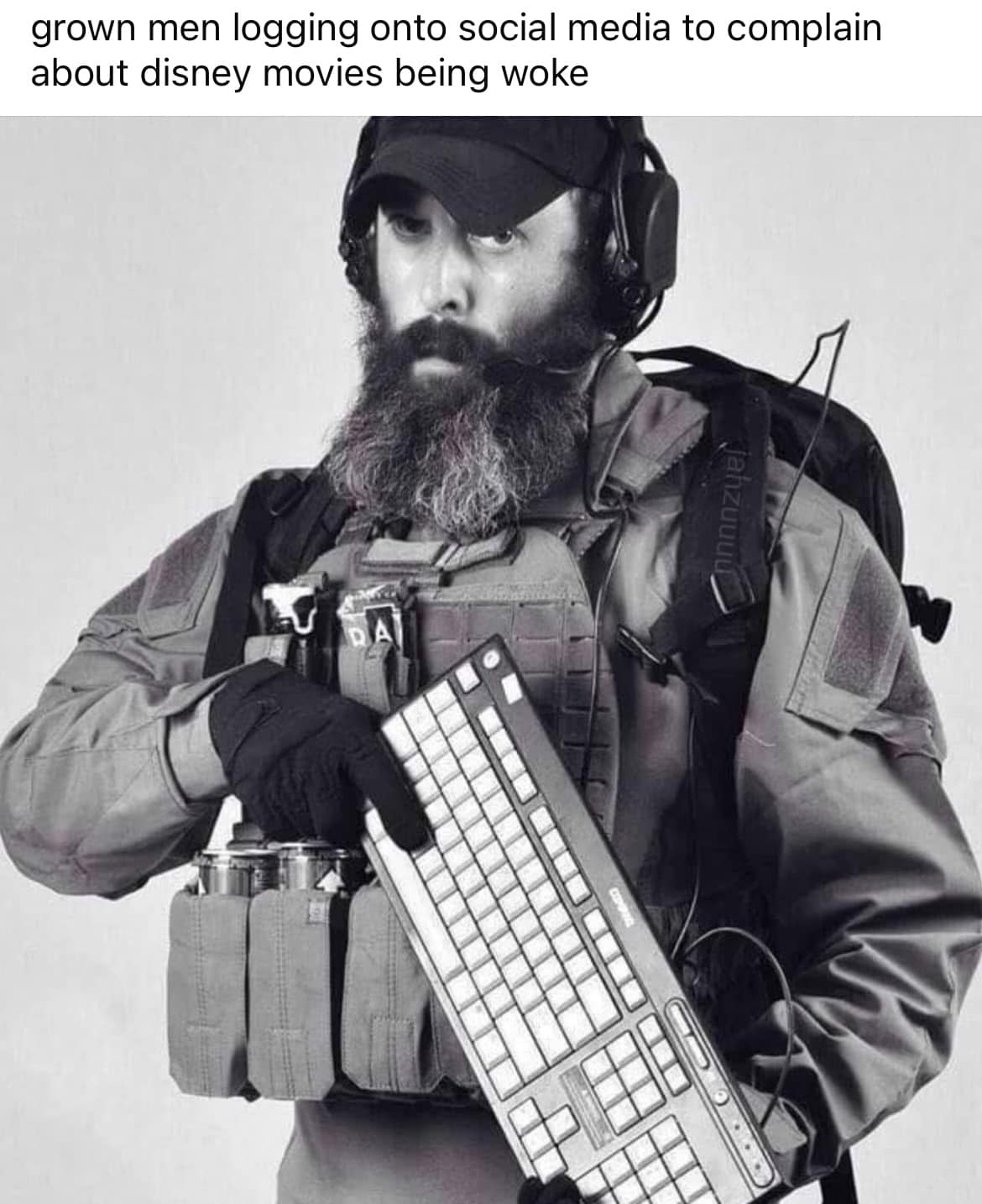
The image depicts a man dressed in tactical gear – a tactical vest, headset, neck strap, etc. He's heavily bearded, presenting a specific (often stereotyped) image of masculinity. Crucially, he is holding a computer keyboard as if it were a weapon. This is the central visual gag. The strap over his shoulder reads “jannzuu”.
The overall aesthetic is deliberately jarring and hyperbolic. It evokes imagery associated with military operations, law enforcement, or even paramilitary groups. The stark black and white enhances this sense of gravity and seriousness, which is then deliberately undercut by the absurdity of the keyboard.
2. Foucauldian Genealogical Discourse Analysis
From a Foucauldian perspective, the meme highlights the discourse surrounding "wokeness" and its relationship to power. "Wokeness" (a term itself contested, but here used as a signifier for progressive social values) has become a focal point in a power struggle, and is demonized by conservative actors.
The man in the image represents the construction of a conservative subject engaged in a "battle" against this perceived threat. The tactical gear is not about actual physical defense, but a symbolic assertion of power and control. He’s performing a hypermasculine role in a digital landscape. The keyboard as a weapon shows how discourse and internet culture become sites of struggle. The meme exposes the way this discourse creates an "us vs. them" mentality, defining itself against the perceived enemy (progressivism).
Foucault's concept of "power/knowledge" is relevant here. The conservative discourse relies on a specific construction of "knowledge" – framing progressive values as a dangerous subversion of traditional norms. This meme exposes that construction as manufactured and ridiculous.
3. Critical Theory
This meme operates as a form of critical commentary on the culture industry (drawing on Adorno & Horkheimer's work). It argues that the conservative outrage over Disney is not a genuine concern for artistic quality or family values, but a symptom of deeper anxieties about shifting social power dynamics.
The meme points to the ways in which capitalist media (like Disney) often co-opts and commodifies progressive ideas (token representation, superficial inclusivity) while still operating within a fundamentally conservative framework. The outrage then becomes a reaction against even these limited forms of progress.
From a critical theory lens, this is a form of false consciousness. The man is focusing his energy on a trivial issue (perceived "wokeness" in Disney) while remaining oblivious to the larger systemic inequalities and power structures that truly shape society.
4. Marxist Conflict Theory
While not a direct application, the meme can be viewed through a conflict theory lens. The outrage over Disney can be interpreted as a class-based anxiety, even if it's expressed culturally.
Traditionally, conservative values have been associated with maintaining existing social hierarchies, which often benefit the dominant classes. The perceived threat of "wokeness" – a push for greater equality and social justice – is seen as undermining that hierarchy. The meme satirizes the defensive reaction of those who benefit from the status quo.
The keyboard as a weapon can be seen as a metaphor for the digital "front line" of this cultural class warfare. It highlights how the internet has become a space where these conflicts are fought out.
5. Queer Feminist Intersectional Analysis
This meme resonates strongly with a Queer Feminist Intersectional perspective. The backlash against "wokeness" is often explicitly targeted at efforts to include LGBTQ+ characters and stories, and to challenge gender stereotypes.
The hypermasculine presentation of the man in the image is itself a response to the perceived threat of gender fluidity and the dismantling of traditional gender roles. He embodies the anxieties of those who feel their privilege is being challenged by a more inclusive cultural landscape.
The meme can be seen as a critique of the patriarchal structures that uphold those anxieties. It exposes the fragility of traditional masculinity when confronted with the possibility of a more equitable and diverse society.
In Conclusion:
From an Anti-Conservative viewpoint, this meme is a scathing critique of the reactionary forces resisting social progress. It uses satire and hyperbole to expose the absurdity, insecurity, and ultimately, the underlying power dynamics driving the conservative outrage over cultural shifts. It’s a visual commentary on the culture wars, presented as a caricature of those who are perceived as fighting a losing battle against an inevitable and, from this perspective, desirable future.
simple-description (llama3.2-vision_11b)
The meme depicts a man in a military uniform, holding a keyboard and a controller, with a caption that reads: "When you're a grown man who still lives in your mom's basement and complains about Disney movies being 'woke'". The image is a humorous commentary on the stereotype of a certain type of online personality who is overly critical of social justice issues and uses their online presence to complain about perceived "woke" culture, specifically in the context of Disney movies.
detailed-analysis (gemma3-27b-vision)
Okay, here's an analysis of the image, broken down into relevant theoretical sections. Given the strong performative elements and socio-political context, there's a lot to unpack.
---
Visual Description
The image depicts a man dressed in tactical gear—a vest with pouches, a headset, potentially a chest rig, and a weapon holster—holding a computer keyboard like a weapon. He has a full beard and appears to be staring intensely at the viewer. The image is in black and white. The caption reads, "grown men logging onto social media to complain about Disney movies being woke."
The contrast between the overtly militarized/tactical appearance of the man and the domestic/digital nature of a keyboard and social media is immediately striking. The overall aesthetic aims for a deliberate exaggeration and irony. The monochromatic color scheme reinforces a sense of starkness and seriousness, while simultaneously highlighting the absurdity of the situation.
---
Foucauldian Genealogical Discourse Analysis
This image is a prime example of how discourses surrounding masculinity, security, and cultural anxiety are constructed and deployed. Foucault's genealogical method seeks to uncover the historical emergence of power relations embedded in language and practices.
- Discourse of Security/Warfare: The tactical gear directly references the discourse of warfare, security, and "fighting" a perceived enemy. This visual shorthand associates complaining online with a state of conflict. This is a crucial element because it frames what is essentially a disagreement over media representation as an actual struggle for survival.
- Masculinity & Performance: The performative aspect is critical. The man performs a hyper-masculine role through his attire, aligning himself with ideals of strength, protection, and aggressive defense. He presents himself as a "warrior" battling against "cultural threats". This isn't necessarily about actual danger, but about performing and reaffirming a particular version of masculinity.
- Normalization of Aggression: The image subtly normalizes the association of strong, militaristic imagery with online commentary. It positions outrage and complaint as a legitimate form of defense, thereby potentially desensitizing viewers to actual violence and conflict.
- Power/Knowledge: The image constructs a "knowledge" regime where “wokeness” (a contested and often intentionally misconstrued term) is framed as a threat that requires a strong defense. The man positions himself as a knower, a defender of traditional values against this threat.
---
Critical Theory
From a Critical Theory perspective (drawing from the Frankfurt School), the image represents a specific form of false consciousness. It reveals a displacement of genuine anxieties and issues onto a symbolic target (Disney movies and "wokeness").
- Distraction from Real Problems: The outrage over Disney is likely a symptom of broader socio-economic anxieties (economic inequality, job insecurity, loss of status). Focusing on "cultural wars" distracts from addressing the root causes of these problems.
- Commodification of Outrage: The virality of such imagery (and the outrage it generates) can be seen as a form of commodification. Social media algorithms amplify conflict to increase engagement, turning outrage into a marketable commodity.
- Reification of Ideology: The image reifies a specific ideology – a conservative backlash against perceived cultural change. It transforms abstract concepts (“wokeness”) into a tangible enemy that can be “fought” online.
- The Culture Industry: This imagery is part of a broader “culture industry” that produces and disseminates ideologies. It reinforces existing power structures by normalizing certain forms of expression (aggression, outrage) and demonizing others.
---
Marxist Conflict Theory
From a Marxist perspective, this image can be viewed as a manifestation of class conflict and the anxieties of a declining social group.
- Defense of Hegemony: The outrage over Disney (and perceived "wokeness") can be seen as a reaction by a dominant social group (often white, heterosexual, middle-class men) to the increasing visibility and empowerment of marginalized groups. It's a defense of existing power structures and a desire to maintain hegemonic control.
- Symbolic Violence: The image itself is a form of symbolic violence. It positions "wokeness" as an enemy that must be "fought" and reinforces a hierarchy of power.
- False Consciousness & Ideology: As mentioned in the Critical Theory section, the image represents a displacement of genuine class-based grievances onto a symbolic target. It distracts from addressing the real sources of inequality and exploitation.
- Reactionary Politics: The image embodies a reactionary political stance – a desire to return to a perceived "golden age" where traditional values were unchallenged.
---
Postmodernism
From a Postmodern perspective, the image demonstrates the hyperreality and simulacra of contemporary culture.
- Simulation of Conflict: The image simulates conflict, presenting a mundane activity (complaining online) as a life-or-death struggle. This creates a sense of heightened drama and absurdity.
- Collapse of Meaning: The image’s irony questions the authenticity of emotions. Is the outrage genuine, or is it a performance? The collapse of meaning is a key feature of Postmodernism.
- Deconstruction of Masculinity: The image can be read as a deconstruction of traditional masculinity. The juxtaposition of tactical gear and a keyboard exposes the performative and constructed nature of masculine identity.
- Irony & Pastiche: The image relies heavily on irony and pastiche – the deliberate mixing of different styles and genres. The combination of military aesthetics and digital culture is a form of cultural commentary.
---
Important Note: These are just a few possible interpretations. The image is complex and open to multiple readings. Each theoretical framework provides a different lens through which to understand its meaning. The interpretation is also based on the context of the image and the socio-political climate in which it was created.
Let me know if you'd like me to elaborate on any of these points or explore a different theoretical perspective.
simple-description (llama3.2-vision)
This meme features a photo of a rugged, bearded man in military gear, holding a keyboard and mouse. The image is captioned "grown men logging onto social media to complain about Disney movies being woke". The meme is poking fun at the stereotype that some men, often referred to as "incels" or "men's rights activists", are overly sensitive and aggressive online, particularly when it comes to issues like feminism and social justice. The image is a humorous exaggeration of this stereotype, with the character's rugged, military-inspired appearance and the fact that he's using a keyboard and mouse, which is a more typical tool for online complaining.