First Seen
2023-05-10T21:03:33+00:00
simple-description (llama3.2-vision_11b)
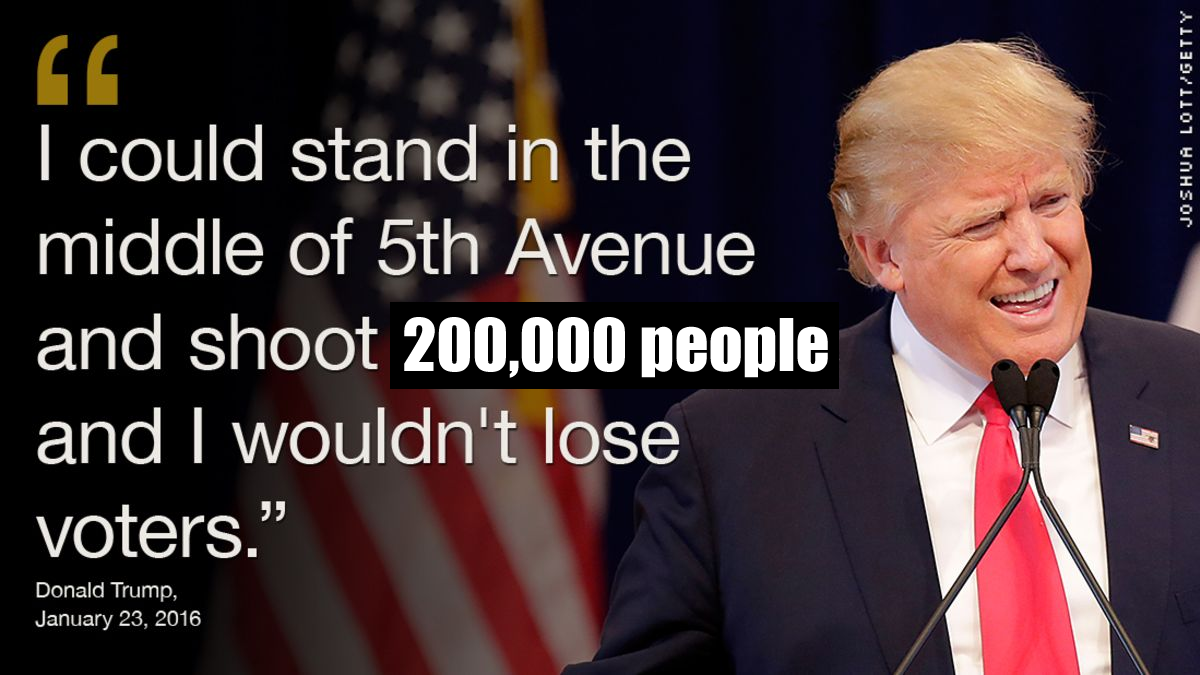
This meme is a satirical take on a quote from Donald Trump, where he claims he could stand in the middle of 5th Avenue and shoot 200,000 people and still not lose the election. The meme is likely to be from an anti-conservative or left-leaning perspective, as it's poking fun at Trump's absurdity and the idea that he would be able to get away with such a violent act. The quote is likely to be used in a humorous or ironic way to highlight the absurdity of Trump's statements.
detailed-analysis (gemma3-27b-vision)
Okay, let's break down this image and quote through the requested theoretical lenses. It's a deeply disturbing piece of content, and the analyses will reflect that.
Please be aware: This content deals with potentially triggering themes of violence and political rhetoric. I will attempt to approach the analysis academically, but the inherent nature of the source material is inherently disturbing.
1. Visual Description
The image is a photograph capturing Donald Trump speaking at a campaign rally. He is positioned behind a podium adorned with American flags, which serve as a backdrop. Trump is caught in a moment of intense expression – his face is contorted in what appears to be a shout or a grimace. His mouth is open wide, and his brow is furrowed, conveying a sense of aggression and passion. He’s wearing a red tie and a dark suit. The lighting is bright, focusing attention on his face. A large, stark white quote is superimposed over the image: "I could stand in the middle of 5th Avenue and shoot 200,000 people and I wouldn’t lose voters.” The quote is attributed to Donald Trump and the date (January 23, 2016) is provided. The photographer's name is in the corner (Joshua Lott). This combination of visual and text presents a powerful and shocking statement, linking Trump's rhetoric with an image of assertive power and, disturbingly, potential violence.
2. Foucauldian Genealogical Discourse Analysis
Foucault's genealogical method focuses on tracing the historical emergence of knowledge, power, and discourse. Applying this to Trump’s quote:
- Discourse of Impunity: The quote doesn’t just state a hypothetical; it performs a discourse of impunity. Trump constructs a reality where even extreme violence (shooting 200,000 people) does not incur consequences (losing voters). This isn’t about literally being able to get away with murder. It's about the creation of a political space where the rules of conventional accountability are suspended.
- Power/Knowledge: The quote reveals a particular configuration of power/knowledge. Trump’s base accepts (or at least tolerates) this statement, revealing the power dynamics at play. The knowledge that violence is wrong is overwritten by a loyalty and identification with Trump that prioritizes tribal affiliation over ethical considerations.
- Genealogy of Authoritarian Rhetoric: Tracing the genealogy, we could see echoes of historical authoritarian figures who relied on cultivating a strong, unyielding relationship with their base – a base that accepted (or ignored) violence enacted in the name of the leader or the group. Trump isn’t inventing this rhetoric; he's drawing upon and amplifying a dangerous historical pattern.
- Normalisation: The way he delivers the quote, like it's a simple truth, normalizes violence and disregards basic human life.
3. Critical Theory
From a Critical Theory perspective, focusing on the Frankfurt School’s concerns with ideology and domination:
- Ideology and False Consciousness: The quote exemplifies the power of ideology to create a "false consciousness." Trump’s statement is a radical assertion that shatters any expectation of ethical or legal consequence. The fact that his supporters might not be repulsed by this statement indicates how deeply ingrained certain ideological frameworks (e.g., extreme nationalism, loyalty to the leader, demonization of the "other") have become.
- Instrumental Reason: The quote can be seen as an example of "instrumental reason" run amok. The sole concern is with achieving a political goal (maintaining voter support) regardless of the ethical cost. Human life is treated as a mere instrument in the pursuit of power.
- Culture Industry and Spectacle: Trump’s rhetoric is part of a larger "culture industry" that relies on spectacle and sensationalism. This quote is designed to provoke a reaction, to dominate the news cycle, and to reinforce the emotional bonds between Trump and his base.
- Domination: The quote implicitly asserts Trump’s dominance – his belief that he can act with impunity and that his supporters will remain loyal regardless of his actions. This is a demonstration of power, intended to intimidate opponents and solidify his base.
4. Marxist Conflict Theory
From a Marxist lens:
- Class Conflict & Base/Superstructure: This quote reflects deeper class anxieties and frustrations. While not directly about economic issues, the appeal to Trump's base often revolves around feelings of economic disenfranchisement, cultural loss, and resentment toward perceived elites. The rhetoric of violence could be interpreted as a symbolic expression of these class antagonisms.
- Hegemony & Control: Trump’s statement, and the acceptance of it by his base, reveals a certain hegemonic control over the discourse. The ruling class— in this case, a political movement—has successfully normalized what would otherwise be seen as outrageous behavior.
- False Consciousness (again): Marx would likely view the unwavering support despite the statement as evidence of a "false consciousness"—a situation where the working class is unaware of its own exploitation and instead supports the interests of those who oppress them.
- Maintaining Power: The statement can be seen as a way for Trump to solidify his power, by signaling to his base that he is willing to do whatever it takes to stay in power.
5. Postmodernism
Postmodern thought emphasizes the instability of meaning, the breakdown of grand narratives, and the subjectivity of truth.
- Hyperreality & Simulacra: The quote and its reception can be viewed as part of a hyperreal political landscape. The emphasis is not on reality but on the representation of reality. The spectacle of the statement becomes more important than its actual meaning.
- Deconstruction of Traditional Values: The quote deliberately violates conventional norms and expectations. It deconstructs the idea that political leaders should be held accountable for their actions.
- Rejection of Grand Narratives: Trump’s rhetoric rejects the idea of universal moral principles or objective truth. It emphasizes individual loyalty and immediate emotional response over abstract ethical considerations.
- Power of Discourse: A postmodern analysis would focus on how the way the statement is framed and delivered (Trump’s tone, his body language, the context of the rally) is as important as the statement itself.
6. Queer Feminist Intersectional Analysis
This lens is particularly relevant because the potential victims of violence are implied as a broad, undifferentiated "people," potentially including marginalized groups.
- Violence & Power Dynamics: The quote explicitly links violence with political power. This is particularly concerning from a feminist perspective, as violence against women and marginalized groups is often used as a tool of social control and domination.
- Intersectional Vulnerability: The implied victims are not analyzed through an intersectional lens. Those who are already marginalized due to race, class, gender, sexuality, or other factors would be disproportionately vulnerable to such violence.
- Normalization of Harm: The casual acceptance of such violence normalizes harm and creates a climate of fear and intimidation, particularly for those who are most vulnerable.
- Rejection of Care: The quote demonstrates a profound rejection of care and empathy—qualities that are often associated with feminist ethics. It prioritizes power and dominance over compassion and justice.
Disclaimer: It's important to remember that these are just interpretations through specific theoretical lenses. The full complexity of this statement and its reception requires a multifaceted analysis. This is a highly charged subject, and it’s crucial to approach it with sensitivity and critical awareness.
simple-description (llama3.2-vision)
This meme is a photo of Donald Trump, with a quote superimposed over him. The quote is a misquote of a famous phrase, with the word "I" changed to "I could" and the phrase "I could" changed to "I could". The actual quote is "I could stand in the middle of 5th Avenue and shoot 100,000 people and I would not be held to 100,000,000,000 in damages and would be protected by law."
tesseract-ocr
T4 “a | could stand in iis a middle of 5th Avenue“ r and shoot 200,000 people and | wouldn't lose ‘a: voters.” iN