First Seen
2023-05-10T21:03:33+00:00
simple-description (llama3.2-vision_11b)
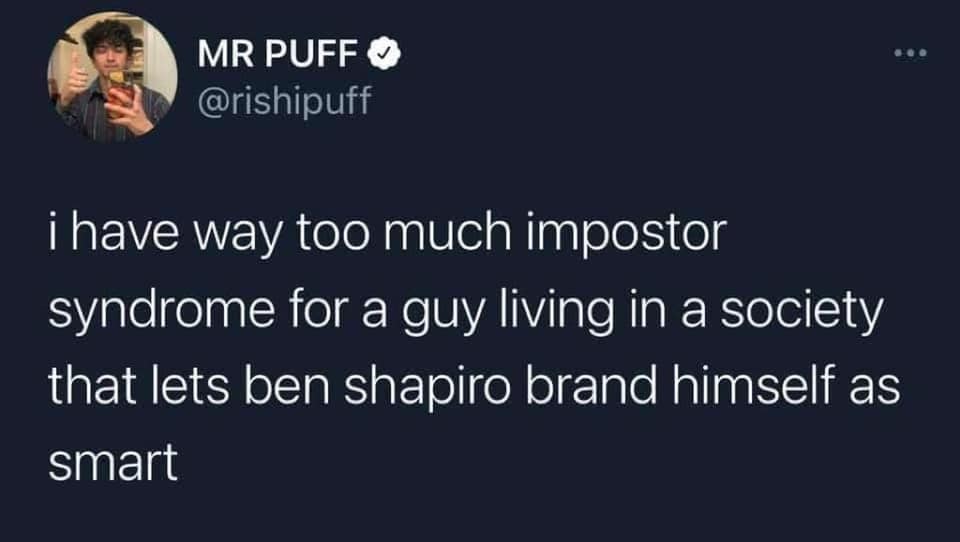
The meme is a screenshot of a tweet from a user named "MR PUFF" (real name not specified). The tweet reads: "i have way too much in common with a guy living in a society that lets ben shapiro be smart." This tweet is likely a satirical comment on the popularization of Ben Shapiro, a conservative commentator, and the irony of him being "smart" in a society that allows him to be so.
The tweet is an anti-conservative commentary, as it implies that the author is unhappy with the societal norms that allow a certain type of person (in this case, Ben Shapiro) to be successful and "smart" in a society that is supposed to be "liberal" or "progressive". The author is likely critiquing the idea of a society that allows someone like Ben Shapiro to be successful, and is likely using the word "smart" to make a satirical comment on the society that allows him to be "smart" and "successful" in the first place.
detailed-analysis (gemma3-27b-vision)
Okay, let's break down this tweet through various theoretical lenses.
Visual Description
The image is a screenshot of a Twitter post. The profile picture is of a person with dark hair and a dark shirt, appearing as a selfie. The profile name is "MR PUFF" with a blue verification checkmark, followed by the Twitter handle "@rishipuff". The text of the tweet is displayed in white on a black background. The lighting in the profile image is somewhat low.
Foucauldian Genealogical Discourse Analysis
This tweet is ripe for Foucauldian analysis. The core statement, "I have way too much imposter syndrome in a society that lets Ben Shapiro brand himself as smart," isn’t merely about personal feelings. It highlights a discourse surrounding intelligence and authority.
- Power/Knowledge: Foucault argues power and knowledge are intertwined. Shapiro performs intelligence, successfully constructing a narrative of intellectual superiority. This isn’t inherent in Shapiro himself, but is created through discourse, media appearances, and the reception of his ideas. The tweeter's imposter syndrome is a symptom of the success of this constructed discourse.
- Genealogy: We can trace the historical "genealogy" of what constitutes "intelligence" in this context. How has the definition of “smart” been historically linked to specific modes of reasoning (e.g., logical, analytical, debate-based – all areas Shapiro emphasizes)? And who has traditionally been authorized to define intelligence? The tweet suggests that Shapiro leverages these historically sanctioned definitions to position himself favorably.
- Disciplinary Power: The tweet implies a “disciplinary” aspect. Shapiro’s successful branding creates a standard against which others measure themselves. This creates a sense of inadequacy (imposter syndrome) for those who don't fit the mold. The tweet is an articulation of resistance to this disciplinary function.
Critical Theory
From a Critical Theory perspective, this tweet exposes the ideological function of seemingly neutral concepts like "intelligence."
- Hegemony: The tweet suggests a dominant ideology (potentially a conservative, rationalistic view of intelligence) is at play. Shapiro’s ability to “brand himself as smart” indicates he is benefiting from, and reinforcing, this hegemonic view.
- Ideology: Shapiro’s "smartness" is presented as a constructed image designed to reinforce a certain worldview. The tweeter isn't necessarily questioning Shapiro's raw intellectual capacity, but the way that capacity is presented and used to legitimize specific political positions.
- Commodification of Intelligence: The branding aspect is crucial. Shapiro isn't just claiming intelligence; he’s selling it – using it to build a platform and influence. This aligns with Critical Theory's critique of the commodification of culture and ideas.
Postmodernism
This tweet embraces a distinctly postmodern sensibility.
- Deconstruction: The tweet implicitly deconstructs the notion of "intelligence." It challenges the idea that there is a fixed, objective standard by pointing out the performative, constructed nature of Shapiro's "smartness."
- Simulacra & Simulation: Shapiro's "smartness" can be seen as a simulacrum – a copy without an original. The image he projects is more important than any inherent intellectual quality. It’s a hyperreality where the simulation precedes the real.
- Rejection of Grand Narratives: The tweet suggests a skepticism towards grand narratives of knowledge and authority. It questions the traditional association of intelligence with expertise and objective truth.
Queer Feminist Intersectional Analysis (While less direct, still relevant)
While the tweet doesn’t explicitly address queer or feminist issues, an intersectional lens can still illuminate it.
- Access to Authority: Historically, access to positions of intellectual authority has been unequally distributed along lines of gender, race, class, and sexuality. Shapiro, as a white, cisgender, heterosexual man, benefits from systemic advantages that allow him to easily claim authority.
- Imposter Syndrome & Marginalization: Imposter syndrome is disproportionately experienced by individuals from marginalized groups. The tweet implicitly acknowledges this by linking it to a broader societal issue (Shapiro’s unchallenged authority). Someone from a marginalized group might more acutely feel inadequate in a context where those in power (like Shapiro) don't reflect their experiences.
- Challenging Epistemic Violence: The tweet can be interpreted as a challenge to “epistemic violence” – the suppression of knowledge and ways of knowing from marginalized groups. Shapiro’s performance of "smartness" may overshadow alternative forms of intelligence or expertise.
Let me know if you'd like me to elaborate on any of these analyses!
simple-description (llama3.2-vision)
This meme is a tweet from a user named "MR PUFF" that reads: "i have way too much in common with a guy living in a society that lets ben shapiro be a smart person". The tweet is a humorous observation about the irony of living in a society that allows someone like Ben Shapiro, a conservative commentator, to be perceived as a "smart person" despite his controversial and often divisive opinions.
tesseract-ocr
St Mae ae) vee @rishipuff i have way too much impostor syndrome for a guy living in a society that lets ben shapiro brand himself as Saarelat