First Seen
2024-10-18T19:41:24.108215+00:00
detailed-analysis (gemma3_27b-it-q8_0)
Okay, let's break down this meme through the lens of Anti-Colonialism, using the requested theoretical frameworks where applicable.
Understanding the Meme’s Core Message
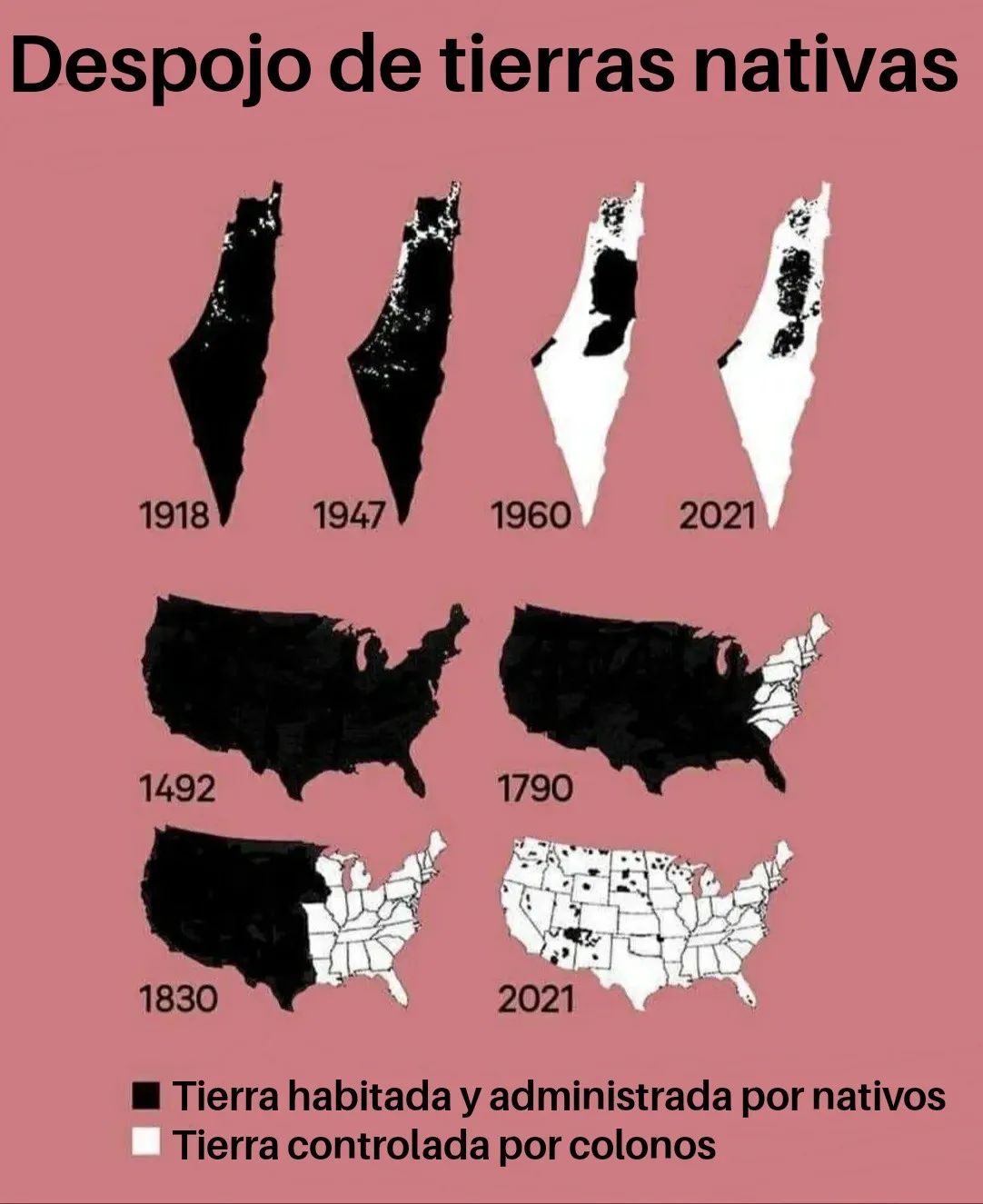
The meme, titled “Despojo de tierras nativas” (“Dispossession of Native Lands”), visually depicts the shrinking territory controlled by Indigenous populations in what is now the United States, from 1492 to 2021. Black areas represent “Tierra habitada y administrada por nativos” (land inhabited and administered by natives), and grey areas represent “Tierra controlada por colonos” (land controlled by colonizers). It’s a stark visual representation of colonial land seizure and its ongoing consequences. The meme functions as a critique of settler colonialism, highlighting its enduring impact and challenging dominant narratives about the formation of the United States.
---
1. Visual Description
The meme is comprised of eight maps of the contiguous United States, each labeled with a year: 1492, 1790, 1830, 1918, 1947, 1960, and two maps for 2021.
The color coding is consistent throughout. Initially, in 1492, the vast majority of the landmass is depicted in black (Native control), with only small pockets of grey (colonizer control) primarily along the coast. As time progresses, the black areas steadily diminish, replaced by expanding grey areas. By 2021, the black areas are reduced to scattered reservations and smaller areas of recognized Native control, illustrating the near-total dispossession of Indigenous lands.
The presentation is deliberately simplified, omitting details like specific tribal boundaries or variations in the nature of colonial control. This simplification emphasizes the overall trend of dispossession and its systematic nature. The choice of black and white reinforces the binary opposition between “native” and “colonizer” and visually highlights the erasure of Indigenous presence.
---
2. Foucauldian Genealogical Discourse Analysis
Michel Foucault’s genealogical approach is highly relevant here. The meme doesn't just show what happened, but implicitly asks how it became possible for this to happen. Foucault argued that power isn’t simply a top-down force, but operates through discourses – systems of thought, language, and practice that construct reality.
This meme unveils the genealogy of a discourse surrounding land ownership and sovereignty. From 1492 onward, a discourse of “discovery,” “conquest,” “eminent domain,” and “manifest destiny” was constructed and legitimized the dispossession of Indigenous peoples. These weren’t neutral concepts; they were tools used to justify colonial violence and to re-define land as a commodity to be owned and exploited.
The meme implicitly demonstrates how this discourse shifted over time, adapting to maintain its core function: legitimizing colonial control. It underscores how legal frameworks (treaties, laws, court decisions) were employed to construct a reality where Indigenous land claims were progressively invalidated, creating a "truth" (colonizer control) that obscured the historical injustice. The meme challenges this discourse by visually presenting the alternative "truth" of Indigenous historical sovereignty.
---
3. Critical Theory
From a Critical Theory perspective (drawing on thinkers like Max Horkheimer and Theodor Adorno, and extended by postcolonial scholars), the meme exposes the inherent contradictions and violence embedded within the Enlightenment project, and the concept of progress. The narrative of "civilizing" the "wilderness" and the supposed benefits of colonial expansion are fundamentally challenged.
The dispossession depicted isn’t merely a series of events; it’s the material manifestation of a broader ideological system. This system prioritizes capital accumulation, expansion, and the domination of nature (and people deemed "other" to the colonizer). The reduction of Indigenous lands to “resources” (timber, minerals, farmland) and the associated destruction of Indigenous ways of life represent a form of instrumental rationality gone awry – where everything is judged by its usefulness to the dominant power structure.
The meme also calls attention to the myth of a neutral or benevolent state. The U.S. government was not simply a mediator in land transactions; it actively participated in the dispossession, often through violence, broken treaties, and legal manipulation. Critical Theory sees the state as an instrument of class power and colonial domination.
---
4. Marxist Conflict Theory
Applying a Marxist framework, the dispossession of Native lands can be understood as a fundamental element in the creation of the conditions for capitalist development. The land itself was the primary means of production, and its seizure from Indigenous peoples created the foundation for the rise of a settler-colonial capitalist economy.
The meme illustrates a stark class conflict – between the colonizers (representing the emerging capitalist class) and the Indigenous populations (whose communal land tenure systems posed an obstacle to private property accumulation). The colonial project involved the forced displacement and exploitation of Indigenous labor, further facilitating capitalist expansion.
The gradual shrinking of Native lands visually represents the increasing dominance of the capitalist mode of production. This is not simply a historical event but a structural pattern of exploitation that continues to shape the relationship between Indigenous communities and the dominant economic system.
---
5. Postmodernism
While seemingly straightforward, the meme also subtly engages with postmodern ideas. By presenting a simplified visual narrative, it challenges the idea of a single, objective historical truth. The meme performs a counter-narrative, questioning the dominant historical accounts that often minimize or ignore the scale and brutality of colonial dispossession.
Postmodernism often deconstructs grand narratives, and this meme does that by highlighting the constructed nature of the history of the United States. The "truth" of land ownership is revealed to be contingent, historically constructed, and fundamentally unjust.
---
6. Queer Feminist Intersectional Analysis
This meme resonates strongly with a Queer Feminist Intersectional analysis. The colonial project didn’t just affect Indigenous people as a homogenous group; it disproportionately impacted Indigenous women, Two-Spirit individuals, and those with non-normative gender expressions. Colonial policies often disrupted traditional gender roles, imposed patriarchal structures, and targeted those who challenged colonial norms.
Furthermore, the dispossession of land is inherently linked to the control of bodies and reproduction. Colonial power sought to control Indigenous populations by controlling their access to land, resources, and traditional ways of life – which in turn impacted their ability to sustain themselves and their communities.
Intersectionality reminds us that the experience of colonialism isn’t solely about land; it’s about the interlocking systems of oppression that target individuals based on their race, gender, sexuality, and other social categories. The meme, while focused on land, serves as a reminder of the broader network of colonial violence and its continued effects.
In Conclusion:
This meme is a powerful anti-colonial statement. It utilizes a simple visual format to expose the historical and ongoing consequences of settler colonialism. When analyzed through various theoretical frameworks, it reveals the complex interplay of power, discourse, economics, and ideology that have shaped the dispossession of Native lands and the persistent struggles for Indigenous sovereignty. It serves as a call to remember, resist, and decolonize.
simple-description (llama3.2-vision_11b)
The meme is a visual representation of the historical shift in the control of land from European colonizers to indigenous peoples. It uses a series of maps to illustrate the transition, with the original text reading "From the colonizers to the colonized". The meme is a commentary on the ongoing struggle for land rights and self-determination, highlighting the need for indigenous peoples to reclaim their ancestral lands.
detailed-analysis (gemma3-27b-vision)
Okay, let's break down the image using the frameworks you've requested. It's a powerful visual, and several frameworks can be applied to deepen our understanding.
Please note: Given the nature of these theoretical approaches, interpretations can be layered and complex. I'll aim for clarity while acknowledging potential nuances. The image and its Spanish text translates to: “Dispossession of Native Lands” and the key indicates “Land inhabited and administered by natives” (black) and “Land controlled by colonizers” (grey).
---
1. Visual Description
The image is a series of maps of the continental United States, presented chronologically. Each map depicts the geographical distribution of land controlled by Native Americans (represented in black) versus that controlled by colonizers/settlers (grey).
- Chronological Progression: The maps span from 1492 to 2021. Over time, the area of black (Native land) shrinks dramatically, becoming increasingly fragmented and isolated. The grey area (colonizer-controlled land) expands.
- Key/Legend: A simple key at the bottom explains the color scheme.
- Emphasis: The visual emphasizes the ongoing and systematic loss of Native land over centuries. The maps aren’t detailed beyond the basic outline of the U.S. and the land distribution, meaning the focus is explicitly on the overarching narrative of dispossession.
- Color Symbolism: Black and grey are stark choices. Black can represent not only the land itself but also historical trauma and mourning. Grey symbolizes the encroachment and overwhelming dominance of the colonizers.
---
2. Foucauldian Genealogical Discourse Analysis
Michel Foucault's genealogical approach looks at the historical emergence of power/knowledge systems. This image directly lends itself to this analysis:
- Power/Knowledge: The image reveals how the knowledge of land ownership (rooted in European legal and philosophical frameworks) became intrinsically linked to power. Colonizers didn't simply take the land; they constructed a discourse about property rights, civilization, and progress to justify their actions. This discourse created a system where Native concepts of land stewardship were delegitimized.
- Genealogy of Dispossession: The series of maps demonstrates the historical unfolding of this process. Each date marks a moment in the construction and reinforcement of the discourse of dispossession. It wasn't a single event but a prolonged, incremental process.
- The "Truth" of Ownership: The maps challenge the assumed “truth” of current land ownership. They show that the current map isn’t the natural or inevitable outcome but the result of a specific historical power dynamic.
- Disciplinary Power: The shrinking area of black land reveals the subtle yet pervasive forms of disciplinary power wielded by the colonizers. This includes legal frameworks, military force, and cultural assimilation, all of which served to control and regulate Native populations and their access to land.
---
3. Critical Theory
Critical Theory (associated with the Frankfurt School) focuses on the ways dominant ideologies maintain power structures.
- Ideology and Legitimation: The image reveals how ideologies of colonialism, manifest destiny, and "progress" were used to legitimize the dispossession of Native land. These ideologies obscured the violence and injustice inherent in the colonization process.
- Dominant Narrative: The traditional historical narrative often presents colonization as a natural and inevitable process of expansion and civilization. This image challenges that narrative by visually demonstrating the systematic nature of land loss.
- False Consciousness: Colonizers, and society at large, may have operated under a "false consciousness" - believing their actions were justified or even beneficial, while failing to recognize the inherent exploitation and oppression involved. The image pushes the viewer to question this consciousness.
- Critique of Reason: Critical Theory often critiques the idea of "rational" progress. This image suggests that the "rational" expansion of the United States was built on the irrational and unjust dispossession of Native populations.
---
4. Marxist Conflict Theory
From a Marxist perspective, history is driven by class struggle, but this can be extended to colonial contexts:
- Class Struggle – Colonial Edition: While not strictly about class within the U.S. initially, this image depicts a conflict between two groups: the colonizers seeking control over resources (land) and the Native populations who had historically inhabited and managed those resources. The land itself represents a key means of production.
- Mode of Production: Colonization can be seen as a specific mode of production focused on the extraction of resources from colonized lands. The dispossession of Native land was essential to this process.
- Exploitation: The image demonstrates the exploitation of Native land and resources for the benefit of the colonizers. Native populations were dispossessed of their means of subsistence and forced into dependence.
- Superstructure: Legal systems, political institutions, and dominant ideologies (like Manifest Destiny) served as the “superstructure” that justified and maintained this exploitative relationship.
---
5. Postmodernism
Postmodern thought challenges grand narratives and emphasizes the subjectivity of truth.
- Deconstructing Grand Narratives: The image actively deconstructs the traditional “American” narrative of westward expansion and progress. It reveals the violence and dispossession that were obscured in that narrative.
- Multiple Perspectives: The image implicitly calls for a recognition of multiple perspectives. It challenges the dominant colonial perspective and invites viewers to consider the perspective of Native populations.
- Relativism: Postmodernism suggests that “truth” is always relative to a particular context and perspective. The image highlights how the “truth” of land ownership is constructed and contingent, rather than being an objective fact.
- Fragmentation: The increasingly fragmented pattern of Native land in later maps visually represents the fragmentation of Native cultures, communities, and ways of life.
---
6. Queer Feminist Intersectional Analysis
This is perhaps the most complex application, but vital given the history:
- Intersectional Oppression: Native people faced multiple, intersecting forms of oppression – based on race, colonization, and gender/sexuality. Traditional colonial narratives often marginalized or erased the experiences of Native women, Two-Spirit individuals, and other marginalized groups.
- Colonial Gendered Violence: Colonization involved not only land theft but also forms of gendered violence – including sexual violence, the disruption of traditional gender roles, and the targeting of Indigenous women and girls.
- Two-Spirit Erasure: Colonization aimed to destroy Indigenous cultures and ways of life, including the recognition of Two-Spirit individuals who held important social and spiritual roles in many Native communities. This erasure represents a form of queer erasure and colonial violence.
- Land as Relational: Indigenous perspectives often see land not as a commodity to be owned, but as a sacred and relational entity. Dispossession of land therefore represents a profound disruption of spiritual and cultural connections.
- Challenging Binaries: Colonialism imposed rigid binaries of race, gender, and sexuality. Indigenous cultures often embraced more fluid and inclusive understandings of these concepts. The image implicitly challenges these binaries by highlighting the diversity and resilience of Native cultures.
---
I hope this detailed breakdown helps you understand the multifaceted layers of meaning in this powerful image. Let me know if you’d like me to expand on any of these frameworks.
simple-description (llama3.2-vision)
This meme is a humorous comparison between the current borders of Israel and Palestine (left) and the historical borders of Israel and Palestine (right). The text "Israel" is written above the left image and "Palestine" is written above the right image. The meme is a play on the phrase "from the river to the sea" which is a phrase used by some Palestinians to refer to the idea of a Palestinian state encompassing all of Israel and the Palestinian territories.