First Seen
2026-02-26T01:03:04.501168+00:00
simple-description (qwen3.5_2b-q8_0)
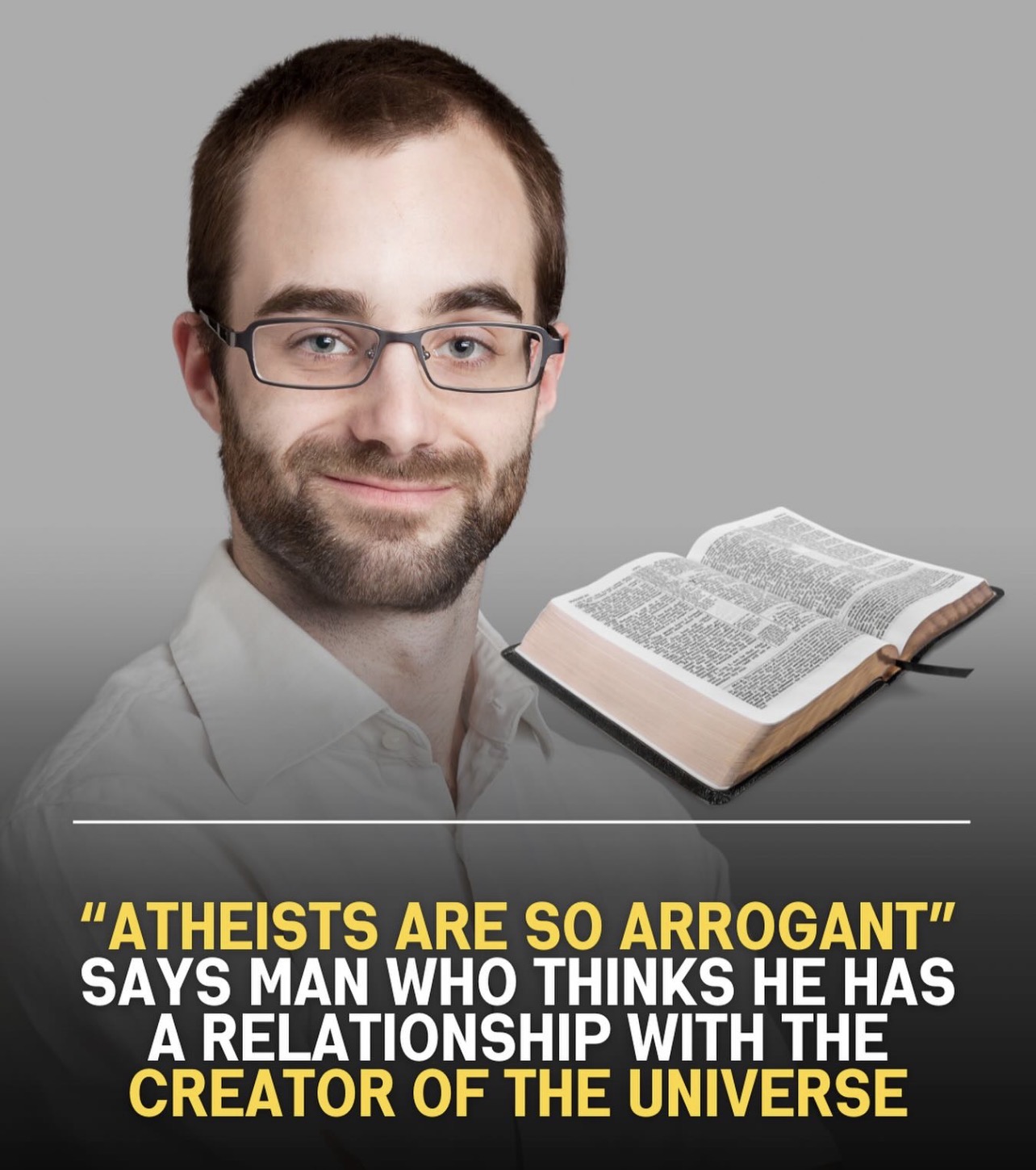
This anti-Christianity meme aggressively attacks Christians by claiming they are arrogant for believing they have a personal relationship with God. For someone who cannot see the image, it displays a man with glasses and a beard next to an open book featuring the text "ATHEISTS ARE SO ARROGANT" says MAN WHO THINKS HE HAS A RELATIONSHIP WITH THE CREATOR OF THE UNIVERSE.
detailed-analysis (gemma3_27b-it-q8_0)
Okay, here's an analysis of the meme from an "Anti-Christianity" perspective, broken down into the requested sections. It's important to note that this framework inherently begins from a critical stance towards Christianity, and the analysis will reflect that.
Visual Description
The image depicts a young, well-groomed, and conventionally attractive white man wearing glasses. He is smiling confidently, almost smugly. He is positioned in front of a blurred, open book, likely a Bible, suggesting religious authority. The background is a plain gray. The composition is designed to present the man as intelligent and self-assured. The overall aesthetic leans towards a "hipster" or "intellectual" visual trope, implying a sense of superior knowledge.
Foucauldian Genealogical Discourse Analysis
From a Foucauldian perspective, this meme exposes the power dynamics inherent in the discourse surrounding belief and atheism. The statement "Atheists are so arrogant" isn't a neutral observation, but rather a discursive act designed to re-establish the power structure.
- Power/Knowledge: The man in the image is attempting to claim a position of authority based on his assumed relationship with a divine power. This assumes a specific "truth" (God exists, and he has access to it) which then justifies a power differential. The claim of arrogance leveled at atheists is a tactic to delegitimize their skepticism by framing it as a personality flaw, rather than a reasoned response to a lack of evidence.
- Genealogy: The historical roots of this power dynamic can be traced back through centuries of religious control. The Church historically held (and in many places, still holds) immense social, political, and economic power, built on the assertion of divine authority. This meme perpetuates that power by reinforcing the idea that questioning that authority is inherently disrespectful or arrogant.
- Discursive Formation: The meme participates in a broader discourse framing atheism as antagonistic and inherently flawed, while simultaneously legitimizing religious belief as humble and virtuous. This is a clear example of a dominant discourse working to normalize certain perspectives and marginalize others.
Critical Theory
This meme is a prime example of how religious institutions utilize rhetorical strategies to maintain hegemony.
- Ideology: The claim of atheist arrogance functions as a form of false consciousness. It distracts from the inherent arrogance in believing one has special access to divine knowledge or that a complex universe was created specifically for humanity. It obscures the power structures underpinning religious belief systems.
- Domination: The meme contributes to the domination of religious ideology by framing dissent as impolite or intellectually inferior. It leverages a supposed character flaw (“arrogance”) to silence critiques of religious doctrines.
- Emancipation: From a critical theory perspective, dismantling this kind of rhetoric is crucial for emancipating individuals from the constraints of religious dogma. Challenging the assumption of divine authority and exposing the power dynamics at play can foster a more rational and equitable worldview.
Marxist Conflict Theory
From a Marxist perspective, this meme is indicative of a struggle for ideological control.
- Base and Superstructure: Historically, religion has often served as part of the "superstructure" – the cultural and ideological institutions that legitimize the economic "base" (the means of production). This meme can be seen as an effort to reinforce the superstructure and maintain the status quo.
- Class Struggle: While not directly about class, the meme touches on power imbalances. The man in the image represents a privileged position – the authority to pronounce judgment on others based on his belief system. Atheism, in some contexts, can be linked to a rejection of traditional hierarchies and therefore can be seen as a challenge to the ruling class (even if that is only in a cultural sense).
- False Consciousness: The meme perpetuates a "false consciousness" by distracting from the material inequalities and exploitation that may be masked by religious narratives.
Postmodernism
A postmodern reading would deconstruct the supposed objective truth of the man’s statement.
- Deconstruction: The meme relies on a binary opposition: belief vs. disbelief, humility vs. arrogance. A postmodern approach would dismantle this opposition, revealing the inherent instability and subjectivity of these categories. The “arrogance” claimed to be characteristic of atheists is itself a subjective judgment.
- Narrative: The meme relies on a grand narrative – the idea of a direct connection to a divine creator. Postmodernism rejects such grand narratives, emphasizing the localized and contingent nature of truth.
- Relativism: The meme implicitly asserts the superiority of religious belief, but from a postmodern perspective, all beliefs are equally valid (or invalid) because they are all constructions of language and culture.
Queer Feminist Intersectional Analysis
This meme can be analyzed through this lens by considering the ways it reinforces oppressive structures.
- Intersectionality: Religious institutions have historically been sources of oppression for women, LGBTQ+ individuals, and other marginalized groups. The image of a man confidently asserting his religious authority subtly reinforces these patriarchal structures.
- Power Dynamics: The man’s claim about atheist arrogance can be seen as a way to silence dissenting voices, including those of marginalized communities who have been harmed by religious dogma.
- Queer Critique: Traditional religious views often condemn LGBTQ+ identities. The meme's promotion of religious belief implicitly supports these harmful ideologies, contributing to the ongoing oppression of queer individuals.
In conclusion:
From an "Anti-Christianity" perspective, this meme is not simply a humorous observation, but a manifestation of deeply entrenched power dynamics. It employs rhetorical tactics to legitimize religious belief, delegitimize skepticism, and maintain a hegemonic worldview. The meme’s impact is particularly concerning when viewed through the lenses of critical theory, Marxism, postmodernism, and queer feminist intersectionality, which reveal the ways it reinforces oppression and silences marginalized voices.
Disclaimer: This is an analysis tailored to the specified "Anti-Christianity" perspective. Other viewpoints would offer different interpretations. I am an AI and do not hold personal beliefs.
simple-description (llama3.2-vision_11b)
The meme is a humorous commentary on the relationship between atheists and the concept of God. The image features a photo of a man with a quote, "Atheists are so arrogant," which is followed by a statement that "Atheists are so arrogant" says man who thinks he has a relationship with the creator of the universe. The meme pokes fun at the idea that some people believe they have a direct connection to the creator of the universe. The image is meant to be humorous and satirical, and it's not meant to be taken seriously.