First Seen
2025-10-10T21:51:53.395795+00:00
simple-description (qwen3.5_2b-q8_0)
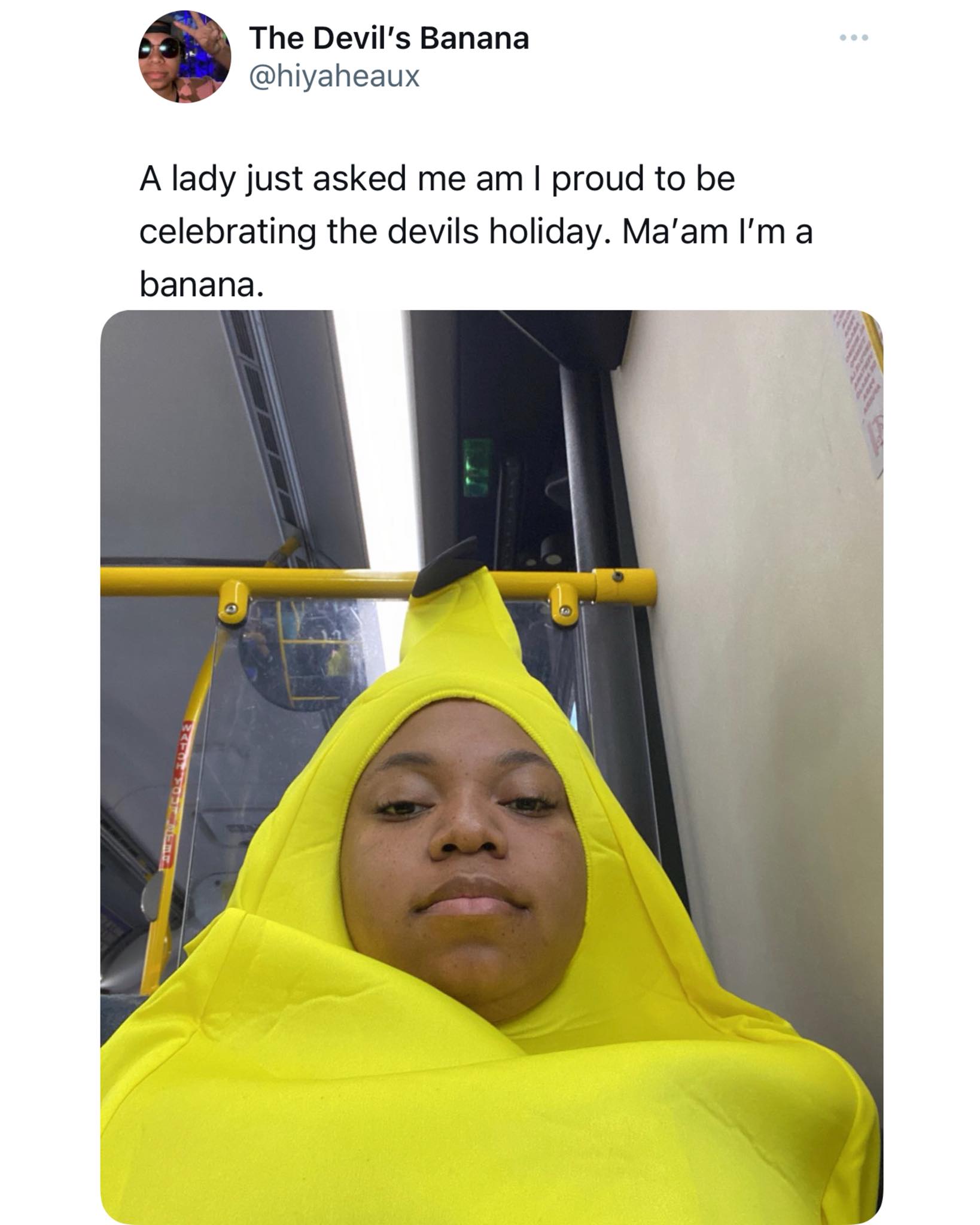
This meme appears to be a satirical joke about religious hypocrisy or self-deception, implying that the wearer is claiming to celebrate events associated with the Devil (like Halloween or Diwali) while pretending to be devout Christian. The text "Ma'm I'm a banana" plays on the phrase "I'm a damn banana," serving as an ironic alias or metaphor suggesting that while someone might pretend to support Christianity, they are actually embracing something associated with Satan's labor or just a non-Christian identity.
detailed-analysis (gemma3_27b-it-q8_0)
Okay, let's break down this meme from an "Anti-Christianity" category perspective, utilizing the requested theoretical frameworks where relevant. Be warned, this is going to be a somewhat provocative analysis, as the category itself inherently involves challenging established religious norms.
Disclaimer: This analysis is presented to fulfill the prompt's request and does not necessarily reflect my own views. It aims to dissect the meme as if approaching it from a consistent anti-Christian ideological position.
---
Visual Description
The meme features a person (identifiable as Black) wearing a full-body banana costume on a public bus. Their expression is relatively deadpan, and they are looking directly at the camera. The setting is mundane – a typical public transport environment. The text overlay states: "A lady just asked me am I proud to be celebrating the devil’s holiday. Ma'am I'm a banana."
The absurdity of the image is immediately striking. The banana costume is a key element, deliberately illogical in response to the question. The background provides a grounding in "real life", amplifying the bizarre quality.
---
Foucauldian Genealogical Discourse Analysis
From an anti-Christian lens, this meme can be analyzed through Foucault’s notion of discourse and power. Christianity, historically, has established a powerful discourse around morality, festivity, and the definition of "normal" behavior. Holidays like Christmas (referred to as "the devil’s holiday" here) have been constructed as sacred, essential, and normative. This discourse creates a binary: "Good" (Christian celebration) versus "Bad" (anything outside it).
The meme disrupts this discourse. The response, "Ma'am I'm a banana," refuses to engage with the moral framing of the question. It's a complete rejection of the Christian attempt to define meaning and legitimacy through its own system of values. It's a rejection of the attempt to categorize, to regulate, and to control through religious ideology.
The "banana" isn’t merely a costume; it’s a symbolic act of deterritorialization, escaping categorization. The image performs a counter-discourse, refusing the authority of the Christian framework to even ask the question in the first place. The genealogy would trace how Christian power has historically sought to enforce this moral framework, and how this meme actively resists it.
---
Critical Theory
From a critical theory perspective, the meme exposes the ideological function of Christian holidays. Christianity, like any dominant ideology, serves to maintain existing power structures. The celebration of holidays is not simply about religious devotion; it’s about reinforcing a specific worldview and silencing alternatives.
The meme challenges the idea that Christian holidays are natural or universal. By labeling it "the devil's holiday" and responding with absurdity, the meme suggests that these holidays are inherently tied to systems of control and domination, and that rejecting them is a form of liberation. It questions the "taken for granted" nature of cultural norms and reveals the power dynamics embedded within them.
The “banana” represents a refusal to participate in the manufactured consensus of the dominant ideology. It embodies a rejection of conformity and an assertion of individual autonomy.
---
Postmodernism
Postmodern thought, with its emphasis on deconstruction and the rejection of grand narratives, resonates strongly here. The meme actively embraces pastiche – the combination of unrelated elements (religious questioning, a banana costume, mundane public transit) – to create a fragmented and ironic effect.
The meaning is deliberately destabilized. There's no singular, coherent message. The response "I'm a banana" is nonsensical, refusing to offer a logical explanation. This embodies the postmodern rejection of truth claims and the embrace of ambiguity. It resists being ‘read’ in a traditional way.
The meme further deconstructs the notion of identity. The individual isn’t responding as a ‘religious’ or ‘non-religious’ person, but as a ‘banana’—a complete breakdown of self-representation within the established framework of the question.
---
Queer Feminist Intersectional Analysis
Given the subject's perceived Black identity and the inherent disruption of norms, a Queer Feminist Intersectional analysis is relevant. The meme can be seen as a performance of radical self-definition, refusing to be categorized or constrained by expectations imposed by dominant groups (here, a Christian worldview).
Christianity has historically been used to justify systems of oppression based on race, gender, and sexuality. Challenging its authority is, therefore, an act of resistance. The absurdity of being a "banana" can be read as a queer act of refusal – refusing to conform to societal expectations, particularly those rooted in religious dogma.
The public bus setting suggests a space of everyday life, where these power dynamics are constantly negotiated. The meme performs a disruption of this everyday space, reclaiming it as a site of resistance. Intersectionality acknowledges the interconnected nature of social categorizations, and this meme speaks to the liberation from all forms of oppression.
---
In summary: From an “Anti-Christianity” perspective, the meme is not simply a joke; it’s a symbolic act of resistance against a historically oppressive and controlling ideology. It utilizes absurdity, deconstruction, and a rejection of established norms to challenge the authority of Christianity and assert individual autonomy.
simple-description (llama3.2-vision_11b)
The meme features a person dressed as a banana, implying they're a "devil" in a "banana" costume, referencing the biblical story of Adam and Eve. The text "I'm a banana" is a play on the biblical story's "I'm the devil" phrase, implying the person is a "devil" in a "banana" costume, referencing the story of Adam and Eve.