First Seen
2026-02-23T19:21:41.968297+00:00
simple-description (qwen3.5_2b-q8_0)
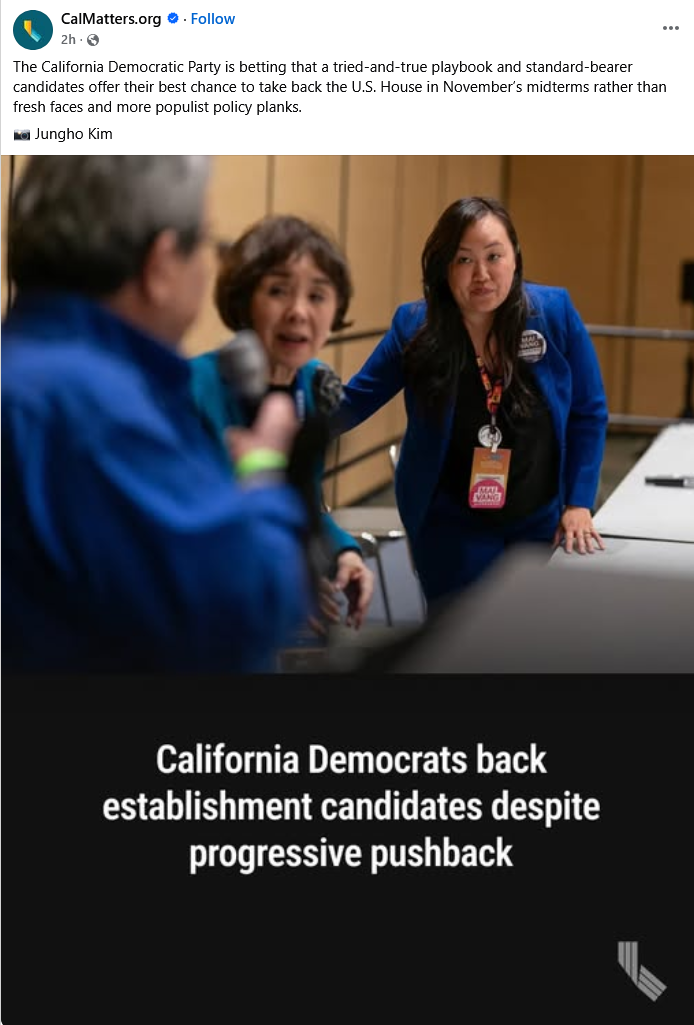
The meme depicts a political event where leaders are selecting well-known, established politicians over fresh talent. The accompanying text criticizes these "standard-bearers" for relying on safe, familiar choices rather than embracing bold new ideas. It argues that the Democratic Party is prioritizing their own internal power dynamics and conservative policies instead of the progressive pushback against those very candidates.
detailed-analysis (gemma3_27b-it-q8_0)
Okay, let's analyze this image and the accompanying text through the lens of Anti-Centrism. Given the provided categories, not all will be relevant, but we'll cover the most pertinent ones.
Here's a breakdown:
Visual Description
The image depicts two women, appearing to be political figures, leaning over a young person who is holding a phone. The older woman on the left is gesturing with her hand, seemingly directing attention towards the phone screen. The woman on the right is observing. The setting is a room with tables and what looks like campaign materials (badges, etc.). The overall impression is of a power dynamic where the older figures are directing or influencing the younger one. The text superimposed reads "California Democrats back establishment candidates despite progressive pushback," positioning this as a moment of control or strategizing.
Marxist Conflict Theory
This image and text align very strongly with a Marxist understanding of power dynamics. Here's how:
- Class Struggle within the Democratic Party: Anti-centrism often emphasizes internal class conflict within political parties. This meme illustrates a clash between the "establishment" (older, more traditional Democrats) and the "progressive pushback" (represented by potentially younger, more activist-oriented members). The establishment is seeking to maintain their control of the party apparatus and the narrative.
- Ideological Control: The action in the picture—leaning over someone and directing their attention—symbolizes the attempt by the establishment to maintain ideological control over the base. They want to steer the narrative and ensure that candidates aligned with their interests are promoted, rather than those advocating for more radical change.
- Base vs. Superstructure: The 'progressive pushback' can be seen as originating from the base – the working class and those who actively call for change. The establishment operates within the political superstructure, manipulating the means of governance to preserve the status quo.
- False Consciousness: The image subtly suggests that the younger person with the phone might be vulnerable to manipulation, or potentially unaware of the larger strategic game being played. This touches upon the Marxist idea of 'false consciousness' – where the working class is misled into supporting systems that are against their best interests.
Critical Theory
Critical Theory builds upon Marxist foundations, exploring how power operates through broader societal structures. This image connects to critical theory in the following ways:
- Critique of Rationality: Anti-centrism often critiques the notion of a "reasonable" center as a tool to stifle progressive thought. The Democrats' decision to back establishment candidates despite progressive desires suggests a prioritization of "practicality" or "electability" over genuine political transformation. This ‘practicality’ is often a smokescreen for maintaining existing power structures.
- Domination and Subjugation: The dynamic depicted visually represents domination—the establishment figures physically imposing themselves upon the younger person. Critical Theory analyzes how these patterns of domination are replicated in broader social institutions.
- Reproduction of Power: The backing of establishment candidates is presented as an attempt to reproduce the existing power structures within the Democratic Party and, by extension, within the political system.
Foucauldian Genealogical Discourse Analysis
A Foucault-inspired reading would focus on the discourse surrounding this image and how it shapes our understanding of power.
- Power/Knowledge: The text frames the situation as a strategic decision. This frames power as not just repressive, but productive. The decision to support establishment candidates isn’t simply about preventing progressives from winning; it’s about actively constructing a certain narrative about what is "realistic" or "viable" in politics.
- Disciplinary Power: The act of guiding or directing (visually depicted) can be viewed as a form of disciplinary power. It's about normalizing certain behaviors and beliefs within the party. Progressive voices are being 'disciplined' by being sidelined.
- Genealogy of "Establishment": We could ask: What is the history of this concept of "establishment" within the Democratic Party? How has it been constructed and what interests does it serve? This genealogy would reveal how the idea of a ‘safe’ or ‘reasonable’ candidate has been used to exclude more radical alternatives.
Postmodernism
Postmodernism, in this context, is less directly applicable, but can inform the analysis.
- Deconstruction of "Centrism": Anti-centrism is, fundamentally, a deconstruction of the idea that a "center" exists or is even desirable in politics. The image shows that the “center” is not a neutral space, but an actively constructed position that favors certain interests.
- Meta-Narratives: Postmodernism critiques grand narratives (like the idea that "electability" is the ultimate goal). Anti-centrism challenges the narrative that establishment candidates are the only path to victory.
In conclusion, from an anti-centrist perspective, this image is a potent symbol of the Democratic Party establishment attempting to suppress progressive voices and maintain its grip on power. It demonstrates a conflict within the party and calls into question the validity of centering 'practicality' over actual change. The various theories allow us to unpack the layers of power, control, and ideological manipulation at play.
simple-description (llama3.2-vision_11b)
The meme is a screenshot of a Facebook post from the account "CalMatters" with a news article title "California Democrats back establishment candidates". The article reports that California Democrats are backing "establishment" candidates, which is a term that has been used to describe a political … [more]
The meme is a screenshot of a Facebook post from the account "CalMatters" with a news article title "California Democrats back establishment candidates". The article reports that California Democrats are … [more]