First Seen
2023-05-10T21:03:33+00:00
simple-description (llama3.2-vision_11b)
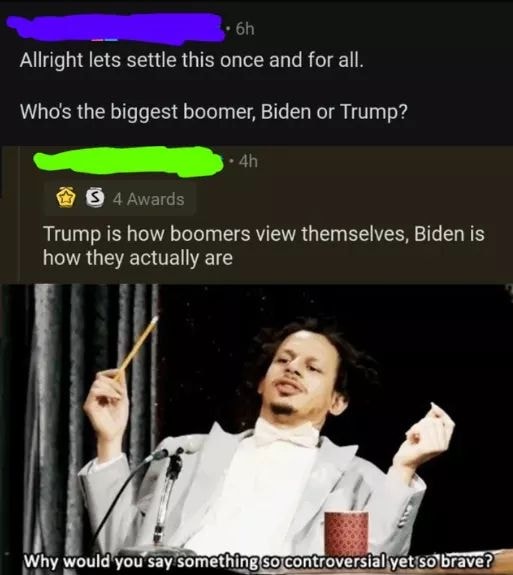
The meme is a screenshot of a Reddit thread where someone asks "Who's the biggest boomer, Biden or Trump?" and another user responds with a quote from a 1999 interview with a 16-year-old boy, saying "I'm not a boy, I'm a boy". The response is a reference to the 1999 interview with a 16-year-old boy, where he says "I'm not a boy, I'm a boy" to a question about his age.
detailed-analysis (gemma3-27b-vision)
Okay, let's break down this internet comment/meme through the lenses of different theoretical frameworks. It's a dense little bit of internet culture, so we'll see where these theories apply.
Visual Description
The image features a digitally manipulated photograph of Lenny Kravitz. He is dressed in a formal white suit with a frilled shirt. He is conducting an orchestra with a baton in his right hand, standing behind a podium. His eyes are closed and he has a dramatic, almost ecstatic expression. His arms are outstretched as if in reverence. Below the image is text in a meme format: "Why would you say something so controversial yet so brave?". The original post is a question asking who is the "biggest boomer" – Trump or Biden, with a response claiming Trump represents how boomers see themselves, and Biden represents how they actually are.
Foucauldian Genealogical Discourse Analysis
This meme is rife with potential for a Foucault-inspired reading.
- Discourse and Power: The initial question (“Who's the biggest boomer?”) establishes a discourse around generational identity. This discourse isn't neutral; it inherently assigns value (or lack thereof) to "being a boomer." The response reinforces this by defining Trump and Biden in relation to this "boomer" identity, establishing them as types or expressions of this identity.
- Genealogy of the "Boomer": Tracing the history of the term "boomer" reveals how it has evolved from a demographic label to a pejorative, carrying connotations of privilege, entitlement, and resistance to change. The comment leverages this historical baggage. The question and answer operate as if this term and its negative associations are universally understood, thus reinforcing the power of this discourse.
- Truth and Power: The statement, "Trump is how boomers view themselves, Biden is how they actually are," is presented as truth. However, this isn't an objective truth, but a claim made within a specific power dynamic (online, generational). It’s a claim meant to be taken on faith or with existing biases in mind. The image and statement establish an idea about what it means to be a boomer.
Critical Theory
This meme engages with some core tenets of Critical Theory, specifically concerning ideology and representation.
- Ideology & False Consciousness: The assertion about Trump and Biden taps into the idea that people often have a distorted perception of reality (false consciousness). The implication is that boomers believe they embody Trump-like qualities (strength, defiance) but are actually more akin to Biden (establishment, potentially out of touch).
- Dominant Narratives: The meme participates in a dominant narrative that paints boomers as resistant to change and out of touch with contemporary values. It frames Trump and Biden as archetypes that fit into this narrative.
- Critique of Representation: The image of Lenny Kravitz (an artist known for blending genres and challenging norms) ironically paired with a statement about generational stereotypes is a form of meta-commentary. It’s a critical commentary on how identities are constructed and used to judge and categorize.
Marxist Conflict Theory
While not central, Marxist thought can offer some insights.
- Generational Conflict: The framing suggests a conflict between generations, with boomers (represented by the question and the assessment) being positioned as a distinct and potentially dominant group.
- Ideological Struggle: The claim about how boomers see themselves versus how they are implies an ideological struggle – a battle over how reality is defined and understood. The commenter attempts to define boomers for others.
- Power Dynamics: The question implicitly places boomers in a position of power (historically, economically, politically) and sets up the assessment as a challenge to that power.
Postmodernism
The meme exhibits elements characteristic of postmodern thought:
- Irony & Parody: The use of the Lenny Kravitz image, seemingly unrelated to the topic, is inherently ironic. The entire meme relies on a disconnect between image and text.
- Deconstruction of Identity: The statement “Trump is how boomers view themselves, Biden is how they actually are,” attempts to deconstruct the idea of a unified "boomer" identity. It suggests that the label is a construct, a performance, rather than an inherent truth.
- Simulacra and Simulation: The meme itself is a simulacrum – a copy of a copy, removed from any original reality. It's a commentary about generational identity expressed through layers of digital representation.
Queer Feminist Intersectional Analysis
This lens is the least applicable, but we can still tease out some connections.
- Stereotyping and Essentialism: The meme relies on broad generalizations about an entire generation. This can be seen as a form of essentialism, assuming that all members of a group share the same characteristics.
- Power and Marginalization: Generational dynamics can intersect with other forms of oppression. The framing of boomers as a dominant group potentially obscures the experiences of marginalized individuals within that generation (e.g., people of color, LGBTQ+ individuals, women).
- Performance of Identity: The idea that boomers see themselves a certain way can be linked to the feminist concept of gender as performance – the idea that identity is constructed and expressed through social behaviors.
In conclusion, this seemingly simple meme is actually a surprisingly complex artifact of internet culture that can be analyzed through a variety of theoretical lenses. It taps into issues of identity, power, ideology, and representation, revealing how even seemingly mundane online content can reflect larger social and political dynamics.
simple-description (llama3.2-vision)
This meme is a screenshot of a Reddit comment thread where someone asks "In a world where the most popular presidents are named after foods, who's the biggest?" and a user responds with a joke about the difference between Donald Trump and Joe Biden. The response includes a quote from a 1983 comedy special by Eddie Murphy, which is edited to replace "Richard" with "Donald" and "Prescott" with "Trump".
tesseract-ocr
Allright lets settle this once and for all. Who's the biggest boomer, Biden or Trump? & 8 4 Awards Trump is how boomers view themselves, Biden is how they actually are a i ; | : ‘ } | ! | : ua ale