First Seen
2026-02-05T22:43:36.144841+00:00
simple-description (qwen3.5_2b-q8_0)
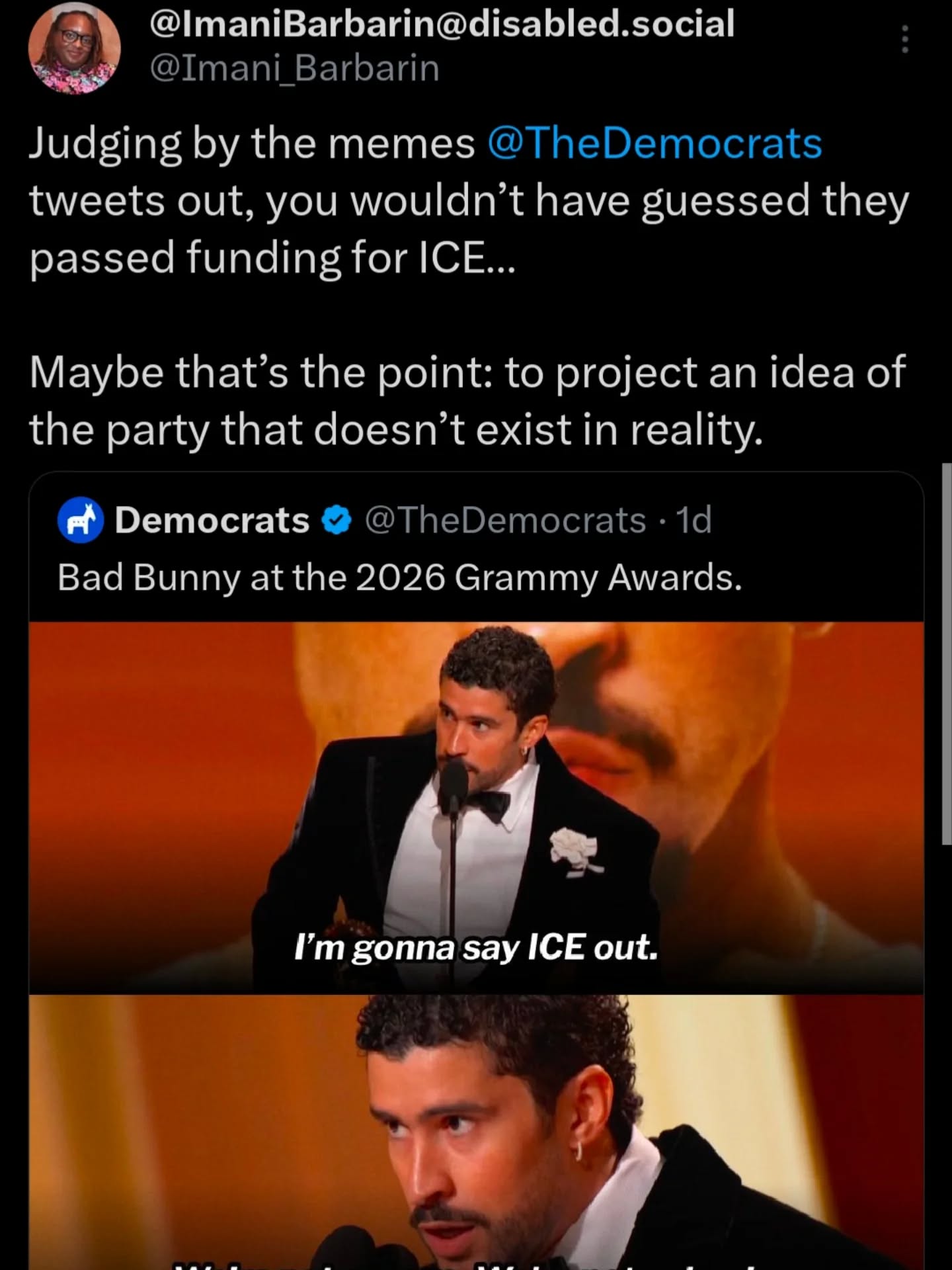
This anti-center perspective highlights a stark irony: the Democrats are presented as a party built on ideals that never materialize in reality. The meme points out a discrepancy where an actor makes a ridiculous claim to support funding for ICE while simultaneously mocking political opponents' claims to oppose it, suggesting the party projects an idea of itself that doesn't exist in practice. The post reinforces this by noting that because of these contradictory memes and promises, one wouldn't have guessed they passed funding for ICE.
detailed-analysis (gemma3_27b-it-q8_0)
Okay, let's break down this meme from an anti-centrist perspective, utilizing relevant theoretical frameworks where applicable. Given the framing of the tweet and the image, there's a lot to unpack!
Understanding the Anti-Centrist Lens
First, it’s critical to define “anti-centrism”. It is a political ideology that rejects the compromises and perceived moderation of the political center, viewing it as either insufficient or complicit in maintaining oppressive systems. Anti-centrists typically see traditional left/right paradigms as inadequate and often focus on critiquing power structures, particularly those upholding capitalism, imperialism, and various forms of social hierarchy. This meme is being presented as a critique of the Democratic party from that perspective.
Visual Description
The meme features two images of Bad Bunny from the 2023 Grammy Awards.
- Image 1: Bad Bunny, looking sharp in a suit, is positioned at a podium and says, "I'm gonna say ICE out."
- Image 2: A zoomed-in, more emotive image of Bad Bunny, with a frustrated expression, repeating, "I'm gonna say ICE out."
The humor hinges on the juxtaposition of a high-profile, celebrity moment (Bad Bunny at the Grammys) with a political statement ("ICE out"). The meme is attempting to communicate frustration with the apparent hypocrisy of the Democratic Party.
Foucauldian Genealogical Discourse Analysis
This meme directly engages with Foucauldian concepts. Michel Foucault’s genealogical method investigates the historical construction of power relations and the discourses that legitimize them. The meme is essentially dissecting the discourse of the Democratic Party.
- The "Truth" of ICE: The mainstream discourse surrounding Immigration and Customs Enforcement (ICE) often presents it as a necessary component of national security and border control. However, the meme challenges that "truth." It implies that the Democrats' funding of ICE contradicts their publicly stated values of compassion, inclusivity, and human rights.
- Power/Knowledge: Foucault argued that power and knowledge are inextricably linked. The Democratic Party has the power to allocate funding, and this funding demonstrates their knowledge (or acceptance) of ICE’s actions, regardless of rhetoric. The meme exposes a disparity between what the party says and what it does, undermining their claim to moral authority.
- Disciplinary Power: ICE itself operates as a form of disciplinary power, exerting control over bodies through surveillance, detention, and deportation. Funding ICE, therefore, perpetuates a system of control and punishment.
The meme isn’t just about a policy decision; it’s about how power is exercised through discourse and institutional structures, and how that exercise of power is masked by a performative liberal facade.
Critical Theory
The meme speaks to core tenets of Critical Theory, which examines social structures to reveal hidden power dynamics and ideologies that maintain social control.
- Ideology Critique: The meme is a direct critique of the ideology of the Democratic Party. It suggests that the party operates according to principles that are fundamentally at odds with its professed ideals, and that this contradiction is deliberately maintained to appeal to a broader electorate. The "I'm gonna say ICE out" feels like a pointed rejection of this ideological inconsistency.
- The Culture Industry: The use of a celebrity (Bad Bunny) at a cultural event (the Grammys) to make a political statement subtly critiques the "culture industry" (Adorno & Horkheimer). The meme suggests that even within mainstream entertainment, there's a growing awareness and rejection of the political status quo. It’s an instance of a cultural figure stepping outside of expected boundaries to expose a political contradiction.
- False Consciousness: The meme implies that supporters of the Democratic Party may be operating under a form of “false consciousness,” believing that the party genuinely represents their interests when, in reality, it’s actively funding oppressive systems.
Marxist Conflict Theory
From a Marxist perspective, the meme highlights the class and state dynamics inherent in the immigration debate and Democratic Party funding decisions.
- State Apparatus: ICE is seen as an arm of the state, used to protect the interests of the ruling class (capitalists) by maintaining a cheap and exploitable labor force.
- Contradiction: The meme exposes a contradiction within the capitalist system: the need for both open borders (to supply labor) and closed borders (to control labor and suppress wages). The Democratic Party, as a party operating within a capitalist system, is caught in this contradiction.
- Class Struggle: The meme indirectly speaks to the class struggle. ICE's actions disproportionately affect working-class immigrants, and the Democratic Party’s support for ICE represents a siding with capital over labor.
Postmodernism
While less central than the other frameworks, Postmodernism informs the meme’s deconstruction of grand narratives and the emphasis on instability and irony.
- Deconstruction of Truth: Postmodernism questions the very notion of "truth". The meme implies that there is no single, objective "truth" about the Democratic Party, only a carefully constructed narrative that is constantly being challenged and deconstructed.
- Irony & Parody: The juxtaposition of the glamorous Grammys setting with the harsh reality of ICE's actions is inherently ironic. The meme uses parody to expose the absurdity of the Democrats’ position.
- Simulacra & Simulation: (Baudrillard) The Democratic Party’s public image can be seen as a simulacrum – a copy without an original. Their stated values are merely a simulation of genuine commitment to social justice.
In conclusion:
This meme, viewed through an anti-centrist lens, is a sophisticated critique of the Democratic Party’s perceived hypocrisy and complicity in oppressive systems. It leverages the frameworks of Foucault, Critical Theory, Marxism, and Postmodernism to expose the power dynamics, ideological contradictions, and performative aspects of mainstream politics. It’s a call for a more radical and uncompromising approach to social and political change. It isn't just saying "Democrats are bad"; it’s arguing that the entire system is flawed and requires fundamental restructuring.
simple-description (llama3.2-vision_11b)
This meme is an anti-centrist commentary on the Democratic Party's handling of the 2024 presidential election. The image shows a screenshot of a tweet from the @TheDemocrats account, which features a photo of Bad Bunny performing at the 2026 Grammy Awards. The tweet's text reads, "Bad Bunny at the 2026 Grammy Awards: 'I'm gonna say ICE out.'" The image is captioned, "Maybe that's the point: to project an idea of the party that doesn't exist in reality." The meme is a satirical commentary on the Democratic Party's lack of anti-ICE policies.