First Seen
2026-01-24T07:46:47.156219+00:00
simple-description (qwen3.5_2b-q8_0)
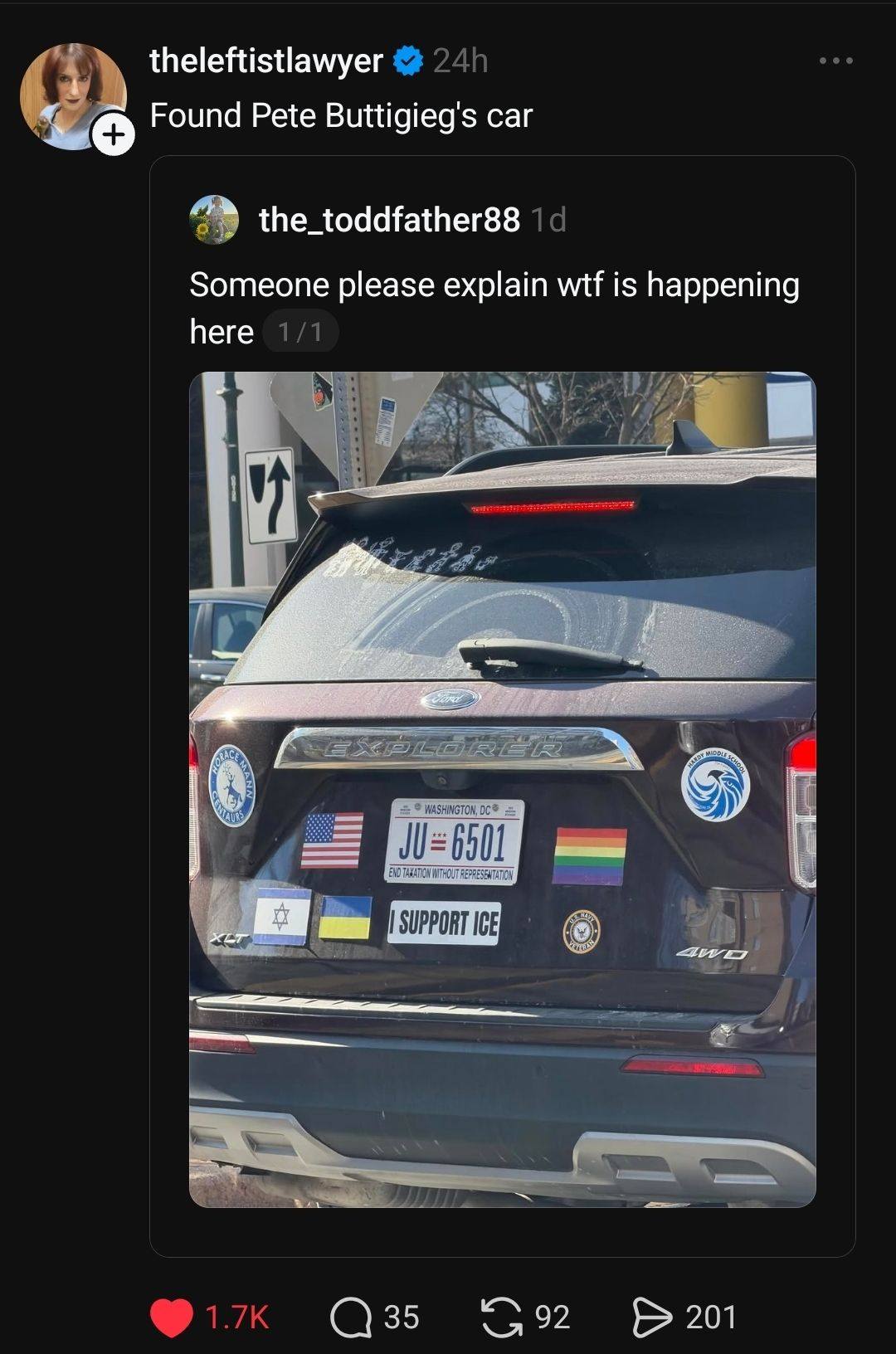
This meme functions as a critique of bureaucratic institutions—specifically police and education agencies—by associating a vehicle with the tragic history of Harry Middle School in Washington, DC. For an anti-centrist perspective, this is not just about student safety; it is a commentary on how government bodies often take traumatic events into their own jurisdiction, effectively "securing" or "handling" the situation rather than providing preventative mental health support. The sticker explicitly stating "I SUPPORT ICE" suggests a frustration with the decision-making process or response of those institutions to the crisis at Harry Middle School.
detailed-analysis (gemma3_27b-it-q8_0)
Okay, let's break down this image as a meme circulating within an anti-centrist online context. Given the user names ("theleftistlawyer" and "the_toddfather"), and the implied question of "what is happening here," it's clear this isn't just a casual observation, but a pointed critique. Here’s an analysis through the requested theoretical lenses.
Visual Description
The image shows the rear of a dark-colored Ford Explorer. This is immediately significant because Pete Buttigieg is the current U.S. Secretary of Transportation and is known to drive a Ford Explorer. The license plate reads “JU 6501” followed by the slogan “END TAXATION WITHOUT REPRESENTATION.” Several bumper stickers are visible: a thin blue line flag, a “Star of David” sticker, a sticker that says “XLT,” and a sticker that says “I SUPPORT ICE.” The background suggests an outdoor, possibly urban, setting.
Foucauldian Genealogical Discourse Analysis
From a Foucauldian perspective, this image is incredibly rich. Foucault's genealogy focuses on the historical emergence of power structures and the discourses that legitimize them. This image is a discourse, a set of statements/signs that construct a particular narrative.
- Power/Knowledge: The placement of these stickers isn't random. They signify adherence to specific power structures. The "I SUPPORT ICE" sticker embodies the discourse of border control, the criminalization of migrants, and state violence. The Thin Blue Line flag represents a pro-police discourse, framing law enforcement as a force for order against chaos (even if that order is selectively applied). The Star of David sticker is complex as it could be a signifier of Jewish identity or co-opted by certain right-wing political ideologies.
- Discursive Formation: The combination of these seemingly disparate elements – a high-profile Democratic politician (Buttigieg), support for a highly controversial agency (ICE), pro-police symbolism, and a statement about taxation – disrupts a "normal" political alignment. This disruption is key to the meme's impact. It forces a reassessment of Buttigieg's positioning and challenges the comfortable narratives surrounding him. The “END TAXATION WITHOUT REPRESENTATION” sticker is particularly jarring. It's a slogan historically associated with American Revolutionary ideals of self-determination, but its juxtaposition with pro-ICE and pro-police symbols effectively appropriates that language for a much more conservative and authoritarian agenda.
- The Archive: The image is part of an “archive” of political symbolism. Each sticker acts as an entry point to understanding the broader historical and political forces at play. Foucauldian analysis would explore how each symbol has been constructed, contested, and re-appropriated over time.
Critical Theory
Critical Theory, particularly influenced by the Frankfurt School, would analyze this image in terms of ideology and the reproduction of power.
- False Consciousness: The image suggests that Buttigieg, despite presenting as a moderate progressive, harbors or is willing to support ideologies that maintain the status quo. This evokes the concept of “false consciousness” – the idea that individuals may unknowingly support systems that are detrimental to their own interests.
- Instrumental Reason: The efficiency-focused mindset often associated with Buttigieg’s technocratic approach to politics can be interpreted through the lens of instrumental reason – a rationality focused solely on means and ends, without regard for ethical or social implications. The endorsement of ICE, an agency known for brutal practices, reflects this utilitarian approach.
- Culture Industry: The very act of sharing the image online can be seen as a form of resisting the dominant culture industry, where messages are carefully curated to maintain a particular order. Sharing and analyzing the image creates a counter-narrative, exposing the contradictions of the political landscape.
Marxist Conflict Theory
From a Marxist standpoint, the image highlights class struggle and the role of the state in maintaining capitalist hegemony.
- State Apparatus: ICE, as a governmental agency, functions as part of the repressive state apparatus, enforcing laws that protect the interests of the ruling class and suppressing dissent. Supporting ICE implicitly supports the maintenance of this system.
- Ideological Hegemony: Buttigieg’s potential alignment with such forces demonstrates how even those positioned within the Democratic Party can be co-opted by capitalist ideology. The slogan about taxation challenges the idea that the state represents the interests of all people, exposing it as a tool for maintaining economic inequality.
- Contradiction: The image reveals a fundamental contradiction within the liberal political order—the simultaneous promotion of progressive ideals (like equality and justice) and the support of institutions that perpetuate oppression (like ICE).
Postmodernism
A postmodern reading would emphasize the breakdown of grand narratives and the fragmentation of meaning.
- Deconstruction: The image deconstructs the notion of a coherent political identity. Buttigieg is no longer easily categorized as a liberal or progressive politician. The conflicting symbols challenge the very idea of fixed political positions.
- Simulacra and Simulation: The image could be interpreted as a “simulacrum” – a copy without an original. The slogan about taxation, ripped from historical context, becomes a hollow signifier devoid of genuine meaning.
- The Death of the Author: The focus shifts away from Buttigieg's intentions and towards the multiple interpretations and meanings that the image generates.
Queer Feminist Intersectional Analysis
While not the primary focus, this lens can also contribute to understanding.
- Intersectionality: The image brings together various forms of oppression – anti-immigrant sentiment (ICE), state violence (police), and potentially challenges regarding queer identity (given Buttigieg’s own position).
- Power Dynamics: The pro-police imagery signifies a reinforcement of patriarchal power structures, where law enforcement often disproportionately targets marginalized communities.
- Challenging Normativity: The disruption of conventional political alignments, while not explicitly queer feminist, can be seen as a questioning of the normative order and a rejection of the status quo.
In Summary
The meme is powerful because it condenses a complex critique into a single, visually arresting image. Within an anti-centrist context, it functions as a critique of the perceived hypocrisy and compromises of mainstream liberal politics, particularly concerning issues of policing, immigration, and economic justice. The theoretical frameworks above provide ways to unpack the layers of meaning embedded in this seemingly simple photograph. It's a clear demonstration of how online meme culture can serve as a vehicle for political analysis and dissent.
simple-description (llama3.2-vision_11b)
The meme is a photo of a car with a bumper sticker that reads "I Support ICE" (Immigration and Customs Enforcement) surrounded by other stickers that appear to be anti-ICE or anti-immigration. The image is likely meant to be humorous or ironic, as the owner of the car is likely not a fan of the "I Support ICE" message, but rather is using it to poke fun at the idea of supporting a group that is often criticized for its treatment of immigrants. The meme is likely being shared to highlight the irony or absurdity of the situation.