First Seen
2025-02-13T01:47:22.898609+00:00
detailed-analysis (gemma3_27b-it-q8_0)
Okay, let's break down this meme through the lens of Anti-Centrism, utilizing applicable theoretical frameworks. It's a layered piece of online political communication, and a deeper look reveals why it's resonating within that subculture.
Overall Context: Anti-Centrism & the Rejection of Liberalism
Before diving into specifics, it’s vital to understand that anti-centrism, as a political attitude, fundamentally rejects the notion of a "middle ground" or compromise with ideologies perceived as upholding oppressive systems. It often critiques both mainstream conservatism and liberalism, seeing liberalism as a limited, reformist project that doesn't challenge the underlying power structures. Within this framework, there's a frequent insistence on clearly defined ideological boundaries. This meme embodies that rejection.
---
Visual Description
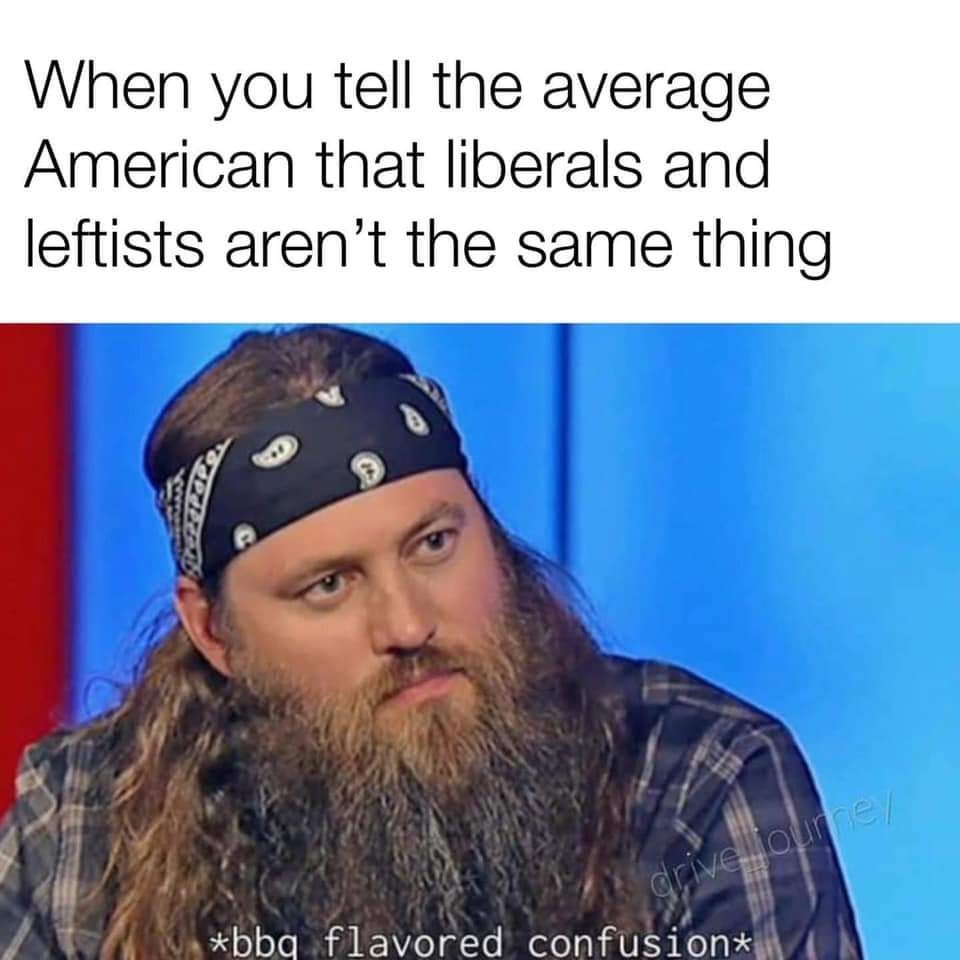
The meme depicts a very bewildered-looking man, seemingly in a game show setting (likely a Jeopardy! set). He has an intensely confused expression, furrowed brows, and a face that conveys a total inability to process what he's just heard. He's wearing a bandana, giving off a slightly "rough around the edges" aesthetic. The caption at the bottom reads "bbq flavored confusion," which implies the bewilderment is akin to a mundane, perhaps redneck, experience. The image intends to represent a stereotypical "average American" (though, clearly, constructed and stereotyped).
---
Foucauldian Genealogical Discourse Analysis
From a Foucauldian perspective, this meme highlights the construction of the categories "liberal" and "leftist." Michel Foucault argued that concepts aren't inherent truths, but products of historical power dynamics – discourses. The meme exposes the power of dominant narratives in shaping how people understand political identity.
- Discursive Collapse: The meme points out how, in mainstream American discourse, “liberal” is often used as a catch-all term to encompass a vast spectrum of political thought, stretching from moderate social democrats to radical socialists. This 'collapse' serves to homogenize and neutralize potentially disruptive leftist ideas.
- Genealogy of Confusion: Foucault would ask how this conflation came about. Through mass media, political rhetoric, and the historical association of liberalism with gradual reform, the "left" has been progressively absorbed into the liberal framework. The confusion expressed in the image is a result of this historical discursive formation.
- Power/Knowledge: The meme suggests that the "average American" operates within a power/knowledge regime where the boundaries between liberalism and leftist ideologies have been intentionally blurred – often by those invested in maintaining the status quo.
---
Critical Theory
Critical Theory, particularly drawing on the Frankfurt School, emphasizes the critique of ideology and the reproduction of power relations. This meme is relevant here in several ways:
- False Consciousness: The “average American” in the meme is presented as being in a state of “false consciousness,” unable to grasp the fundamental differences between liberalism and more radical leftist approaches. This inability is not merely a matter of ignorance, but a product of ideological conditioning.
- The Culture Industry: The meme implicitly critiques the role of the "culture industry" (mass media, entertainment, etc.) in perpetuating simplified and often inaccurate representations of political ideologies. This simplification obscures the complexities of leftist thought.
- Critique of Instrumental Reason: The meme suggests that the inability to discern between liberalism and the left is symptomatic of a larger problem—a reliance on "instrumental reason" that prioritizes pragmatic solutions over critical reflection on underlying power structures. Liberalism, in this view, is a prime example of instrumental reason, focusing on incremental change within existing systems rather than challenging them.
---
Marxist Conflict Theory
From a Marxist standpoint, the meme highlights the class interests at play in shaping political discourse.
- Ideology as Class Struggle: Liberalism, from a Marxist perspective, is often seen as the ideology of the bourgeoisie (the ruling class) – designed to maintain the capitalist system while offering limited reforms. Leftist ideologies, particularly socialism and communism, represent challenges to that system.
- False Unity: Conflating liberals and leftists obscures the fundamental class conflict. By presenting them as essentially the same, the meme critiques the attempt to create a "unified" progressive front that ultimately serves the interests of the ruling class.
- Revolutionary Potential: The meme implicitly argues that true social change requires a clear distinction between reformist (liberal) and revolutionary (leftist) approaches. The confusion in the image is seen as a barrier to developing a radical consciousness.
---
Postmodernism
While perhaps less central than the other frameworks, a postmodern reading can be applied.
- Deconstruction of Categories: Postmodern thought would question the very stability of the categories "liberal" and "leftist." Are these fixed identities, or are they fluid and socially constructed? The meme, by pointing out the confusion, implicitly destabilizes those categories.
- Rejection of Grand Narratives: The meme challenges the "grand narrative" of a unified progressive movement. It suggests that the idea of a seamless alliance between liberals and leftists is an illusion.
- Simulacra & Simulation: The "average American" in the meme could be seen as existing within a world of simulacra – copies without originals. Their understanding of political ideology is shaped by mediated representations, rather than direct experience.
---
In conclusion:
The meme is a microcosm of the anti-centrist rejection of liberal hegemony. It uses humor to underscore the perceived limitations of liberalism and the need for a more radical, clearly defined leftist analysis. The layers of theoretical application—from Foucault’s discourse analysis to Marxist conflict theory—reveal its potential for deeper engagement with the complexities of political identity, ideology, and power. The "bbq flavored confusion" adds a specific, relatable, and slightly ironic tone that resonates strongly within online subcultures that subscribe to these viewpoints.
simple-description (llama3.2-vision_11b)
This meme is an example of anti-centrism, as it pokes fun at the idea that people from the liberal and conservative sides of the political spectrum are always in disagreement. The meme uses a photo of a person with a confused expression, accompanied by the text "When you tell the average American that liberals and conservatives can't both be right." The image is captioned with the phrase "I'm not saying I'm wrong, I'm saying I'm right" to highlight the absurdity of the situation.
detailed-analysis (gemma3-27b-vision)
Okay, here's an analysis of the image, broken down by the requested theoretical frameworks, as applicable. I'll indicate when a section doesn't apply.
Image Description
The image is a screenshot of a man, appearing to be reality television personality Willie Robertson (from Duck Dynasty), with a visibly confused and somewhat grimacing expression. He is wearing a bandana and a camouflage-patterned jacket. Text above the image reads: "When you tell the average American that liberals and leftists aren't the same thing." Below the image, the caption reads “bbq flavored confusion”. The context suggests this image is a meme, communicating amusement at the perceived inability of "average Americans" (presumably those with more conservative viewpoints) to understand nuanced political positions.
---
Foucauldian Genealogical Discourse Analysis
This meme lends itself well to a Foucauldian approach. We can examine the discourse around political ideology, specifically how terms like "liberal" and "leftist" are used (and often conflated) within a dominant power structure.
- Power/Knowledge: The meme suggests a power dynamic where those who do understand the distinction between liberals and leftists (and likely hold more progressive or academic views) are positioned as having specialized knowledge, while "average Americans" are seen as lacking it. This creates a hierarchical relationship through the construction of knowledge.
- Genealogy: Looking at the historical genealogy of the terms "liberal" and "leftist" reveals shifting meanings. Originally rooted in Enlightenment thought, "liberal" emphasized individual rights and limited government, while "leftist" emerged from the French Revolution, representing those who sat on the left side of the assembly demanding more radical change. However, over time, these meanings have blurred and become increasingly politicized. The meme highlights this conflation.
- Discursive Formation: The meme participates in a discursive formation that constructs a certain image of the “average American” as intellectually limited or resistant to nuance in political discourse. It reinforces a narrative of ideological division.
---
Critical Theory
This image can be analyzed through the lens of Critical Theory, particularly in relation to the concept of ideology.
- Ideology: The meme implies that the “average American” has been socialized into a simplified understanding of political ideologies. This simplification serves to maintain the status quo by making it harder to engage with complex issues or consider alternative perspectives. The conflation of "liberal" and "leftist" is itself a form of ideological simplification.
- Culture Industry: The meme, as a form of popular culture, operates within the broader "culture industry." It can be seen as both reflecting and reinforcing existing ideological structures. It’s humorous precisely because it taps into a commonly held (or perceived) misunderstanding.
- False Consciousness: The "average American" in the meme might be seen as suffering from a form of "false consciousness" – being unaware of the true nature of political structures and believing in a distorted representation of them.
---
Marxist Conflict Theory
Applying a Marxist lens, we can examine the meme as representing a class-based (or at least a cultural class-based) conflict of understanding.
- Dominant Ideology: The meme suggests that a "dominant ideology" (likely rooted in more conservative values) prevails within a certain segment of the American population. This ideology simplifies political divisions to maintain power structures.
- Class Consciousness: The meme implies a lack of "class consciousness" (broadly defined, not just economic class) among "average Americans" regarding the nuances of political ideologies. They are presented as unable to distinguish between different positions within the political spectrum.
- Hegemony: The meme can be seen as a commentary on how "hegemony" (the dominance of one group’s ideology over others) operates. The simplification of political positions reinforces the dominance of a particular worldview.
---
Postmodernism
From a postmodern perspective, the meme embodies the deconstruction of fixed categories and the questioning of grand narratives.
- Deconstruction: The meme plays on the deconstruction of the categories "liberal" and "leftist". It implies that these terms are not stable or self-evident, but rather socially constructed and subject to interpretation.
- Relativism: It hints at a degree of relativism, suggesting that understanding of these terms is subjective and dependent on individual perspectives.
- Simulation & Hyperreality: The meme itself is a simulation, a digital representation of a perceived reality. It reinforces a "hyperreality" where the simulation (the meme) becomes more compelling than the actual experience of political discourse.
---
Queer Feminist Intersectional Analysis
This lens is less directly applicable, but can still offer some insight.
- Othering: The meme implicitly "others" the "average American" as intellectually unsophisticated. This can be linked to broader power dynamics where certain groups are marginalized or dismissed as less capable of understanding complex issues.
- Intersectionality: While not explicitly present, the meme's focus on a perceived intellectual gap can be connected to how intersecting identities (e.g., class, education, region) shape political understanding. The "average American" in the meme is often implicitly understood as white, working-class, and rural, suggesting a lack of access to or interest in nuanced political discussions.
Let me know if you'd like me to expand on any of these analyses!
simple-description (llama3.2-vision)
This meme is a humorous image of a person with a confused expression, accompanied by the text "When you tell the average American that liberals and leftists aren't the same thing". The image is likely a photo of a person looking puzzled, with a caption that pokes fun at the common misconception that liberals and leftists are interchangeable terms.