First Seen
2026-03-20T04:44:34+00:00
simple-description (qwen3.5_2b-q8_0)
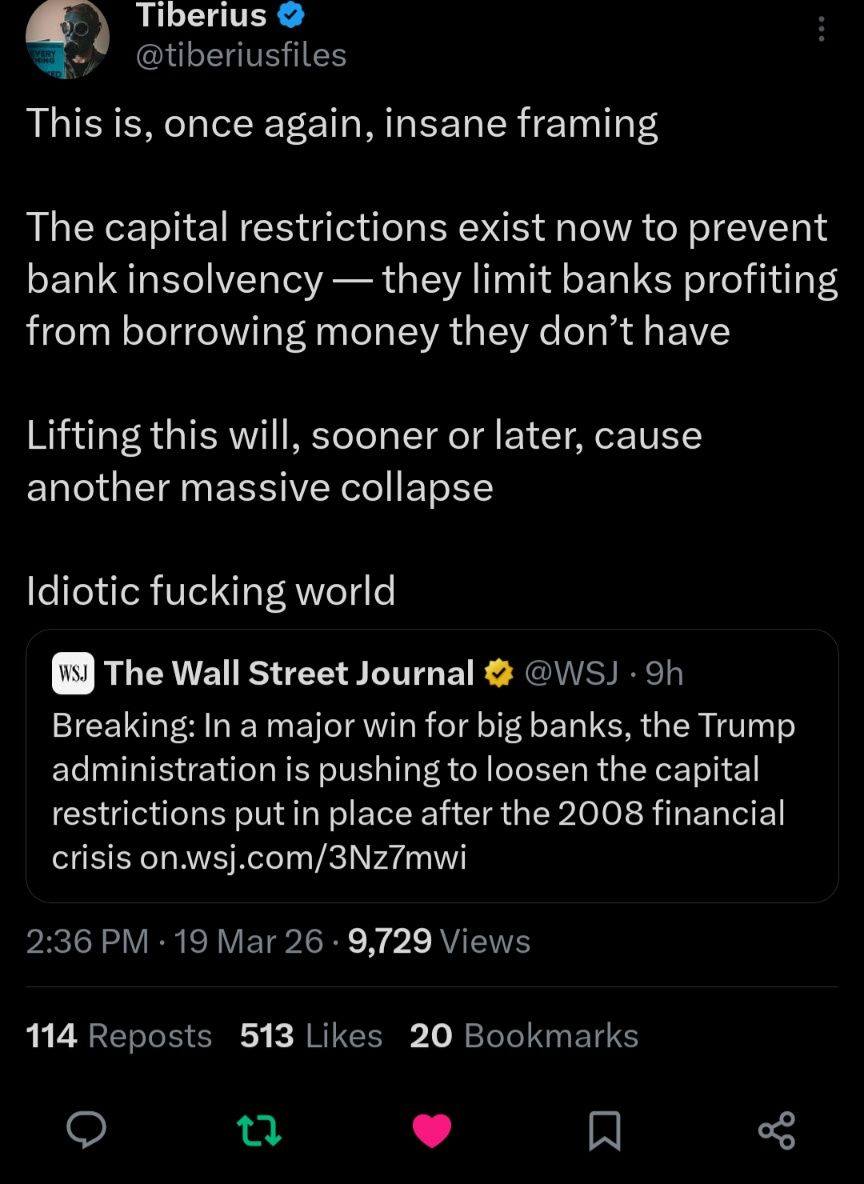
In an anti-capitalist context, this meme suggests that strict financial regulations are actually protective measures designed to stop banks from failing due to risky lending practices. The poster argues that removing these controls allows large institutions to borrow money people can't afford, a move that creates "bad debt" and threatens a massive collapse of the banking sector.
detailed-analysis (gemma3_27b-it-q8_0)
Okay, let's break down this social media post through the lens of Anti-Capitalism, utilizing relevant theoretical frameworks where appropriate.
Overall Summary: The post expresses deep concern and scathing criticism regarding the potential rollback of financial regulations put in place after the 2008 financial crisis. It frames this rollback as a reckless act that will inevitably lead to another economic collapse, driven by the inherent tendencies of capitalism to prioritize profit over stability. It is an expression of disillusionment and anger towards the “idiotic” nature of a system that seems to perpetually repeat its mistakes.
---
Visual Description
The post presents a screenshot of a tweet from The Wall Street Journal reporting that the Trump administration is attempting to loosen capital restrictions implemented after the 2008 financial crisis. The tweet is juxtaposed with a critical, emotionally charged commentary from an account called @tiberiusfiles. The WSJ logo and the “Breaking” tag signal the authoritative (from a conventional perspective) source of the information, ironically setting it up to be immediately challenged. The use of strong language ("insane framing," "idiotic f*cking world") conveys a sense of urgency and outrage. The numbers on the Tweet (reposts, likes, views) show how much engagement this message is getting.
---
Foucauldian Genealogical Discourse Analysis
From a Foucauldian perspective, the post highlights the discourse of financial regulation and the power dynamics within it. The initial regulations after 2008 represent an attempt to discipline the behavior of banks, to impose a framework that ostensibly limited their risk-taking. These rules were a manifestation of power – a way to define acceptable and unacceptable conduct within the financial sphere.
However, the rollback of these regulations signifies a shift in this discourse. It reflects the power of financial institutions (the "big banks" mentioned in the WSJ article) to successfully lobby for the loosening of constraints on their activities. The discourse is being reconfigured to prioritize profit maximization, even if it means increasing systemic risk. Tiberius' post is an attempt to counter this dominant discourse, to reveal its inherent dangers, and to expose the power relations that drive it. The "insane framing" critique points to how the rollback is being presented (or discursively constructed) as something positive when, from an anti-capitalist perspective, it is deeply problematic.
---
Critical Theory
The post embodies core tenets of Critical Theory, particularly the critique of instrumental reason and the concept of system contradiction. The rollback of regulations is presented as an example of instrumental reason run amok – a prioritization of economic efficiency (profit for banks) without consideration for broader social consequences (potential collapse, hardship for ordinary people).
Critical Theory argues that capitalism contains inherent system contradictions. In this case, the contradiction lies between the drive for endless accumulation (profit) and the need for systemic stability. The rollback of regulations exacerbates this contradiction by allowing banks to engage in riskier behavior, increasing the likelihood of a crisis. The "massive collapse" foretold is not seen as an accidental outcome but as a logical consequence of the system's internal dynamics.
The author's use of strong emotional language ("idiotic fcking world") also reflects a recognition of the culture industry’s* role in obscuring these contradictions and normalizing destructive practices.
---
Marxist Conflict Theory
From a Marxist lens, this post is a clear articulation of class conflict. The "big banks" represent the bourgeoisie – the capitalist class that owns the means of production (in this case, financial capital). The loosening of regulations benefits this class by allowing them to accumulate more wealth and power. The implicit victims of this policy are the proletariat – the working class and the broader population who bear the brunt of economic crises.
The post frames the rollback as an act of exploitation, where the interests of the capitalist class are prioritized at the expense of the majority. The potential for another collapse is seen as a direct result of this inherent conflict between capital and labor. The repetition of crises (2008 and the potential for another) is presented as a characteristic feature of capitalism, a system inherently prone to instability due to its reliance on profit-driven accumulation.
---
Postmodernism
While not the primary framework, postmodernism is relevant in understanding the skepticism towards narratives of progress and the dismantling of "grand narratives." The author's language and tone suggest a rejection of the idea that regulations can provide a permanent solution to the problems of capitalism. They have lost faith in the ability of institutional mechanisms to prevent future crises. The repetition of crises (the 2008 crisis being a significant historical point) and the expectation of another, suggests a cyclical nature of boom and bust, undermining any linear notion of progress.
---
Queer Feminist Intersectional Analysis
This framework applies less directly, but is still relevant. It could be argued that the impacts of financial collapse aren't felt equally. Marginalized groups – including women, people of color, LGBTQ+ individuals, and those with disabilities – are often disproportionately affected by economic downturns due to existing systemic inequalities. The rollback of regulations therefore exacerbates these inequalities. These groups are vulnerable during financial collapses due to existing structural marginalization.
In conclusion, this post is a scathing critique of capitalism, leveraging the tools of Anti-Capitalist thought to expose the inherent contradictions and power dynamics that drive the system. It highlights the potential for ongoing crisis and the prioritization of profit over social well-being.
simple-description (llama3.2-vision_11b)
This meme is a satirical commentary on the current state of the global economy and the effects of capitalism. The text states, "This is, once again, insane framing," followed by a series of statements that describe the insurmountable debt and financial instability that many people face. The author concludes by saying, "Idiotic f**king world," indicating that they find the situation both laughable and concerning. The image is likely meant to be shared on social media platforms to raise awareness about the financial struggles that many people face.