First Seen
2023-05-10T21:03:33+00:00
simple-description (llama3.2-vision_11b)
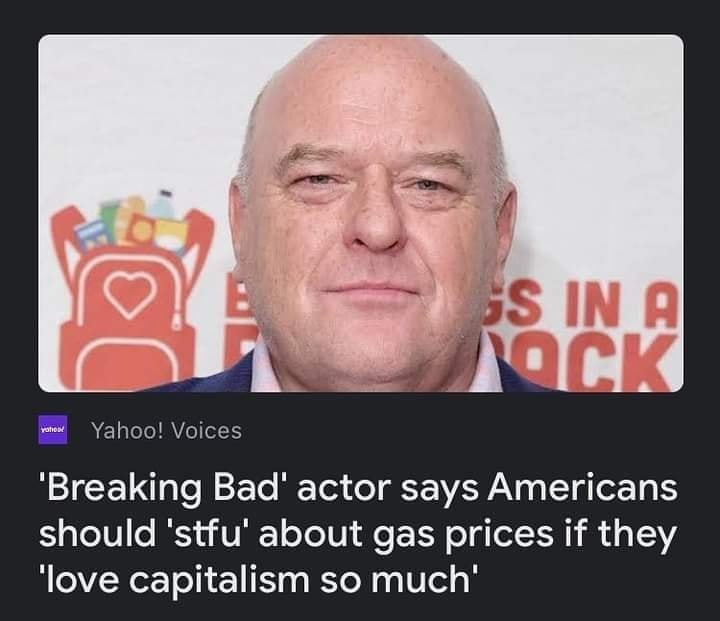
The meme is a screenshot of a news article from the "Anti-Capitalism" category, featuring a photo of a man with a scowl on his face. The article's headline reads: "Breaking Bad actor says Americans should 'f**k you' about gas prices if they 'love capitalism so much'". The meme is a satirical take on the actor's comments, using a quote from the article to poke fun at the idea that Americans are not willing to pay for gas prices due to their love of capitalism.
detailed-analysis (gemma3-27b-vision)
Okay, let's break down this image and headline through a few different theoretical lenses.
Visual Description
The image is a close-up portrait of actor Bryan Cranston, known for his role in "Breaking Bad". He has a stern expression, looking directly at the viewer. The background is a blurred red and white pattern with some indistinct writing. The image seems to be taken from a public event or press conference, suggesting a performative context. The headline, displayed beneath the image, reports Cranston's comment about Americans complaining about gas prices while also "loving" capitalism. The composition immediately draws the viewer's attention to Cranston's face, framing his message. The color scheme, with the bold red and white, adds to the intensity and sense of confrontation.
Marxist Conflict Theory
This image and headline deeply resonate with Marxist Conflict Theory. The core of the statement hinges on the inherent contradictions within a capitalist system. Cranston’s comment suggests that complaints about the effects of capitalism (high gas prices, cost of living) are inconsistent with embracing the ideology itself.
* Class Struggle: It subtly points to a class dynamic. Those most affected by price fluctuations are generally the working class and those with fewer resources. The statement implies a lack of awareness or acceptance of this disparity.
Commodity Fetishism: The complaint about gas prices, within this framework, can be seen as focusing on the symptom, not the system. It's a focus on the commodity (gas) rather than the labor relations and power dynamics that produce* the price.
* Ideology and False Consciousness: The statement suggests those complaining are in a state of "false consciousness" – they haven’t fully grasped how the system functions to benefit certain groups at the expense of others. Cranston implies they are benefiting, or believe they benefit, from capitalism, and therefore shouldn't complain about one of its predictable outcomes.
Critical Theory
This image can be analyzed through the lens of Critical Theory, which seeks to uncover and critique power structures and social norms.
* Power Dynamics: Cranston, as a well-known figure, wields symbolic power through his statement. His position as a celebrity gives weight to his opinion, framing the conversation.
* Social Critique: The comment is a critique of the unacknowledged bargain inherent in capitalist societies - accepting the downsides (like high prices) as the price of freedom or prosperity.
* Dominant Narrative: The comment challenges the dominant narrative of consumer choice. It suggests that complaining about prices is a contradiction if one simultaneously supports the economic system that determines those prices.
* Reflexivity: Critical Theory also invites us to reflect on the context of the statement itself. A celebrity offering social commentary is a performative act. Is this genuine political thought, or a calculated move for public attention?
Foucauldian Genealogical Discourse Analysis
Applying a Foucauldian framework, we can examine the discourse around capitalism and consumerism.
* Power/Knowledge: The statement exemplifies how power operates through knowledge. Cranston isn't simply stating an opinion; he's deploying a particular understanding of capitalism – one that frames complaints as illogical. This constructs a certain “truth” about who is “reasonable” and “consistent” within the system.
* Genealogy of Capitalism: We can trace the historical development of discourses around personal responsibility and market forces. Capitalism, over time, has been framed as a natural, inevitable system, and critiques are often met with arguments about individual choice and the "free market." Cranston's statement is a manifestation of this historical discourse.
Subjectivation: The statement seeks to subjectivate* those who complain, attempting to position them as irrational or hypocritical. It implies that their complaints are a deviation from the "correct" way to behave within a capitalist framework.
Postmodernism
Postmodernism would not be the strongest theoretical lens for analysis here, but aspects can be considered.
* Deconstruction of Grand Narratives: While the statement doesn't directly deconstruct capitalism, it does challenge the coherence of a consumerist worldview. It points to the contradictions within it.
* Irony and Playfulness: The comment could be seen as ironic. It subverts expectations by suggesting that complaining about the consequences of a system one supposedly loves is illogical.
* The Simulacrum: It also can be seen as a "simulacrum" or a copy without an original. Consumers are expected to be a certain way (accepting prices as simply “how things are”), and those who question that expectation are seen as anomalies.
Queer Feminist Intersectional Analysis
While not the primary focus of the statement, a queer feminist intersectional lens can provide some context.
* Economic Vulnerability: The impact of high gas prices (and broader economic instability) disproportionately affects marginalized communities, including women, people of color, LGBTQ+ individuals, and those with disabilities. This analysis recognizes how these intersecting identities amplify economic precarity.
* Gendered Expectations: Women are often positioned as primary caregivers and household managers, making them acutely aware of the financial burdens of high prices.
* Critique of Individualism: The statement promotes a form of individualism that ignores the systemic factors that contribute to economic inequality. Feminist thought often critiques this emphasis on individual responsibility and emphasizes the need for collective action and social support.
I hope this provides a comprehensive analysis of the image and headline through these different theoretical frameworks! Let me know if you’d like me to explore any of these lenses in more detail.
simple-description (llama3.2-vision)
The meme is a screenshot of a news headline from Yahoo News featuring a photo of Bryan Cranston, the actor who played Walter White in Breaking Bad. The headline reads: "'Breaking Bad' actor Bryan Cranston says Americans should 'f*** off' when discussing gas prices, citing the 'love of capitalism' as a reason for the high costs."
tesseract-ocr
-. ff = $ na eq i aud iy [() = Bs Ina We) \O | Yahoo! Voices ‘Breaking Bad' actor says Americans should 'stfu' about gas prices if they ‘love capitalism so much'