First Seen
2023-05-10T21:03:33+00:00
simple-description (llama3.2-vision_11b)
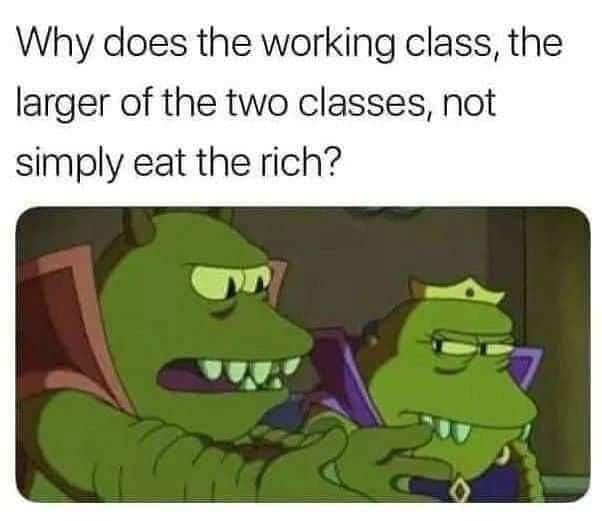
This meme is a humorous take on the concept of class struggle and the exploitation of the working class by the wealthy. The image features a cartoon character from the show "The Simpsons" in a scene where he is addressing the "class struggle" of the working class. The text above the image reads, "Why does the working class, the largest class, struggle to eat when the ruling class, the smallest class, eats the most?" This meme is a satirical commentary on the economic disparity between the working class and the wealthy.
detailed-analysis (gemma3-27b-vision)
Okay, let's break down this meme using the lenses you've requested. It's a rather complex meme combining a provocative question with a specific visual, so several of these frameworks can be applied.
Visual Description
The meme features a screen capture from the animated television series Futurama. Specifically, it depicts two members of the species known as the "Nibblonians" (a race that consumes planets). One is wearing a cape, and the other wears a crown and jeweled collar. They both have exaggeratedly smug expressions, exhibiting sharp teeth. The image is dark and moody, suggesting an air of privilege and predatory intent. The caption reads, “Why does the working class, the larger of the two classes, not simply eat the rich?”
Marxist Conflict Theory
This meme is very firmly rooted in Marxist conflict theory. The question itself, "Why does the working class… not simply eat the rich?" is a rhetorical one meant to highlight the perceived imbalance of power and wealth distribution.
* Class Struggle: The meme implicitly frames society as a site of class struggle between the “working class” (a massive group) and “the rich” (a much smaller, privileged group).
Exploitation: It suggests the working class should* “consume” the rich – this is, of course, metaphorical, but it points to an idea of reclaiming wealth or taking back what has been unfairly accumulated. It implicitly posits the rich as exploiting the labor and resources of the working class.
* Revolution: The implied call to action suggests a desire to overturn the existing socio-economic order and redistribute wealth.
The Image as Metaphor: The Nibblonians from Futurama* are a brilliant choice because they literally consume planets. This is a powerful visual metaphor for the complete devouring of the wealthy, and the implied violence makes the question stand out.
Critical Theory
The meme resonates with several tenants of Critical Theory:
* Power Dynamics: It exposes and challenges the power structures that maintain the dominance of the wealthy and the subordination of the working class. The meme questions why the larger group allows this imbalance to continue.
Ideology Critique: It implicitly critiques the ideologies that justify wealth inequality (meritocracy, trickle-down economics, etc.) by framing the question as almost absurd – as if the solution should* be obvious.
* Emancipatory Interest: The meme has an “emancipatory interest” – it asks the question from the perspective of those who are disadvantaged by the current system, suggesting a desire for liberation.
* Reflexivity: A critical theorist might also note that the meme itself is an act of challenging the dominant narrative – it's an attempt to disrupt the status quo through ironic commentary.
Foucauldian Genealogical Discourse Analysis
This is where it gets interesting. Foucault’s genealogy would analyze the historical conditions that have shaped our understanding of wealth, class, and power.
* Discourse: The meme challenges the dominant discourse around wealth and poverty. The prevailing narratives often focus on individual responsibility, market forces, or philanthropic efforts. This meme disrupts that by framing it as a matter of direct consumption, suggesting a history where such acts may have been permissible or common.
Power/Knowledge: Foucault’s concept of power/knowledge suggests that knowledge is not neutral, but always entangled with power relations. The meme calls into question how* we have come to accept such a vast disparity in wealth – what historical and cultural forces have shaped our perceptions of this imbalance?
* Genealogy of “The Rich”: A genealogical analysis would trace the historical construction of the category “the rich.” How has the definition of wealth and status changed over time? What social and political forces have contributed to the accumulation of wealth in the hands of a few?
The Absurdity: The meme’s humour arises from a deliberate absurdity. The act of eating* the rich is a violent act, but also a very simple solution – thus it becomes a vehicle for thinking about the complex historical dynamics that have resulted in wealth inequality.
Postmodernism
Postmodern theory would be relevant through its examination of meaning and representation:
* Simulacra and Simulation: The image of the Nibblonians and the provocative question create a kind of “simulation” of a revolutionary act. It’s not a literal call for cannibalism, but a symbolic representation of a desire for radical change.
* Deconstruction: The meme deconstructs traditional notions of wealth and poverty by presenting a hyperbolic and absurd solution. This challenges the assumptions that underpin the existing system.
* Irony and Parody: The use of humor and irony is central to postmodernism. The meme's playful tone masks a serious critique of power and inequality.
* Fragmented Meaning: The meme doesn't offer a clear or definitive answer. It’s open to interpretation and encourages viewers to question the prevailing narratives.
Queer Feminist Intersectional Analysis
While not the primary focus, a queer feminist intersectional analysis could also be applied.
* Interlocking Systems of Oppression: The meme implicitly acknowledges that wealth inequality is linked to other forms of oppression. The wealthy are often those who benefit from systems of patriarchy, white supremacy, and other forms of domination.
* Reclaiming Power: The act of “consuming” the rich can be interpreted as a symbolic act of reclaiming power from those who have historically oppressed marginalized groups.
* Disrupting Normative Power Structures: Queer and feminist theories challenge traditional power structures, and the meme’s radical question aligns with this impulse.
* Symbolic Violence: The violent metaphor can be seen as a way to express the frustration and anger felt by those who are marginalized and oppressed.
Let me know if you'd like me to elaborate on any of these perspectives!
simple-description (llama3.2-vision)
This meme is a humorous take on the concept of class struggle, using a popular cartoon character to illustrate the idea that the wealthy are often able to exploit the working class. The image features a quote from the TV show "The Simpsons" - "Why does the working class, and the middle class, vote for the rich and the middle-class to get rich, and not the poor to get rich?" - but replaces the name "the rich" with "the working class". The image is a still from the TV show "The Simpsons" featuring a character named "Mr. Burns" (a wealthy character) and a character named "Bart Simpson" (a working-class character) in a humorous situation.
tesseract-ocr
Why does the working class, the larger of the two classes, not simply eat the rich? fo}