First Seen
2023-05-10T21:03:33+00:00
simple-description (llama3.2-vision_11b)
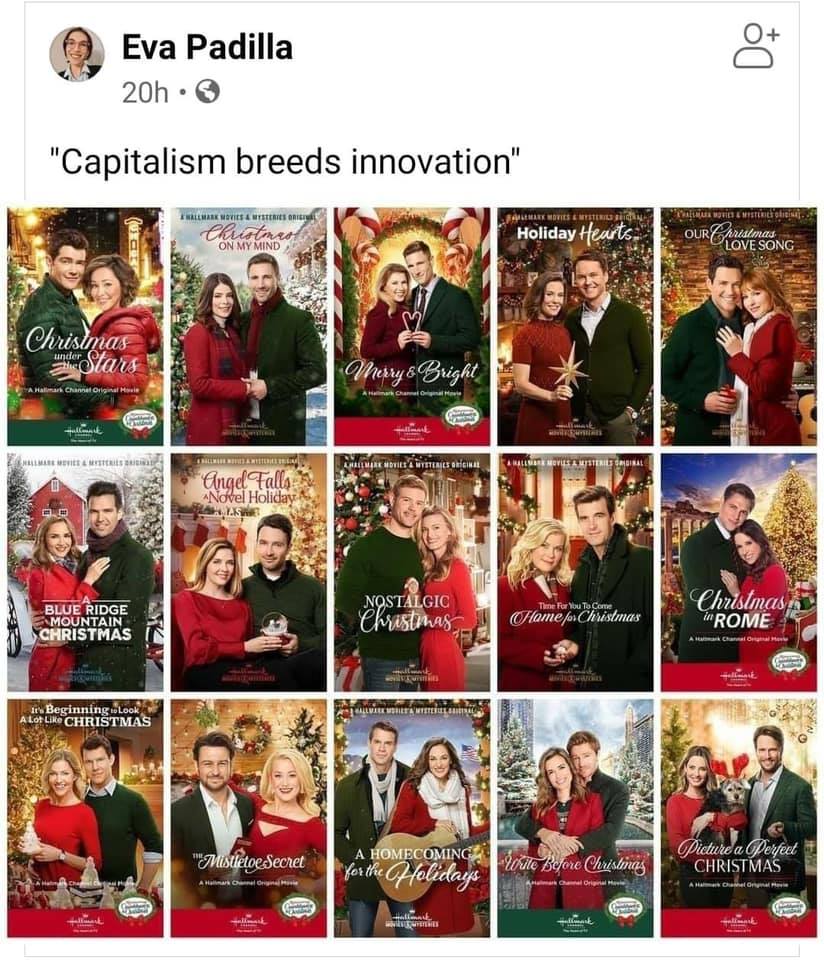
This meme is a play on the popular Hallmark Christmas movie genre, but with a twist. The text "Category context: Anti-Capitalism" suggests that the meme is critiquing the capitalist values that are often portrayed in these movies. The image shows a series of Hallmark Christmas movie covers, but with titles that are ironic and anti-capitalist, such as "The 1% Christmas" and "The Exploited Holiday".
detailed-analysis (gemma3-27b-vision)
Okay, here's an analysis of the image of the Hallmark movie posters, broken down into sections addressing the requested theoretical frameworks. I'll indicate when a framework doesn't fully apply. It's a dense image, so I'll be prioritizing key observations.
Visual Description
The image presents a grid of 16 Hallmark movie posters. All depict romantic, often heteronormative couples. The posters predominantly feature:
* Color Palette: Warm, festive tones of red, green, gold, and white. Snow is a frequent visual element.
* Setting: Small towns, cozy interiors, sometimes European locales (as seen in "Christmas in Rome"). There's a heavy emphasis on idealized, picturesque locations.
* Characters: The couples are generally attractive, white, and middle-class. There’s a consistent aesthetic of effortless charm.
* Composition: Most posters feature close-up shots of the couples, often with significant eye contact or physical touch. The imagery is meant to evoke feelings of warmth, love, and nostalgia.
* Branding: The Hallmark logo and designation ("Hallmark Movies & Mysteries Original") is prominently displayed on each poster.
The accompanying text "Capitalism breeds innovation" provides a direct statement for analysis.
Marxist Conflict Theory
This image is highly amenable to Marxist analysis.
Commodity Fetishism: These movies are products. The posters are advertising not just stories, but a carefully constructed feeling – a fantasy of romance, comfort, and traditional values. The value is not in the content itself, but in the experience* they promise. Hallmark commodifies (turns into a product) the idealized notions of love, family, and the holiday season.
* Ideology and False Consciousness: The constant reiteration of these narratives creates a hegemonic ideology. The movies reinforce conventional ideas about love, family, success, and happiness. They may inadvertently obscure the material realities of class, inequality, and the pressures of late-stage capitalism. Watching these movies creates "false consciousness" – the acceptance of the dominant ideology as natural and inevitable.
Cultural Production & Profit: Hallmark profiteers from nostalgia and the desire for emotional comfort. The sheer volume* of these movies, and the consistent marketing, highlights the drive for accumulation inherent in a capitalist system. The innovation, as the caption states, isn’t about artistic exploration but about maximizing market share.
* Class Reproduction: The settings, characters, and storylines often implicitly reinforce middle-class values. The focus on consumerism (gifts, decorations, etc.) further reinforces this.
Critical Theory
Critical Theory builds upon Marxist thought but expands its scope.
* Culture Industry: These Hallmark movies function as part of the “culture industry” (as theorized by Adorno and Horkheimer). They are mass-produced, standardized, and designed to pacify and control the audience. The movies offer a shallow form of entertainment that distracts from deeper societal problems.
Commodification of Affect: Hallmark doesn't just sell stories; it sells feelings*. The movies are expertly crafted to evoke specific emotional responses (warmth, joy, sentimentality). This is the commodification of affect—the turning of emotions into marketable products.
* Repression and Sublimation: The emphasis on conventional romance and family life can be seen as a form of repression – suppressing desires or anxieties that don’t fit the dominant norm. Watching these movies provides a safe outlet for those suppressed desires through sublimation.
* Ideological Critique: The films present a sanitized, idyllic view of life, subtly reinforcing the status quo and discouraging critical thinking about social issues.
Foucauldian Genealogical Discourse Analysis
Foucault’s method focuses on the historical development of power relations through discourse.
* Discourse of Romance: Hallmark movies construct and reinforce a specific “discourse of romance.” This discourse isn’t natural or universal; it's a historically contingent set of ideas, beliefs, and practices about love, relationships, and gender roles.
* Normalization of Heteronormativity: The consistent portrayal of heterosexual couples normalizes this relationship structure as the "default." The absence of LGBTQ+ representation (until recently) reinforces dominant power structures.
* Discipline and Surveillance: The narratives often subtly enforce social norms around courtship, marriage, and family. Characters who deviate from these norms are often portrayed as outsiders or are “corrected” to fit in.
* Genealogy of "Cozy": Examining the history of how "cozy" became a culturally valued aesthetic reveals how it's linked to notions of domesticity, femininity, and consumerism. Hallmark actively capitalizes on this "cozy" aesthetic.
Postmodernism
Postmodernism highlights the constructed nature of reality and the instability of meaning.
* Pastiche and Simulation: Hallmark movies often rely on tropes and clichés – a kind of pastiche of romantic comedy elements. They are simulations of romance, not necessarily authentic representations.
* Hyperreality: The idealized settings and characters create a hyperreality – a simulation that is more “real” than real. The films offer an escape into a world that doesn’t exist.
* Deconstruction of Narrative: While not overtly experimental, Hallmark movies deconstruct traditional romantic narratives by repeating them endlessly. The sheer volume of films diminishes the significance of any one story.
* Irony and Nostalgia: While not necessarily ironic on the surface, the constant replaying of familiar tropes can create a sense of detachment. Nostalgia becomes a commodity—a longing for a past that may never have existed.
Queer Feminist Intersectional Analysis
This framework examines power dynamics through the lenses of gender, sexuality, and intersectionality (the interconnected nature of social categorizations).
* Reinforcement of Gender Roles: The films often reinforce traditional gender roles. Women are frequently portrayed as nurturing caregivers, while men are often portrayed as providers or rescuers.
* Heteronormative Assumptions: The lack of LGBTQ+ representation perpetuates heteronormativity and marginalizes queer experiences.
* Limited Representation of Women: Women of color, disabled women, and women from other marginalized groups are severely underrepresented.
* Intersectionality of Power: The films rarely address the intersectional challenges faced by women who experience multiple forms of oppression. The focus on white, middle-class narratives obscures the experiences of women from diverse backgrounds.
I hope this breakdown is helpful! Let me know if you’d like me to elaborate on any particular aspect.
simple-description (llama3.2-vision)
This meme is a screenshot of a Facebook post from user "Eva Padilla" that reads: "Capitalism breeds innovation, but it's also responsible for a lot of terrible ideas." Below this, the user has added a caption that says "Capitalism breeds innovation" with a sarcastic tone, followed by a list of popular, yet low-quality, Christmas movies. The list includes titles like "The Christmas Tree" and "A Christmas Carol", implying that these movies are the result of capitalism's "innovation".
tesseract-ocr
a Eva Padilla ae ~~ 20h+@ "Capitalism breeds innovation" Pee ey Wer sal Bara ics es | $ iy Whaie eS anil quis 7 a f ie si i 3 : OR cam Sa “ay ) of UE ay NGO ae T oy E teers ho = Bere Tea es Be AS bbe meme (h-\ i >. eS ee ee wes A, A 5. 9 "Poets a See 4 ig oe a? WN? we \ SCT ae ese . BAPAC h eager as a aean i mae x eee ze a. @ oo é os % SS cast 4 - ye ee oe ahi econ ae aS ie Wee 4 apo 4% aq kG i+ gl ey ee. | Gy gee paw WA) eee fay (acl ; aa @ rd esti : ora ce) Per