First Seen
2023-05-10T21:03:33+00:00
simple-description (llama3.2-vision_11b)
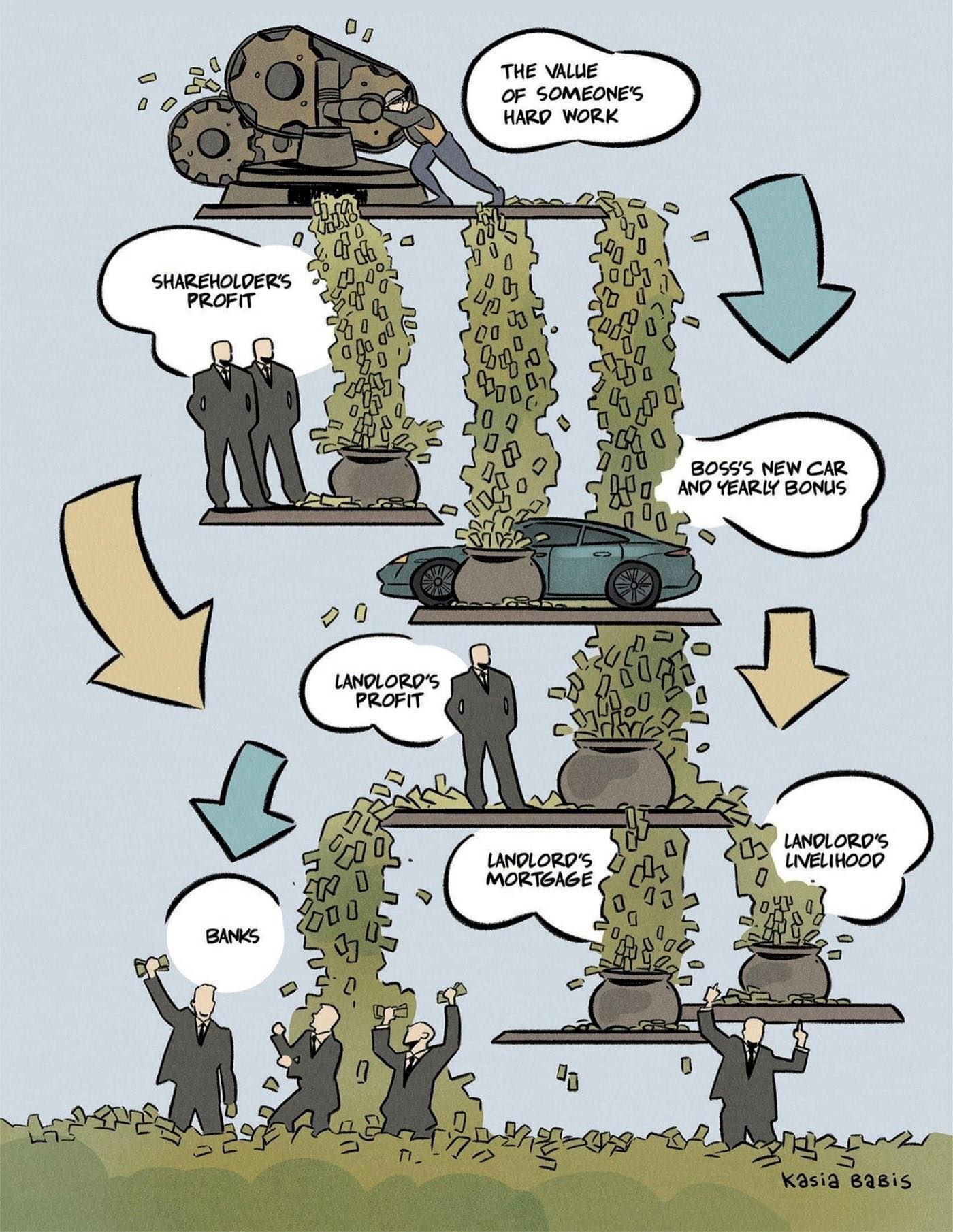
From the perspective of Anti-Capitalism, this meme critiques the exploitation of workers by corporate entities and the wealthy. The image depicts a person toiling in a factory, with a machine spewing out cash, while the owner of the factory is enjoying a luxurious car and a bonus, illustrating the unequal distribution of wealth and the exploitation of labor. The text "The value of someone's hard work" is a commentary on the capitalist system's prioritization of profit over people, highlighting the exploitation of workers and the benefits of the wealthy.
detailed-analysis (gemma3-27b-vision)
Okay, here's a breakdown of the image, analyzing it through the requested theoretical lenses. I'll include sections only where the theory feels significantly relevant.
## Visual Description
The image is a cartoon-style illustration depicting a cascading flow of money (represented by small square symbols resembling coins) originating from a large machine labeled "The Value of Someone Else's Hard Work". This machine sits atop a series of figures, each receiving a portion of the wealth before it descends to the next.
The figures are depicted as silhouetted men in suits, representing various actors in a capitalist system. The cascading money flows from the machine to a “Shareholder’s Profit,” then a “Boss’s New Car and Yearly Bonus,” then a "Landlord's Profit," "Landlord's Mortgage," and "Landlord's Livelihood" before going through the "Banks." At the very bottom, are small men in suits with their hands held up as if to receive the last trickle of money. The artwork is monochrome with a grey background. The artist's signature, "Kasia Babis," is in the lower right corner. The style is deliberately stark and schematic, reinforcing the idea of a system in operation.
---
## Marxist Conflict Theory
This image is strongly rooted in a Marxist understanding of capitalist exploitation. Here's how:
Base and Superstructure: The machine, representing labor, is the “base” – the economic foundation. All the figures and their “profits” constitute the “superstructure” – the institutions, ideologies, and power relations built upon that base. The image clearly illustrates how the product of labor is siphoned off and distributed unequally*.
* Surplus Value: The cascading money represents the extraction of "surplus value" – the difference between the value created by workers and the wages they receive. This surplus value is captured by the various actors—shareholders, bosses, landlords, banks—who do not directly engage in the labor that creates it.
* Class Struggle: The image visually represents the core of class struggle. The tiny figures at the bottom, presumably the workers whose labor powers the machine, receive only a minuscule amount of the wealth they generate. The vast majority goes to those who control the means of production (the machine) and the structures of capital (banks, landlords).
* Alienation: The faceless figures and the schematic depiction further highlight the alienation of labor within a capitalist system. The workers are reduced to mere components in a machine that profits others.
* Accumulation of Capital: The cascading money depicts the constant accumulation of capital within the system, where wealth concentrates at the top, leaving little for those at the bottom.
The image isn't merely illustrative of Marxist theory; it is a visual argument for it, highlighting the inherent inequalities of capitalism.
---
## Foucauldian Genealogical Discourse Analysis
While not as dominant as the Marxist reading, a Foucauldian perspective is valuable. The image depicts a system that is constituted by discourse and power.
Power/Knowledge: The image visually embodies the interplay of power and knowledge. The very concept of "profit", "mortgage," "shareholder value," etc. are not neutral terms, but constructs of a specific discourse that legitimizes the unequal distribution of wealth. These terms constitute* the reality they describe; they define what is considered valuable and acceptable within the system.
* Discipline & Control: The machine itself can be seen as a disciplinary device. It organizes and directs labor, enforcing certain patterns of production and extraction. This isn't necessarily about overt coercion but about the subtle and pervasive mechanisms that shape behavior.
* Genealogy of the System: A genealogical analysis would trace the historical development of the concepts and institutions depicted in the image—how notions of property, profit, and banking evolved and became normalized over time. This would reveal the contingent nature of the system, rather than its seeming inevitability.
* Normalization: The image depicts this system of wealth extraction as a normalized part of society. The depiction of the figures in suits suggests that this system is simply the way things are, and that those at the top are justified in taking their share.
---
## Postmodernism
A postmodern reading isn't as central as Marxist or Foucauldian, but elements can be noted.
Deconstruction of “Value”: The image implicitly deconstructs the notion of "value" itself. What constitutes* value in this system? Is it solely economic? The image challenges the assumption that the wealth generated by labor is distributed fairly or that it reflects the true value of that labor.
Simulacra & Simulation: The machine could be seen as a "simulacrum" – a representation that has become more real than the reality it represents. The machine doesn't create value, it simply represents* the flow of wealth, obscuring the actual labor behind it.
* Fragmentation: The cascading money and the series of figures represent a fragmented system, where each actor plays a role in extracting value, but no one has a complete understanding of the whole process.
However, the image is relatively direct in its critique, lacking the ironic playfulness or ambiguity often associated with postmodern art.
---
In conclusion: The image is a powerful and concise visual statement about the inherent inequalities of capitalism. While various theoretical lenses can be applied, a Marxist analysis provides the most compelling and complete interpretation, highlighting the extraction of surplus value, class struggle, and the alienation of labor. Foucauldian and postmodern readings offer additional insights into the role of power/knowledge and the constructed nature of value within the system.
simple-description (llama3.2-vision)
The meme is a humorous illustration of the struggle between the wealthy and the working class. It depicts a series of escalating situations, from a worker being exploited by a shareholder, to a landlord taking advantage of a tenant, to a wealthy individual (a "landlord" and a "shareholder" in one) being exploited by a "bank" that is also a "landlord". The text in the image reads "In a world where the top 1% own 50% of the wealth, the rest of us are just trying to pay rent".
tesseract-ocr
oe atf mace THE VALUE oot JE OF SOMEONE'S ° ODDS cae | a HARO WORK yy oS . ° Pr La nl A~ ee, a C) Sa Rt >. Van oma? fh 0 e. 2 yeh f ony” Hl SHAREHOLDERS en, bop Oy | oe v cles Se Some. a-\N JY mo? xy : ARDY ae LE at ( ( ons q nad “tl ae ir Sins oe gud Ce Wa Test Z = In Gh) oe 9) Ge Bosss NEW CAR ; 0 a INT ANO YEAR BONUS a 1 TG Coe = © 2 0 ee ae . LANOLORO'S i PROFIT (qa of fy, ea SYR y Bren ti oa . > (=m en ee le 0 te a) oth LANOLORO'S Gg GUY. LANOLORO’S Gi UNEHHOO? i MORTCAGE @ OFS | —_ ) y 3 Rd {0,832 of ans OF Unalee allt, = aS metic) Hus ‘ oe . e Wr i ee 4 (ts ie ke GL ae Qi q NSP g 0 Qa Y Oo nk. UL ae .n WA AN PORN op Ana ae, 1 of 2 2