First Seen
2025-07-11T20:19:28+00:00
detailed-analysis (gemma3_27b-it-q8_0)
Okay, let's break down this meme within the context of Anti-Capitalism, specifically relating to Minimum Wage, using the requested theoretical frameworks. It's a complex image, and the analysis will be layered.
Image Description
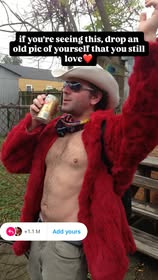
The image presents a person in a highly performative and arguably ironic outfit. They are wearing a cowboy hat, sunglasses, a flamboyant red furry coat (partially open, revealing their bare chest), a patterned scarf, and jeans. They are holding a beer and making a gesture with one hand, seeming to "throw" something. The meme text above them says, "if you're seeing this, drop a pic of yourself that you still love ❤️". The image feels deliberately "extra" and ostentatious, like a parody of a certain kind of masculine posturing. It originates from TikTok, evidenced by the interface elements (add yours prompt, like count).
Foucauldian Genealogical Discourse Analysis
From a Foucaultian perspective, this meme can be seen as a playful disruption of discourses around labor, masculinity, and self-worth as tied to productivity. Foucault's genealogy isn't about finding a single origin but tracing the historical conditions that have led to our current understanding of concepts.
- The Discourse of "Worth" & Labour: Capitalism constructs a discourse where an individual’s worth is frequently measured by their economic contribution – their labor. The "drop a pic of yourself you still love" prompt acts as a counter-discourse. It asks for self-affirmation independent of labor, of productivity, and of capitalist value. It subtly challenges the idea that we are only valuable for what we do.
- The Performance of Masculinity: The outfit itself is a performance—an exaggerated, almost mocking, display of masculinity. Foucault would analyze how power operates through the normalization of certain masculine ideals (often tied to work, strength, financial success). This meme disrupts that by presenting a masculinity that is over-the-top, playful, and arguably unproductive in the capitalist sense. It doesn't offer a 'useful' skill for the economy.
- Power/Knowledge: The meme operates through the power/knowledge relationship. The shared recognition of the meme's irony (“this is silly, but I get the point”) creates a sense of shared understanding and resistance to the dominating discourses.
Critical Theory
Critical Theory (influenced by the Frankfurt School) focuses on uncovering power structures and ideologies embedded in culture. This meme operates as a critique of the "culture industry" and the alienation it creates.
- Commodity Fetishism: The beer in the hand, the attention-grabbing outfit—these can be seen as examples of "commodity fetishism." We are encouraged to find value and identity in objects, rather than recognizing the exploitative labor that goes into producing them. The meme ironically leans into this, drawing attention to it.
- False Consciousness: Capitalism encourages "false consciousness"—the acceptance of the status quo as natural and inevitable. By asking for a picture of self-love, the meme aims to awaken a kind of self-awareness outside the dictates of economic function. It’s saying, “You are more than your job. You are more than your productivity."
- The Illusion of Freedom: Social media platforms like TikTok (where this meme originates) present themselves as spaces of freedom and self-expression. Critical Theory would argue that these platforms are also deeply implicated in capitalist structures (data collection, advertising, etc.). The meme utilizes this space to subtly undermine its inherent contradictions.
Marxist Conflict Theory
From a Marxist perspective, this meme is a micro-expression of class consciousness and the potential for resistance against capitalist exploitation.
- Alienation: The meme suggests a rejection of the alienation inherent in wage labor. Marx argued that capitalism alienates workers from their labor, from the product of their labor, from other workers, and from their own human potential. By prompting people to find value in themselves outside of work, the meme implicitly acknowledges and resists this alienation.
- Class Struggle: The prompt to share a "loved" self-image implicitly challenges the notion that self-worth is tied to economic contribution. This is a subtle form of class struggle, as it refuses to accept the capitalist definition of value.
- Ideology: The meme challenges the dominant ideology that equates work with worth. It encourages individuals to reclaim their identities and find affirmation outside the constraints of the capitalist system. It represents a fleeting moment of collective recognition of a shared experience of exploitation.
Postmodernism
Postmodernism emphasizes the deconstruction of grand narratives and the embrace of ambiguity and irony.
- Rejection of Meta-Narratives: The meme doesn't offer a solution or a clear political program. It doesn't claim to have the answer to the problems of capitalism. Instead, it's a playful, fragmented expression of discontent. It embraces irony.
- Simulacra & Hyperreality: The flamboyant outfit can be seen as a “simulacrum” – a copy without an original. It's a performance of masculinity, not genuine masculinity. The meme reflects a hyperreal world where images and simulations have become more real than reality itself.
- Deconstruction: The meme deconstructs the conventional association between self-worth and productivity. It exposes the constructed nature of those categories.
In Conclusion
This meme, while seemingly lighthearted, is a surprisingly complex cultural artifact. Within the context of Anti-Capitalism and Minimum Wage, it serves as a subtle but potent critique of the ways capitalism shapes our identities, our values, and our sense of self-worth. It’s a playful act of resistance, using irony and performance to challenge the dominant ideology and encourage self-affirmation outside the confines of the capitalist system. The power of the meme lies in its ability to spark a brief moment of collective recognition and to invite individuals to question the underlying structures that govern their lives.
Disclaimer: This analysis is based on the visual information provided and common interpretations of the theoretical frameworks. There's always room for multiple interpretations.
simple-description (llama3.2-vision_11b)
This meme is a humorous take on the idea of a "minimum wage" job, where the worker is so underpaid that they're essentially giving their employer a "free" service. The image shows a man in a red coat and a cowboy hat, holding a cup of coffee and looking rather pleased with himself. The text overlay reads "If you're seeing this, drop an old pic of yourself that you still love" - a tongue-in-cheek reference to the idea that the worker's "old" self is still a "free" service.
detailed-analysis (gemma3-27b-vision)
Okay, here's an analysis of the image, broken down into the requested sections. Given the image's content, some sections will be more applicable than others.
Visual Description
The image appears to be a screenshot of a social media post, likely Instagram or TikTok. It features a man standing outdoors, seemingly in a backyard. He is wearing a cowboy hat, a red furry coat that is open, revealing his bare chest, and a bandana around his neck. He is holding a can of beer. He is looking off to the side and appears to be in a relaxed, slightly celebratory pose. The background includes a fence, foliage, and a blurred glimpse of a house. A text overlay reads, "if you're seeing this, drop an old pic of yourself that you still love ❤️" with an area for users to "Add yours". The bottom of the screen shows a red heart emoji and the user engagement numbers of 1.1M.
Foucauldian Genealogical Discourse Analysis
This image invites us to consider the discourse of nostalgia and self-presentation online. Foucault’s genealogical approach traces the historical formation of concepts and practices. The "challenge" to share an old photo isn't simply about remembering the past. It's about constructing a particular kind of past.
- Power/Knowledge: The prompt ("drop an old pic...") exerts a subtle power, encouraging conformity to a mode of self-representation. It doesn’t ask “what is a meaningful memory?” but rather “construct an image of yourself you can still love.” Love is not a neutral state; it's shaped by cultural narratives.
- Disciplinary Practices: The 'challenge' encourages self-surveillance and self-regulation. Participants are asked to present a version of themselves that is acceptable – “loveable” – to a broader online audience. It’s a micro-example of the panoptic gaze.
- Historical Context: The current trend of ‘throwback’ or ‘nostalgia’ posts is not new. It's tied to a broader cultural anxiety about the present and a desire to create a (potentially idealized) past. This image is a piece of that broader historical trend.
Critical Theory
From a critical theory perspective, this image can be examined in terms of how it contributes to the creation and maintenance of ideology.
- Commodity Fetishism: The act of sharing the image becomes a form of cultural capital. Likes, comments, and engagement are a form of symbolic capital.
- Culture Industry: The 'challenge' is part of the broader culture industry – the production of standardized cultural goods and experiences. It encourages participation in a predictable pattern of online behavior.
- False Consciousness: The image might contribute to a 'false consciousness' by encouraging individuals to focus on personal nostalgia and self-presentation rather than critical engagement with broader social issues. It normalizes a culture of self-branding and superficiality.
Marxist Conflict Theory
A Marxist analysis focuses on the underlying power dynamics and class struggle inherent in the image. While subtle, some points can be made:
- Consumption & Display: The image displays a degree of consumption – the man’s clothing, the beer, the technology enabling the photo. This highlights the economic structures that allow for leisure and the display of wealth or status.
- Distraction: The ‘challenge’ and sharing of personal nostalgia can be seen as a distraction from larger economic and political conflicts. It reinforces a focus on individual experience rather than collective action.
- Ideological Hegemony: The romanticization of the past (implied by the prompt) can contribute to the maintenance of dominant ideologies. By focusing on idealized memories, it avoids critical examination of past injustices.
Postmodernism
The image encapsulates several key postmodern concepts:
- Simulacra & Simulation: The ‘old photo’ itself is already a simulation of a past moment. The act of sharing it online further distances it from its original context, creating a hyperreality. The image becomes more about the representation of the past than the past itself.
- Fragmentation & Pastiche: The man’s attire (cowboy hat, red coat, bandana) is a pastiche of different styles, creating a fragmented and ironic image. It’s a deconstruction of traditional notions of identity.
- Deconstruction of Meaning: The prompt is open to interpretation. What constitutes a photo “you still love?” The ambiguity and lack of a fixed meaning are hallmarks of postmodern thought.
Queer Feminist Intersectional Analysis
While the image doesn't explicitly address queer or feminist issues, some considerations can be made:
- Performance of Masculinity: The man's attire and pose can be analyzed as a performance of masculinity. The cowboy hat and open coat may symbolize hyper-masculinity.
- Gaze and Objectification: Even though the man is the subject of the image, the implicit expectation of sharing personal photos can contribute to the broader culture of surveillance and objectification, particularly for women and other marginalized groups.
- Intersectional Considerations: The image lacks diversity and the context needed to understand how race, class, and other social categories intersect to shape the experiences represented.
It's important to note that these analyses are interpretations based on the image and the theoretical frameworks. Different interpretations are possible, and the meaning of the image is always context-dependent.
simple-description (llama3.2-vision)
This meme is a screenshot of a TikTok video featuring a shirtless man in a red fur coat, cowboy hat, and sunglasses, holding a beer. The text overlaid on the image reads: "If you're seeing this, drop an old pic of yourself that you still love". The image is likely a humorous reference to a popular TikTok trend where users share old, often embarrassing, photos of themselves.