First Seen
2025-07-11T20:19:30+00:00
simple-description (qwen3.5_2b-q8_0)
This meme uses the concept of "minimum wage" to satirize the feeling of having a job for free, where you are essentially earning zero dollars because everything—like rent or bills—is taken care of for you by others. In the context of this image, the people appear relaxed and unburdened by the necessity of work; the space is open and airy, suggesting that they can sit and enjoy their environment without contributing anything financially. The text on the far left wall reads "CAFE" and "OPEN 24H," reinforcing the idea that a coffee shop provides this "free service" so cheaply that its inhabitants are effectively getting paid to live in it.
detailed-analysis (gemma3_27b-it-q8_0)
Here's an analysis of the image through the lens of the "Anti-Capitalism - Minimum Wage" category, broken down into relevant sections. Keep in mind that interpreting an image as a "meme" without accompanying text requires a degree of inference. We'll be working with the assumption that the image is being used to convey a message about minimum wage and/or capitalism.
Visual Description
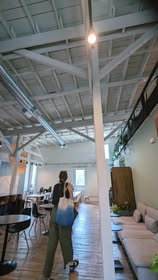
The image depicts a large, brightly lit, and sparsely populated space. It appears to be a modern, loft-style interior—perhaps a co-working space, a gallery, or a high-end cafe. There's a high ceiling with visible structural beams and industrial lighting. The furniture is a mix of modern designs - sleek chairs, a long, comfortable-looking couch, and small tables. A person is walking through the space, carrying a tote bag. The overall aesthetic is clean, minimalist, and suggests a certain degree of affluence. The space is airy and spacious.
Marxist Conflict Theory
This image powerfully evokes the structural inequalities inherent in capitalism. The aesthetic of the space—high ceilings, modern design, spaciousness—immediately suggests a context of economic privilege. It's a space designed for those who have disposable income, those who can afford to work remotely, or engage in "creative" professions that often lack traditional worker protections.
- Class Distinction: The person walking through the space feels out of place. They are carrying a tote bag, suggesting they may be a worker. Their presence in this space, juxtaposed with the high-end design, highlights the class divide. They are in the space, but not of the space. This disparity is emblematic of the distance between the working class and the bourgeoisie in a capitalist system.
- Surplus Value: The very existence of this space represents extracted surplus value. The money to build and maintain it comes from labor. It represents a material manifestation of profit generated from the exploitation of workers.
- Alienation: The spaciousness and lack of human interaction can also be interpreted as a form of alienation. Capitalism promotes individual competition and isolates workers, even in ostensibly “social” spaces. The vastness of the room further emphasizes the individual's relative powerlessness within the larger economic structure.
- Wage Labor: The implied activity of the person – carrying a bag that could contain work materials – subtly draws attention to the necessity of wage labor to access even basic spaces like these. The minimum wage debate centers on whether that wage provides enough access to any meaningful part of the social/economic landscape.
Critical Theory
The image lends itself to a critical theory interpretation focused on the commodification of space and experience.
- Commodification of Space: The loft-style space isn't simply for use; it's a commodity itself. It's designed to appeal to a particular demographic (those who can afford it) and is marketed as a lifestyle. This commodification extends beyond the physical space to encompass the experiences and social interactions that occur within it.
- False Consciousness: The design of the space, with its apparent openness and relaxed atmosphere, could be seen as contributing to a “false consciousness.” It can mask the underlying power dynamics and exploitation that make such a space possible. It presents a vision of modern work/life that is unavailable to many.
- Ideology: The space itself is an ideological statement. It reinforces the values of consumerism, individualism, and meritocracy, implying that success (and access to spaces like this) is attainable for all, when it is, in fact, predicated on systemic inequalities.
Postmodernism
From a Postmodern perspective, the image highlights the constructed nature of reality and the breakdown of grand narratives.
- Simulacra and Simulation: The space can be seen as a simulacrum – a copy without an original. It’s a curated environment that simulates creativity, community, and modern work, but lacks genuine substance.
- Deconstruction of Work/Life Balance: The blurring of lines between work and leisure in spaces like this deconstructs traditional notions of work/life balance. It implies that work should be integrated into all aspects of life, further reinforcing capitalist values.
- Fragmentation: The image is visually fragmented, with its focus on architectural elements and the single figure walking through the space. This fragmentation reflects the fragmented experience of modern life under late capitalism.
Foucauldian Genealogical Discourse Analysis
A Foucauldian analysis would focus on the power dynamics embedded within the design and function of the space.
- Discipline and Surveillance: While appearing open, the space subtly implies systems of discipline and surveillance. The clean lines and minimalist design create a controlled environment. The positioning of furniture and the overall layout likely encourage certain behaviors and discourage others.
- Normalization: The space normalizes a particular lifestyle—one of flexibility, entrepreneurship, and constant self-improvement—that is only accessible to a select few. This normalization serves to marginalize those who do not fit this ideal.
- Power/Knowledge: The space embodies the power/knowledge nexus. Those who create and control spaces like this (architects, developers, investors) wield power through their ability to shape the environment and, consequently, the behaviors and perceptions of those who inhabit it.
In conclusion, this image, when analyzed through the lens of anti-capitalism and minimum wage, becomes a potent symbol of economic inequality, alienation, and the commodification of modern life. It speaks to the ways in which capitalism creates and reinforces hierarchies and how its underlying structures remain largely invisible, masked by aesthetically pleasing spaces and the illusion of opportunity.
simple-description (llama3.2-vision_11b)
The meme is a humorous image of a person standing in a large, empty space with a sign that reads "Minimum Wage" in the background. The person is standing in a room that appears to be a warehouse or a large space, with a sign that says "Minimum Wage" in the background. The image is likely meant to be humorous and satirical, commenting on the idea that even in a large, empty space, the minimum wage is still not enough to get by.
detailed-analysis (gemma3-27b-vision)
Okay, here’s an analysis of the image, broken down into sections as requested. I'll indicate where a section doesn't quite apply or is limited due to the nature of a single image.
Visual Description
The image depicts a large, open-plan interior space, likely a repurposed industrial building or loft. The defining feature is the exposed structural ceiling comprised of a network of white metal beams and bracing. The floor is made of dark, aged wood planks, adding to the industrial aesthetic. The lighting appears to be a combination of natural light coming through windows (out of frame) and a central, bright light fixture hanging from the ceiling.
Within the space, there is sparse but deliberate furniture arrangement. A long, cream-colored sectional sofa sits along one wall, and small, minimalist tables with chairs are scattered throughout. A person with their back turned is seen walking through the space, carrying a bag.
The color palette is relatively muted, with whites, grays, and wood tones dominating. The space appears clean and well-maintained, but retains a raw, unfinished quality. It gives the impression of a multi-purpose space, possibly a co-working area, community center, or art gallery.
Foucauldian Genealogical Discourse Analysis
The space itself is a discourse – a physical manifestation of power/knowledge relationships. The architectural choice of exposing the structural elements (beams, pipes) rather than concealing them is significant. It speaks to a valorization of "authenticity", "industry", and "openness" that emerged in the late 20th/early 21st century. Historically, industrial spaces were often hidden from view, associated with labor and often unpleasant conditions. Revealing this infrastructure is a discursive move; it aestheticizes labor and re-brands it as "cool" or "creative."
The sparse furniture and open layout reflect a shift in how spaces are used and controlled. Traditional offices or institutions utilized furniture and layout to define power hierarchies. This space, with its flexible arrangement, seems designed to de-center authority and promote collaboration, or at least the appearance of it.
The person walking through the space is subject to this discourse. Their movement is shaped by the layout, and they are positioned within the network of power/knowledge embodied by the space. We can ask: What discourses are they carrying? What do their clothes, bag, and posture signal?
Critical Theory
From a Critical Theory perspective, the space can be viewed as an example of a “white cube” aesthetic – even with the industrial characteristics. It evokes a particular type of neutrality and rationalization. The simplification of the space and lack of ornamentation contributes to a sense of detachment and abstraction. The "openness" is not necessarily liberating but can be a form of control, creating an environment where individual expression is implicitly encouraged but also constantly monitored.
The space’s association with “creative” industries raises questions about the commodification of culture. The aesthetic values promoted – rawness, authenticity, collaboration – are often used to market products and services.
Marxist Conflict Theory
From a Marxist viewpoint, the space is symptomatic of a broader shift towards post-industrial capitalism. The repurposing of a former industrial building highlights the transition from manufacturing to service and knowledge-based economies. The aestheticization of industrial infrastructure can be seen as a way to obscure the exploitation and alienation that continue to exist in these new forms of production.
The space may serve as a workplace for "creative class" workers who are often subject to precarious employment conditions and limited economic security. The "open" layout, while appearing egalitarian, can also contribute to increased surveillance and control of labor.
Postmodernism
The space embodies several characteristics of Postmodern aesthetics. There's a clear embrace of pastiche – combining industrial elements with minimalist furniture. The deliberate exposure of structural elements is a deconstruction of traditional architectural conventions. The space resists a single, coherent style, embracing a mix of materials and influences.
The openness and lack of clear definition reflects a postmodern rejection of grand narratives and fixed meanings. The space is intentionally ambiguous, allowing for multiple interpretations and uses.
Queer Feminist Intersectional Analysis
This section is limited given the lack of specific subjects/details in the image, but we can consider the following:
The "open" and "flexible" space could be seen as intentionally designed to break down traditional norms of interaction. A lack of clearly defined boundaries can be liberating for individuals who do not fit neatly into dominant social categories. However, it's important to note that openness doesn't automatically equate to inclusivity. The lack of visual cues about access, safety, or diverse representation raises questions about whether the space truly welcomes all bodies and experiences.
The aesthetic of industrial chic can also be seen as a form of appropriation. The space often overlooks the history of labor and the contributions of marginalized groups who were historically excluded from these environments. Intersectional analysis would necessitate examining who benefits from the aesthetic and who is marginalized by it.
Let me know if you'd like me to expand on any of these sections or focus on a specific aspect of the image.
simple-description (llama3.2-vision)
The meme is an image of a person walking into a room, but the image is intentionally blurry and out of focus. The text "I'm not late, I'm just in a different dimension" is superimposed over the image, implying that the person is indeed late, but just in a different dimension or reality. The image is meant to be humorous and relatable, especially for those who often experience the "I'm not late, I'm just" phenomenon.