First Seen
2025-07-11T20:19:28+00:00
detailed-analysis (gemma3_27b-it-q8_0)
Okay, let's break down this image through the lens of Anti-Capitalism, specifically in relation to the issue of minimum wage, utilizing the requested theoretical frameworks.
Image Description
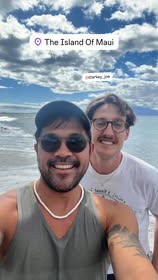
The image depicts two men, seemingly on vacation in Maui, Hawaii. The man in the foreground, taking the selfie, is wearing sunglasses, a tank top, and a pearl necklace. He appears affluent and relaxed. The man behind him is smiling, wearing glasses and a t-shirt. Behind them is a beautiful, expansive ocean view. The location tag explicitly states "The Island of Maui." Notably, the user's name is "turkey_joe," which may carry ironic connotations, hinting at a commentary on privileged and perhaps unaware tourists.
Critical Theory
This image can be interpreted through Critical Theory as an illustration of the commodification of experience and the reproduction of social inequality. Critical Theory examines how societal power structures – often tied to capitalism – create and maintain dominant ideologies that serve the interests of those in power.
- Commodification of Experience: The vacation to Maui is not simply a leisure activity but is bought and sold. It’s a commodity that reinforces a lifestyle available only to those with disposable income. The very act of taking a selfie performs this experience for consumption on social media, further commodifying it.
- Reproduction of Social Inequality: The ability to afford a trip to Maui, a notoriously expensive location, points to a significant economic disparity. This vacation exists because of a system (capitalism) that generates wealth for some while simultaneously rendering others unable to afford even basic necessities. The visible joy of the two men is juxtaposed against the implied labor of the workers on the island who are facilitating their luxury, likely working for low wages. This emphasizes the inherent imbalance within the system.
Marxist Conflict Theory
From a Marxist perspective, this image represents the exploitation of labor that underpins the enjoyment of the privileged class. The beautiful backdrop of Maui isn't just a scenic vista; it's a location where labor is extensively used – hospitality workers, maintenance crews, service providers – often paid minimum wage or less.
- Bourgeoisie vs. Proletariat: The two men in the image can be seen as representing the bourgeoisie (the owning class) enjoying the fruits of the labor of the proletariat (the working class). Their leisure is directly enabled by the labor of those who are likely struggling to make ends meet.
- Surplus Value: The profit generated from tourism in Maui (and elsewhere) represents surplus value – the difference between the value workers produce and the wages they receive. This surplus value is accumulated by the owners of hotels, businesses, and land, allowing them to maintain and expand their wealth, while the workers remain relatively impoverished.
- Alienation: The workers whose labor facilitates this vacation are likely alienated from the fruits of their labor. They don't benefit from the pleasure and luxury experienced by the tourists. This alienation is a core concept in Marxist thought.
Foucauldian Genealogical Discourse Analysis
Foucault's work focuses on how power operates through discourse – the ways we talk and think about things. Here, the image can be analyzed in terms of how capitalism naturalizes inequality.
- Power/Knowledge: The discourse around tourism often frames it as a "right" or a deserved reward. This normalization obscures the power imbalances that make it possible. The image itself contributes to this discourse by presenting the vacation as an unproblematic, natural experience.
- Genealogy of the Minimum Wage: Looking historically, the concept of a minimum wage arose as a response to the exploitative conditions of industrial capitalism. However, it's often been kept at levels insufficient to provide a decent living wage. This image highlights the gap between the "acceptable" wage (the minimum) and the resources needed to participate in experiences like this Maui vacation.
- Discipline & Biopower: The constant pressure to work for low wages can be seen as a form of discipline, controlling and shaping the bodies and lives of workers. The contrast with the leisurely bodies of the vacationers underscores this control.
Postmodernism
From a postmodern perspective, the image can be seen as a simulacrum – a copy without an original. The "authenticity" of the Hawaiian experience is mediated through social media and tourism, becoming a hyperreality divorced from its original context.
- Hyperreality: The idyllic scene is presented as a desirable lifestyle, a perfect vacation. But this is a constructed reality, often ignoring the economic and social complexities of the island. The image performs the idea of a perfect vacation, rather than representing an actual lived experience.
- Deconstruction of "The Dream": The image implicitly questions the "American Dream" of upward mobility and leisure. It reveals how access to such experiences is often determined by existing wealth and privilege, not individual effort.
Intersectionality
It's important to note that, without further information, we cannot assess intersectional elements, like the race of the workers who serve the tourists. However, the history of Hawaii and its colonization by Western powers is deeply intertwined with racial and economic exploitation. Often, the individuals in low-wage positions are Indigenous Hawaiians and Pacific Islanders, whose land and resources have been exploited for the benefit of outsiders.
In Conclusion
The image, while seemingly innocuous, is loaded with meaning when viewed through the lens of anti-capitalist theory. It serves as a visual reminder of the power dynamics inherent in our economic system and the ways in which privilege is sustained through the exploitation of labor and the commodification of experience. The "simple" act of posting a vacation selfie becomes a potent symbol of social and economic inequality.
simple-description (llama3.2-vision_11b)
The meme features a screenshot of a Google Maps location, "The Island of Maui", with a red marker indicating a specific location. The image is overlaid with a caption, "Minimum wage is a thing of the past" and a "1" rating, implying that the location is a place where one can find a job with a low salary.
detailed-analysis (gemma3-27b-vision)
Okay, here's an analysis of the image broken down into sections, utilizing the theoretical frameworks requested. Some sections will be more applicable than others.
1. Visual Description
The image appears to be a selfie taken outdoors, likely on a beach in Maui, Hawaii as indicated by the location tag. Two men are the focus.
- Foreground: A man with dark hair and beard, wearing sunglasses, a sleeveless green shirt, and a white beaded necklace. He has visible tattoos on his upper arm. He is smiling broadly and looking directly at the camera.
- Background: Another man is positioned slightly behind and to the right of the first man. He has lighter hair, glasses, and is wearing a white t-shirt. He is also smiling, but his expression is less prominent.
- Setting: The backdrop is a body of water (likely the ocean) with a cloudy sky. The scene gives a sense of warmth and leisure.
- Overall Impression: The image evokes a casual, vacation atmosphere and suggests a friendly relationship between the two men.
2. Postmodernism
Postmodern thought finds meaning in the breakdown of grand narratives and the celebration of fragmentation and individual experience.
- Self-Representation: The selfie format itself is a key component of postmodern self-construction. The image is not a "realistic" portrait but a carefully curated presentation of self to an online audience. It's about performing identity.
- Simulacra and Simulation: The image can be viewed as a simulation of a 'good time' or 'happiness' for an online audience. The beach, the smiles, and the carefree attire all contribute to a constructed reality.
- Breaking Down Boundaries: The image, by potentially showcasing a same-sex couple or simply two men in a close, friendly relationship, challenges traditional representations of masculinity and relationships. The location tag 'The Island of Maui' adds to the image's constructed and idealized world.
3. Queer Feminist Intersectional Analysis
This framework considers how gender, sexuality, and other social categories (like race/ethnicity) intersect to create unique experiences of power and oppression.
- Challenging Normative Masculinity: The image subtly challenges the traditional performance of masculinity, which often prioritizes stoicism and strength. The men are smiling, enjoying a leisure activity, and displaying physical closeness, which are not always associated with traditional masculine roles.
- Visibility and Representation: The image contributes to increased visibility of diverse relationships and challenges heteronormative assumptions about couples.
- Intersectionality and Power Dynamics: While the image doesn't immediately reveal information about race, ethnicity, or class, it's important to acknowledge that these factors would influence the experience and meaning behind the image. The location (Hawaii) is also important, given its history of colonialism and cultural appropriation.
4. Marxist Conflict Theory
This section is a bit less directly applicable, but it can be approached as follows:
- Consumer Culture and Leisure: The image depicts a scene of leisure and consumption – a vacation to a desirable location. This can be interpreted as a symptom of capitalist society, where leisure is commodified and access to it is determined by economic status.
- Symbolic Capital: The ability to travel to Hawaii and document it on social media can be seen as a form of symbolic capital – demonstrating status, access, and a certain lifestyle.
- Alienation: Ironically, while the image depicts happiness and connection, it is also mediated by technology and the desire for social validation. This can be seen as a form of alienation – a disconnect from authentic experience.
Important Notes:
- Limited Information: This analysis is based solely on the image and the limited information it provides. A deeper understanding would require additional context.
- Multiple Interpretations: These theoretical frameworks are tools for analysis, and there are always multiple valid interpretations.
- Avoid Essentializing: It's important to avoid making assumptions about the men or their identities based solely on this image.
Let me know if you'd like me to elaborate on any of these sections or explore other theoretical perspectives.
simple-description (llama3.2-vision)
The meme features two men, one with a mustache and a tank top, and the other with a beard and a white shirt. The image is a screen capture of a location on a mapping app, with a red pin marking the "Island of Maui" and a "Dude, I'm here" message. The image is likely a humorous way to share a location or a joke about being on a vacation.