First Seen
2026-04-21T05:33:00+00:00
simple-description (qwen3.5_2b-q8_0)
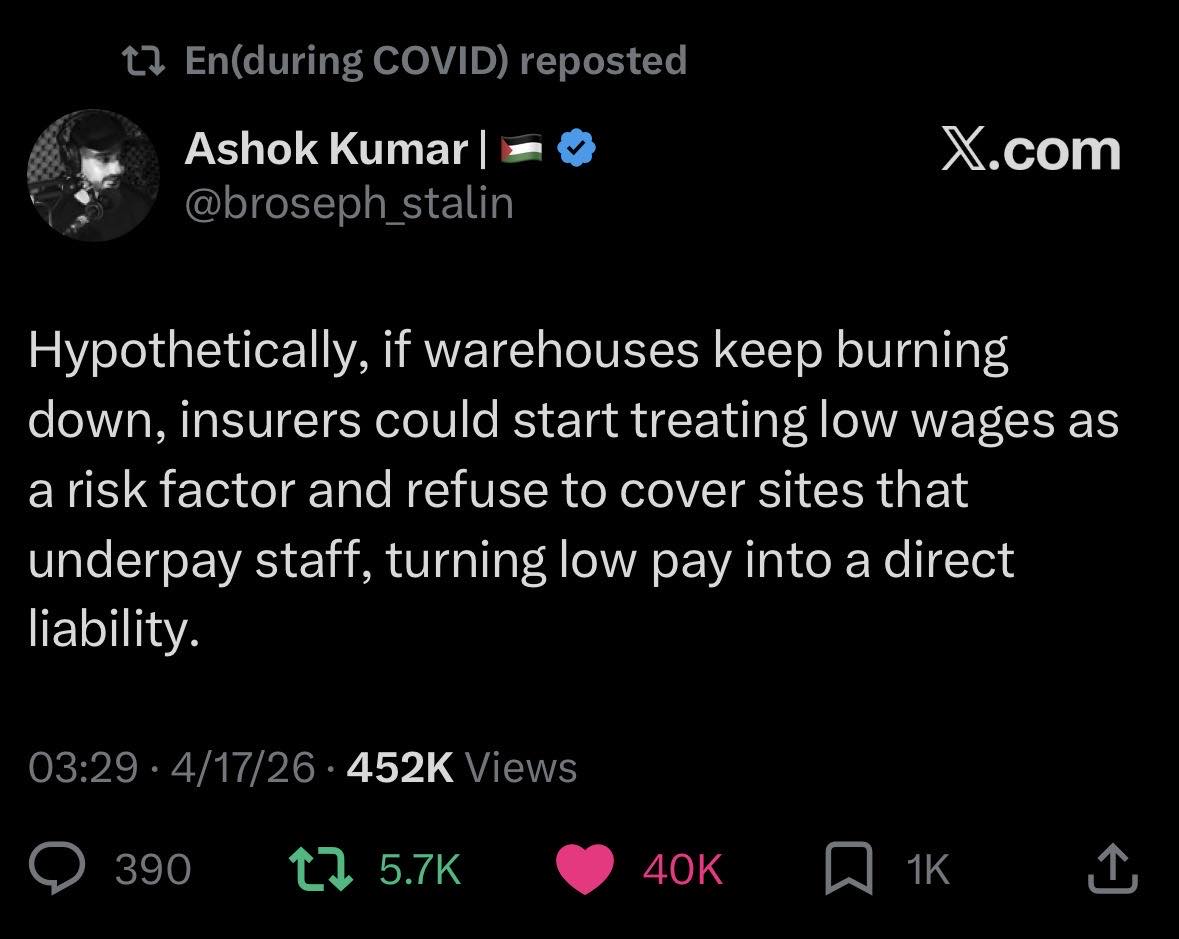
This dark joke suggests that current capitalist owners might treat high-risk labor as a financial liability by refusing to cover workers if they pay them too little. The punchline implies that businesses could legally "underpay" staff just to avoid lawsuits and ensure the warehouses stay burning, effectively making low wages a direct source of business cost.
detailed-analysis (gemma3_27b-it-q8_0)
Okay, let's break down this X (formerly Twitter) post from @broseph_stalin through the lens of Anti-Capitalism - Jobs, utilizing relevant theoretical frameworks where applicable.
Visual Description
The post is a simple text-based post on X. It features the user's profile picture (a black and white image), their username (@broseph_stalin), a blue verification checkmark, and the post itself. Below the post are standard social media engagement metrics: likes, reposts, comments, and views. The aesthetic is typical of X/Twitter: concise, direct, and meant for quick consumption. The simplicity reinforces the directness of the argument.
Marxist Conflict Theory
This post is highly rooted in Marxist Conflict Theory. Here's how:
- Exploitation and Class Struggle: The core argument centers on the exploitation of labor. Low wages, in a Marxist understanding, represent the extraction of surplus value from workers – the difference between the value a worker produces and the wages they receive. The post highlights that this systemic underpayment isn’t just an ethical issue, but a material risk to the capitalist enterprise.
- Capital’s Internal Contradictions: Marxist theory suggests capitalism contains internal contradictions that will ultimately lead to its downfall. The post points to one such contradiction: the drive to maximize profit through wage suppression creates conditions (worker dissatisfaction, potential negligence, or even deliberate acts) that increase risk and ultimately threaten the profitability of the system. The system is literally burning itself up because of its inherent need for more profit.
- The State & Insurance as Tools of Capital: The mention of insurance companies refusing coverage if sites underpay staff implies that even seemingly neutral institutions (insurance) operate within the capitalist framework and can be used to reinforce its logic. This is not about safety, but about maintaining capital. The insurers, operating as capitalistic entities, would respond to risk by shifting the costs of that risk back onto the employer – specifically, the employer's exploitative wage practices.
- Alienation: The underlying implication is that low-wage workers are alienated from their labor and the production process. This alienation can manifest in various ways, potentially leading to increased risk of accidents or, as the post darkly suggests, even intentional acts of disruption.
Critical Theory
This post aligns with Critical Theory, particularly the Frankfurt School's critique of instrumental reason:
- Instrumental Rationality: The post critiques the narrow, instrumental rationality of capitalism, where everything is reduced to cost-benefit analysis. The idea that wages can be treated as a “risk factor” demonstrates this. The well-being of workers is not valued for its own sake but only insofar as it impacts the bottom line.
- Domination and Power Relations: The post exposes the power dynamics inherent in the employer-employee relationship. The employer has the power to suppress wages, and this power creates a situation where workers are vulnerable to exploitation and risk.
- Critique of Systemic Logic: Critical Theory aims to analyze and critique the systemic forces that shape society. The post does this by exposing the logic of capitalism, which incentivizes cost-cutting measures that ultimately undermine the stability of the system itself.
Foucauldian Genealogical Discourse Analysis
A Foucauldian reading can reveal how the discourse surrounding "risk" is being co-opted to further discipline workers and manage capital.
- Power/Knowledge: Foucault argued that power and knowledge are inextricably linked. This post reveals how the concept of "risk" becomes a tool of power – a way to categorize, monitor, and control workers. By framing low wages as a risk factor, insurance companies (and potentially other institutions) gain the power to dictate labor practices.
- Discipline and Biopolitics: While the post doesn't directly address discipline, it hints at biopolitical control. Biopolitics refers to the ways in which states and institutions regulate life. Treating wages as a risk factor is a form of regulating workers' lives – a way of managing the "risk" of their labor.
- Genealogy of Risk: One could analyze the historical development of the concept of "risk" within the capitalist system. Originally, risk might have referred to physical hazards. But the post shows how "risk" is being extended to include social and economic factors, and specifically to the cost of exploiting labor.
In Conclusion:
The X post is a pointed commentary on the exploitative nature of capitalism. It argues that the relentless pursuit of profit, through wage suppression, is not sustainable and will ultimately lead to increased risk and instability. It utilizes a darkly humorous hypothetical to expose the contradictions within the capitalist system. The underlying message is a call to challenge the power structures that allow for the exploitation of labor and to recognize that workers’ well-being is not merely a matter of ethical concern but a fundamental requirement for a stable and just society.
Disclaimer: The interpretations provided are based on the text and the theoretical frameworks mentioned. Different interpretations are possible, and the author's intended meaning may vary.
simple-description (llama3.2-vision_11b)
The image features a tweet from Ashok Kumar, with the text: "Hypothetically, if warehouses keep burning down, insurers could start treating low wages as a risk factor and refuse to cover sites that underpay staff, turning low pay into a direct liability."
Key Points:
- The tweet suggests a hypothetical scenario where warehouses' frequent burning down leads to insurers viewing low wages as a risk factor.
- Insurers may refuse to cover sites that underpay staff, making low pay a direct liability.
- The tweet is likely intended to comment on the treatment of warehouse workers and the potential consequences of their low wages.