First Seen
2023-09-12T05:26:47+00:00
simple-description (llama3.2-vision_11b)
The meme is an image of a cartoon character, Idris Elba as He's Dead Jim, with a caption "I'd rather die than work for a living". The meme is a commentary on the idea that many people feel trapped in their jobs and would rather die than continue to work for a living. The image is a humorous way to express the frustration and desperation that many people feel about their jobs.
detailed-analysis (gemma3-27b-vision)
Okay, let's break down this meme through various theoretical lenses. It's a layered image, ripe for analysis. Here's a section-by-section look, hitting the theoretical frameworks where relevant.
Visual Description
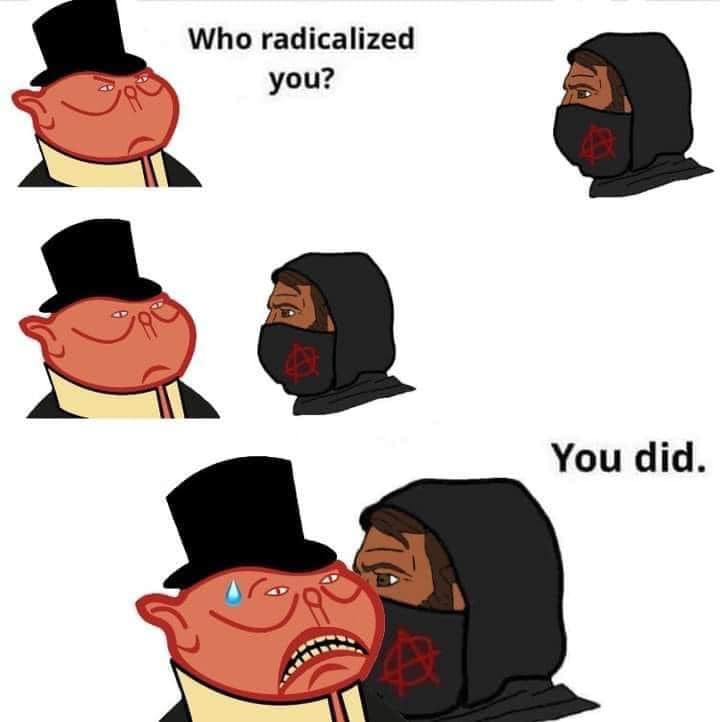
The image is a three-panel meme constructed from simple, cartoonish drawings in a digitally edited style. It’s a variation of the “Who radicalized you?” format.
- Panel 1: A red-skinned cartoon man wearing a top hat looks inquisitively at a figure in black clothing and a face mask, their eyes visible.
- Panel 2: A close-up of the same two figures, with the masked individual seemingly maintaining a neutral gaze.
- Panel 3: An extreme close-up of the red-skinned man, now visibly distressed with tears in their eyes, as the masked figure replies, “You did.”
The masked figure has an anarchist 'A' emblem on the mask.
Foucauldian Genealogical Discourse Analysis
This meme is very ripe for a Foucauldian reading. The dialogue "Who radicalized you?" immediately points to the production of subjectivity. The question implies that 'radicalization' is an external process, something done to someone. However, the answer, "You did," throws this externalization into question.
- Discourse & Power/Knowledge: The question itself is an act of power/knowledge. It seeks to identify a source of deviance, to categorize and control. The assumption that radicalization happens to someone reinforces the idea that there is a “normal” state from which one can deviate.
- Genealogy: A genealogical approach wouldn't ask who radicalized someone, but how the very concepts of ‘radicalization’ and ‘normality’ came to be constructed. The meme subtly subverts the question by turning it inward. The red man's distress suggests he's identified with the “normal” and is disturbed by the realization of his own hand in his “radicalization”. It shows how he may have internalized the structures of the status quo.
- Subjectivation: The final panel shows the subject's distress as they recognize a truth about themselves – their complicity in the system, their capacity for disruption. This recognition is a moment of subjectivation, where the subject is constituted through power relations.
Critical Theory
This meme participates in a broader critique of power structures.
- Ideology: The question "Who radicalized you?" is an ideological one. It frames 'radicalization' as a negative thing, something to be attributed to an external influence. The meme challenges this framing by suggesting that the source of ‘radicalization’ is internal and inherent to the system itself.
- Frankfurt School Influence: The meme echoes themes of the Frankfurt School, specifically the idea that domination is often reproduced through culture and through the seemingly innocuous questioning of behavior. It asks the viewer to question the presuppositions of the original question.
- Critique of Reason/Enlightenment: The top-hatted figure visually connects to Enlightenment ideals. The meme can be read as a critique of Enlightenment rationality itself. The question assumes a rational subject seeking to understand external forces, while the answer reveals the subject’s own role in the systems they attempt to dissect.
Marxist Conflict Theory
While less direct than the other frameworks, a Marxist reading is possible.
- Class Consciousness: The top-hatted figure can be seen as representing a dominant class—someone comfortable with the status quo, asking why another has dared to challenge it. The masked figure represents a challenge to that dominance.
- Ideological Struggle: The meme embodies an ideological struggle, a clash between differing worldviews. The questioner wants to identify the source of dissent, while the answer reveals the inherent contradictions within the system itself.
- Alienation: The red man’s distress and tears could be interpreted as a form of alienation. He's realizing that the structures he believed in (or benefited from) have contributed to the conditions that led to his own "radicalization”.
Postmodernism
This meme is perfectly suited for a postmodern analysis.
- Deconstruction: The meme deconstructs the very idea of ‘radicalization.’ It challenges the binary opposition between 'radical' and 'normal' by blurring the lines and revealing the interconnectedness of both.
- Simulation & Hyperreality: The meme’s cartoonish style and simplified dialogue contribute to a sense of simulation. The question and answer are divorced from any concrete reality and exist purely as signs, creating a hyperreal representation of political discourse.
- Death of the Author/Subject: The meme’s anonymity and reliance on a pre-existing format contribute to the “death of the author”. The meaning of the image isn’t fixed by the creator but is constructed by the viewer through their own interpretation.
In summary, the meme is a surprisingly dense and multi-layered piece of internet culture. It engages with questions of power, ideology, subjectivity, and the very nature of political discourse. The different theoretical frameworks offer distinct but complementary ways of understanding its meaning and significance.
Let me know if you would like me to elaborate on any specific aspect of this analysis.
simple-description (llama3.2-vision)
The meme is a humorous exchange between two characters. The first character asks "Who radicalized you?" and the second character responds with "I was radicalized by the Illuminati". The second character then says "You did." The meme is a play on the idea that the second character's answer is a non-sequitur, implying that the first character is somehow responsible for the second character's radicalization.
tesseract-ocr
SZ. > ee on oe a a) aA S O -_