First Seen
2023-05-10T21:03:33+00:00
simple-description (llama3.2-vision_11b)
The meme is a humorous take on a job interview scenario. The text on the image reads: "During my interview today I was asked 'Where do you see yourself in five years?' I replied 'In the middle of the boss's desk, destroying his laptop'". This is an anti-capitalist joke, as it pokes fun at the idea of a job interview, which is often a stressful and formal process, and subverts the expectation of a typical answer to the question. The joke is also a commentary on the corporate culture of job interviews and the expectations of a job candidate.
detailed-analysis (gemma3-27b-vision)
Okay, let's break down this seemingly simple Twitter post through the lens of several theoretical frameworks.
Visual Description
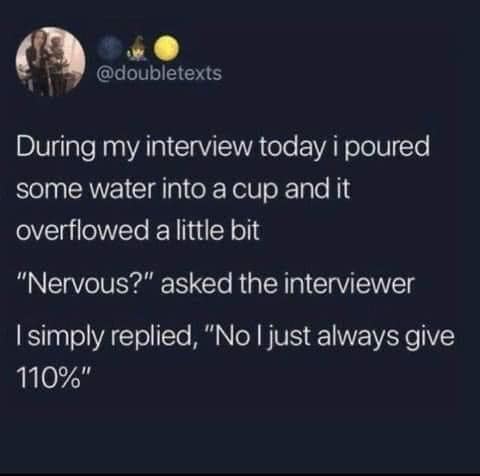
The image is a screenshot of a Twitter post from the user @doubletexts. It features a plain black background with white text. The text details a scenario in a job interview: the applicant purposefully overfilled a cup with water, and when asked if they were nervous, responded with "No I just always give 110%." The profile picture of @doubletexts is a black and white silhouette of a person. The image's impact relies on the concise narrative and the unexpected response, highlighting a mismatch between expectation and performance.
Foucauldian Genealogical Discourse Analysis
This scenario is ripe for a Foucauldian analysis. The "interview" is a site of power/knowledge. The interviewer holds the power to assess and categorize the applicant, creating a discourse around “suitable” candidates. The act of pouring water and overflowing it can be seen as a disruption of this expected performance of "professionalism" and "calmness".
The applicant's response, “No I just always give 110%”, is a masterclass in counter-discourse. It appropriates the language of corporate "go-getter" culture. But by taking the cliché to its illogical extreme, the applicant highlights the absurdity of expecting constant, unbounded effort. It's not about true effort, but the performance of effort.
The whole scene can be seen as a mini-genealogy of the "overachiever" archetype, revealing how expectations around work ethic have become intensified and performative, rather than genuinely reflective of productivity. Foucault would likely be interested in how the applicant's response decenters the interviewer's authority by refusing to play the expected game.
Critical Theory
From a Critical Theory perspective, the post illuminates the ways in which seemingly mundane interactions (job interviews) reinforce systems of domination. The interviewer’s question (“Nervous?”) isn’t just about the applicant's emotional state; it's about gauging their conformity to expected behavior.
The applicant’s response is a subtle act of resistance. While appearing to agree with the demands of the system (the "go-getter" ethos), they expose its irrationality. It's a refusal to be integrated into the smooth functioning of the capitalist work machine.
This post, therefore, can be seen as a critique of instrumental rationality – the idea that everything is measured by its utility and efficiency. The applicant’s "110%" mocks the absurdity of expecting constant, limitless output.
Postmodernism
The post embodies several key elements of Postmodern thought. It is meta – it's a story about performance within a performance (the interview). The applicant is deliberately playing with simulacra - creating a sign (the overflowing cup, the 110% response) that has no original referent, but rather reflects the simulacrum of professionalism itself.
The disruption of expectation is crucial. Postmodernism rejects grand narratives and universal truths. The applicant's response doesn’t offer a “true” explanation but a parodic one – it mocks the clichés of self-presentation. It questions the very idea of “authentic” self-expression within the constraints of a job interview. The meaning becomes destabilized, and the audience is left to question the nature of sincerity and performance.
Please Note: While this Twitter post is a fairly simple scenario, the frameworks above allow for a rich and multi-layered interpretation. It's a great example of how theoretical lenses can expose hidden power dynamics and social meanings.
simple-description (llama3.2-vision)
This meme is a humorous take on a job interview. The text reads: "In my interview today I was asked 'Where do you see yourself in five years?' I said 'In the attic of a remote cabin, living off the grid and avoiding the inevitable 'where do you see yourself in five years?' conversation that I just had." The image is likely a screenshot of a social media post, with the text displayed in a simple, modern font. The tone is lighthearted and self-deprecating, poking fun at the common interview question and the absurdity of the answer.
tesseract-ocr
(% rx A @doubletexts During my interview today i poured some water into a cup and it overflowed a little bit “Nervous?” asked the interviewer | simply replied, “No | just always give 110%"