First Seen
2023-05-10T21:03:33+00:00
simple-description (llama3.2-vision_11b)
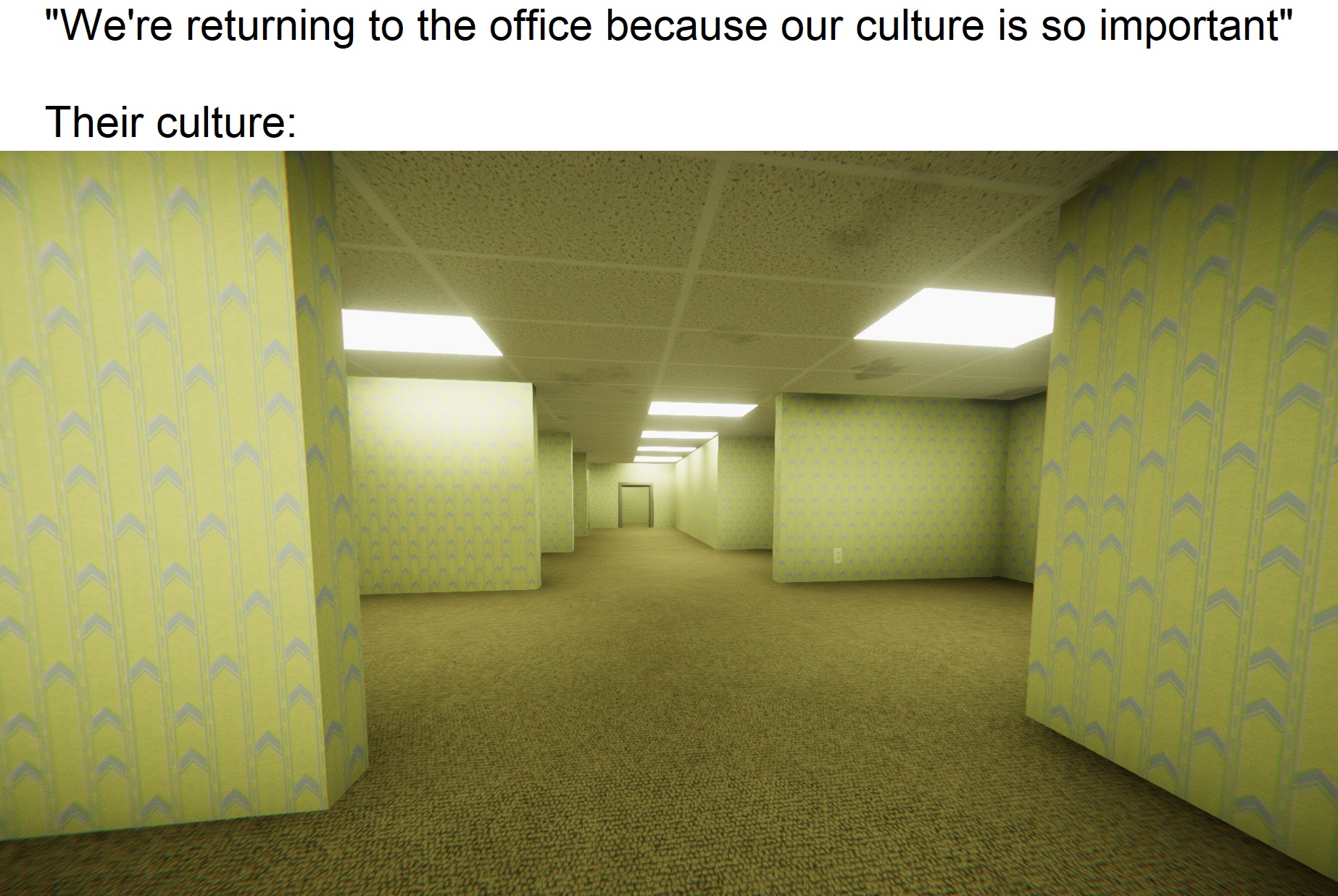
The meme is a play on the common phrase "we're returning to the office because our culture is so important" and how it's often used as a justification for forcing employees to return to a physical workplace. The image depicts a desolate, empty office space, implying that the company's culture is not actually important, but rather a way to justify making employees work in a physically demanding environment. The text at the top reads, "We're returning to the office because our culture is so important," and the text at the bottom reads, "Their culture: empty office".
detailed-analysis (gemma3-27b-vision)
Okay, let's break down this image and the phrase "We're returning to the office because our culture is so important" through the requested theoretical lenses.
Visual Description
The image depicts a long, claustrophobic hallway with a distinctly unsettling aesthetic. The color palette is overwhelmingly pale yellow/green, giving it a sickly, almost institutional feel. The walls are patterned with a geometric design, which, when repeated endlessly, becomes disorienting and oppressive. There are regularly spaced, identical rectangular structures (likely pillars or doorways) receding into the distance, creating an infinite loop effect. The lighting is fluorescent and harsh, casting deep shadows that amplify the sense of isolation. The perspective is wide-angle, contributing to a distorted and uncanny view. The space is entirely empty, devoid of people or objects, further enhancing the feeling of alienation and sterility. The overall impression is one of uniformity, repetition, and a subtle but palpable sense of dread.
Foucauldian Genealogical Discourse Analysis
This image, paired with the statement, is perfect fodder for Foucault. The hallway is a panoptic space. Though there’s no central guard tower visible, the infinite repetition of identical structures creates a feeling of being potentially observed at any point. Discipline doesn't necessarily require a physical enforcer; it is built into the architecture itself. The "culture" cited as the reason for returning is likely the set of norms, values, and practices that produce docile bodies (bodies that are easily controlled and regulated).
The genealogy would trace how this "culture" has evolved - how specific practices, technologies, and discourses have come to define what's acceptable and desirable in the workplace. The statement isn't about genuine shared values; it’s about the exercise of power through the production of a shared subjectivity. The return to the office isn’t for productivity or collaboration; it’s to reassert control over bodies and re-establish the disciplinary mechanisms that were loosened during remote work. The identical structures aren't about efficient work spaces, but the normalization of a system that forces individuals to conform.
Critical Theory
From a Critical Theory perspective (drawing from thinkers like Adorno & Horkheimer), this image embodies the “instrumental rationality” of late capitalism. The hallway represents a space where everything is designed for efficiency and control, stripped of individuality or aesthetic meaning. The “culture” cited is a smokescreen for the economic imperatives driving the return to the office—increased surveillance, maximized output, and the suppression of worker autonomy.
The image highlights the reification of work—where human beings are treated as mere means to an end (profit). The sterile, inhuman environment and the focus on “culture” as justification for this system contribute to the alienation of workers. The repetitive, oppressive nature of the space reflects the repetitive, alienating nature of many modern jobs.
Marxist Conflict Theory
From a Marxist viewpoint, the image depicts the physical manifestation of class relations. The hallway represents the workplace, a site of exploitation where the labor of workers is extracted for the benefit of capital. The statement “our culture is so important” is a form of false consciousness – an ideology used by the ruling class to mask the true nature of exploitation and convince workers to accept their subjugation.
The identical structures symbolize the homogenization of labor—the reduction of workers to interchangeable units in a production process. The return to the office isn't about culture; it's about increasing control over the workforce and maximizing profits. The empty space suggests the dehumanization of workers, who are seen as mere tools for production, stripped of their individuality and agency.
Postmodernism
A postmodern reading would focus on the image’s deconstruction of meaning and its simulation of reality. The hallway is a simulacrum – a copy without an original. It doesn't represent a functional space; it represents the idea of a workplace, divorced from any genuine purpose or authenticity.
The “culture” cited is a pastiche – a meaningless collection of tropes and values used to create the illusion of community and belonging. The image highlights the loss of grand narratives and the fragmentation of meaning in a postmodern world. There is no underlying truth or authenticity to the “culture” – it is merely a construct used to maintain power and control. The repetitive nature of the space underscores the sense of endless, meaningless repetition that characterizes many aspects of modern life.
In summary: This image, when combined with the statement, is a powerful visual metaphor for the oppressive and dehumanizing aspects of modern work. It offers a rich site for applying a range of critical theoretical frameworks, highlighting the power dynamics, ideological manipulations, and loss of meaning that characterize contemporary capitalist society.
simple-description (llama3.2-vision)
This meme is a humorous take on the common phrase "we're going to return to the office because our culture is so important." The image depicts a desolate, abandoned office building, implying that the company's culture is so unimportant that it's been abandoned. The text "We're going back to the office because our culture is so important" is written above the image, with the words "Their culture" written below, implying that the company's culture is actually non-existent.
tesseract-ocr
"We're returning to the office because our culture is so important" Their culture: Ps P| A aA , \ Y | \ lia hh, eA A ryt | Az —— yA la” ie. Pe eS lal A WR AIA |.