First Seen
2023-05-10T21:03:33+00:00
simple-description (llama3.2-vision_11b)
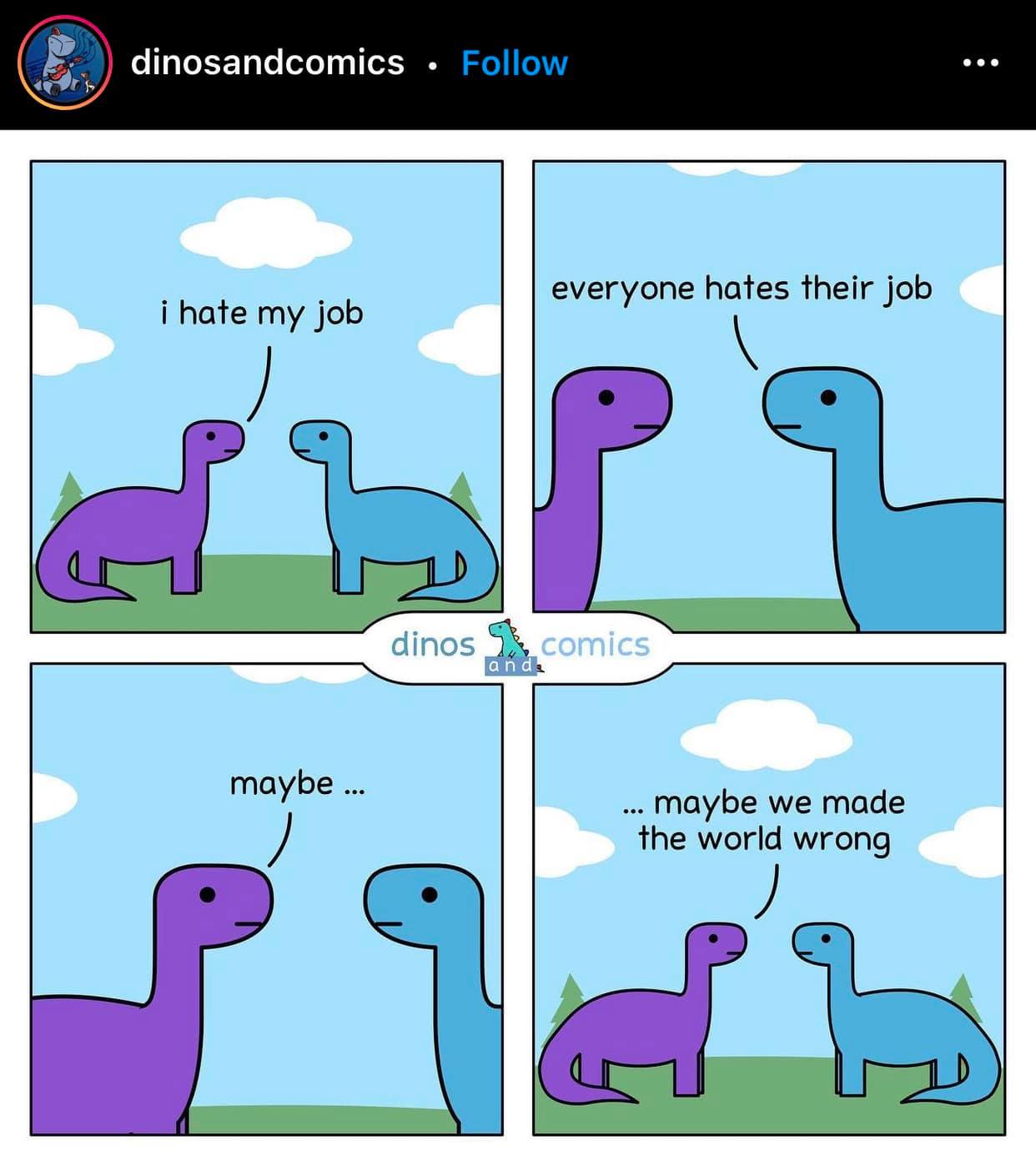
This meme is a humorous take on the struggles of working in a capitalist society. The image features two dinosaurs, one expressing disdain for their job, while the other is oblivious to the problems of the world. The text "I hate my job" is juxtaposed with the response "Everyone hates their job" and the final line "Maybe we made the world wrong" is a commentary on the societal norms of modern capitalism.
detailed-analysis (gemma3-27b-vision)
Okay, let's break down this four-panel comic, "dinos and comics" using the frameworks you requested. I'll include sections only where the framework actively applies – some of these are stretches, and I'll note where that's the case.
Visual Description
The comic is a minimalist, digitally drawn illustration featuring two long-necked dinosaurs (brachiosaurs, likely) standing in a simple, flat, light blue landscape with sparse green "hills." The color palette is limited and soft. Each panel shows the two dinosaurs side-by-side. Text is used as thought bubbles or direct speech attributed to the dinosaurs. The style is cartoonish and focuses on conveying emotion through simple shapes and limited detail. The progression of the panels builds on the dinosaurs’ conversation, starting with individual frustration, moving to collective recognition, and ending with a provocative question.
Foucauldian Genealogical Discourse Analysis
This comic provides a fascinating entry point for a Foucauldian reading. The initial statement, "I hate my job," isn't just personal frustration; it’s a discourse about labor, value, and subjective experience. This personal statement quickly expands to "everyone hates their job," highlighting the normalization of dissatisfaction as a ubiquitous aspect of the modern condition.
The shift in the final two panels, from individual and collective discontent to "maybe we made the world wrong," is the crux of the Foucauldian insight. This suggests the dissatisfaction isn’t simply a problem within the system of work, but a problem of the system itself. It hints at the historical construction of this reality – the 'world' wasn't always this way. This comic suggests that the current experience of labor (alienation, dissatisfaction) is produced by specific power/knowledge regimes. It implies a historical genealogy of work, where the values and structures that cause this universal dissatisfaction were not inevitable but made. It invites questioning the historical forces that have shaped our current conditions of work.
Critical Theory
The comic lends itself strongly to a Critical Theory lens. It’s a clear example of how everyday experiences (dislike of work) can be used to reveal deeper systemic problems. The progression of the thought bubbles illustrates a movement from individual alienation to a collective realization of the problem. This is a classic move in critical theory – to move beyond individual symptoms to identify underlying structures of domination.
The final panel presents a potent question challenging the fundamental assumptions underpinning the current social order. This is a hallmark of critical theory, which seeks to question and expose the power structures that maintain the status quo. The dinosaurs’ statement isn’t simply a complaint; it's a refusal to accept the existing world as natural or inevitable. It implicitly asks, “Who made the world this way, and how can we change it?”
Marxist Conflict Theory
The comic can be interpreted through a Marxist lens, although it’s somewhat subtle. The "job" the dinosaurs dislike represents alienated labor – the worker being separated from the product of their labor, their creativity, and their self-realization. This is a central concept in Marxist thought. The initial complaint ("I hate my job") highlights the inherent contradiction between the worker’s potential and the exploitative conditions of work.
The expansion to "everyone hates their job" can be seen as highlighting the systemic nature of this alienation, showing it’s not just an individual problem but a consequence of the capitalist mode of production. The final panel, with the dinosaurs questioning if "we made the world wrong," implies that the current state of affairs is not natural or inevitable but a result of historical choices and power structures – an implicit critique of the ruling class and their role in shaping the world for their own benefit. It invites a consideration of the need for collective action to restructure society and overcome the alienation inherent in capitalism.
Postmodernism
This is the most tenuous connection, but a postmodern reading is possible. The questioning of the "world" itself in the final panel can be seen as a rejection of grand narratives or universal truths. The dinosaurs aren't offering a solution or a new system; they are simply questioning the foundational assumptions of the existing one. This embrace of questioning and rejection of fixed meaning aligns with some aspects of postmodern thought. Additionally, the simplistic visual style and limited narrative could be seen as a deliberate deconstruction of traditional storytelling.
Queer Feminist Intersectional Analysis
While not immediately apparent, a queer feminist intersectional reading can be applied. The shared experience of dissatisfaction (the "job") could be read as a shared site of oppression, analogous to the ways various marginalized groups experience systemic injustices. The fact that everyone hates their job implies a universality of struggle, but that doesn’t erase the fact that experiences of labor are also deeply shaped by gender, race, class, sexuality, and other identity markers.
The questioning of "the world" opens up space to imagine alternative ways of organizing society that are more equitable and inclusive. The suggestion that "we made the world wrong" can be seen as a call for collective responsibility to dismantle oppressive systems and create a world where all beings can thrive, regardless of their identity.
Let me know if you’d like me to delve deeper into any of these analyses!
simple-description (llama3.2-vision)
This meme is a simple comic strip featuring two dinosaurs. The first panel shows a blue dinosaur saying "I hate my job," and a purple dinosaur responding "Everyone hates their job." The second panel shows the blue dinosaur saying "Maybe," and the purple dinosaur responding "Maybe we made the world wrong."
tesseract-ocr
4eOr i hate my job everyone hates their job 4 ) 4Y | : — dinos 5. — ... Maybe we made the world wrong (is? ) | \ “| { \ y , ’ J ed Ua