First Seen
2023-05-10T21:03:33+00:00
simple-description (llama3.2-vision_11b)
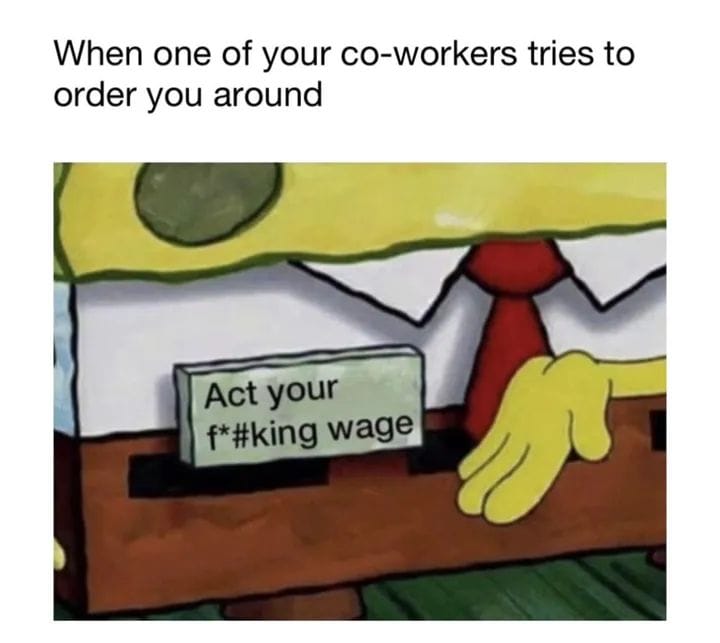
This meme is a satirical commentary on the exploitation of workers in the service industry. The image depicts a character from the popular cartoon "SpongeBob SquarePants" (SpongeBob) with a sign that reads "Act your f***ing wage" (a play on "act your age") in a restaurant setting. The text is a humorous and sarcastic response to the expectation that workers will perform a task without compensation, highlighting the absurdity of being asked to do something without being paid for it.
detailed-analysis (gemma3-27b-vision)
Okay, here's an analysis of the image, broken down into sections based on the requested theoretical frameworks. I'll only include sections where the framework genuinely applies.
Visual Description
The image is a screen capture from the animated television show SpongeBob SquarePants. It depicts Squidward Tentacles, an octopus character, peering over a makeshift cardboard barricade. On the barricade is written (with masking tape) the phrase "Act your fking wage". Squidward’s expression is one of discontent and resistance, a mix of exhaustion and defiance. His body language is defensive, hands raised as if creating a barrier. The overall tone is humorous, but it carries a strong undercurrent of frustration and labor-related discontent. The use of a SpongeBob character is ironic, given the show's generally lighthearted nature, and emphasizes the relatable annoyance of workplace dynamics.
Foucauldian Genealogical Discourse Analysis
This meme lends itself well to a Foucauldian reading. The phrase "Act your wage" directly invokes the discourse of work and compensation. Michel Foucault's concept of power/knowledge is central here. The very idea that one's behavior should be aligned with one’s compensation—that one is expected to perform a certain way (be "grateful," "positive," "productive") because they are being paid—is a manifestation of power. It's not simply about a monetary exchange; it's about the normalization of certain expectations and the subtle (and sometimes not-so-subtle) disciplining of labor.
A genealogical approach would investigate how this expectation arose. How did the idea of "acting your wage" become part of workplace culture? What historical and social forces led to the expectation that workers should not only perform labor but also manage their emotions and behaviors to conform to employer expectations? The barricade and Squidward’s posture represent a resistance to this disciplinary power, a refusal to participate in the expected performance. The meme suggests a breaking point where the worker rejects the imposition of power/knowledge.
Marxist Conflict Theory
The meme is deeply rooted in Marxist conflict theory. The core principle of this theory is that society is characterized by class struggle—the conflict between those who own the means of production (the bourgeoisie) and those who sell their labor (the proletariat). "Acting your wage" speaks to the exploitation of labor inherent in capitalism.
The phrase implies that workers are not just being paid for the actual work they perform, but also for their emotional labor—the effort required to manage one’s feelings and display socially acceptable emotions during interactions at work. This represents an increased demand on the worker without increased compensation. It’s a way to extract more value from the worker, masking exploitation with the expectation of “professionalism” or “positive attitude.”
Squidward’s barricade signifies a symbolic refusal to participate in this exploitative system. He's drawing a line, rejecting the demand for emotional labor in addition to his regular duties. The meme taps into the frustration of workers who feel undervalued and used, highlighting the inherent power imbalance in the employer-employee relationship.
Postmodernism
While not the most dominant theoretical lens, a postmodern reading can highlight the breakdown of traditional workplace hierarchies and expectations. The meme's humor arises from the subversion of these norms. Postmodernism emphasizes the deconstruction of grand narratives and fixed meanings. The phrase "Act your wage" can be seen as a challenge to the traditional narrative of "the happy worker" or the "professional employee."
It's a rejection of the idea that there’s a single “correct” way to behave at work. The ironic use of a cartoon character further contributes to the postmodern sensibility—blending high and low culture, and questioning the authenticity of workplace performances.
Queer Feminist Intersectional Analysis
This is a more subtle layer, but potentially present. The expectation to "act your wage" can disproportionately impact marginalized workers. For individuals who don't conform to dominant norms around gender expression, race, or other social categories, the pressure to perform a certain way at work (e.g., "be agreeable," "be a team player") can be especially burdensome. It can require a constant effort to code-switch or mask aspects of their identity to avoid discrimination or microaggressions.
The "wage" then isn’t just monetary; it’s also about the emotional and psychological toll of suppressing one's authentic self to navigate a hostile or unwelcoming workplace. The barricade can be read as an act of self-preservation, a refusal to further expend emotional energy on maintaining a facade to appease those in power. This relates to intersectionality, as the experience of needing to "act" is compounded by multiple marginalized identities.
Let me know if you would like me to elaborate on any of these sections!
simple-description (llama3.2-vision)
This meme is a humorous take on a common workplace scenario. It features a cartoon character, SpongeBob SquarePants, with a sign that reads "When one of your coworkers tries to order you around" and a second sign that says "Act your f***ing wage". The image is a play on the idea that someone is trying to tell someone else what to do, but the person being told is being sarcastic and uncooperative.
tesseract-ocr
When one of your co-workers tries to order you around ( ——— | Act your ; f#king wage