First Seen
2026-01-08T16:06:12.511756+00:00
simple-description (qwen3.5_2b-q8_0)
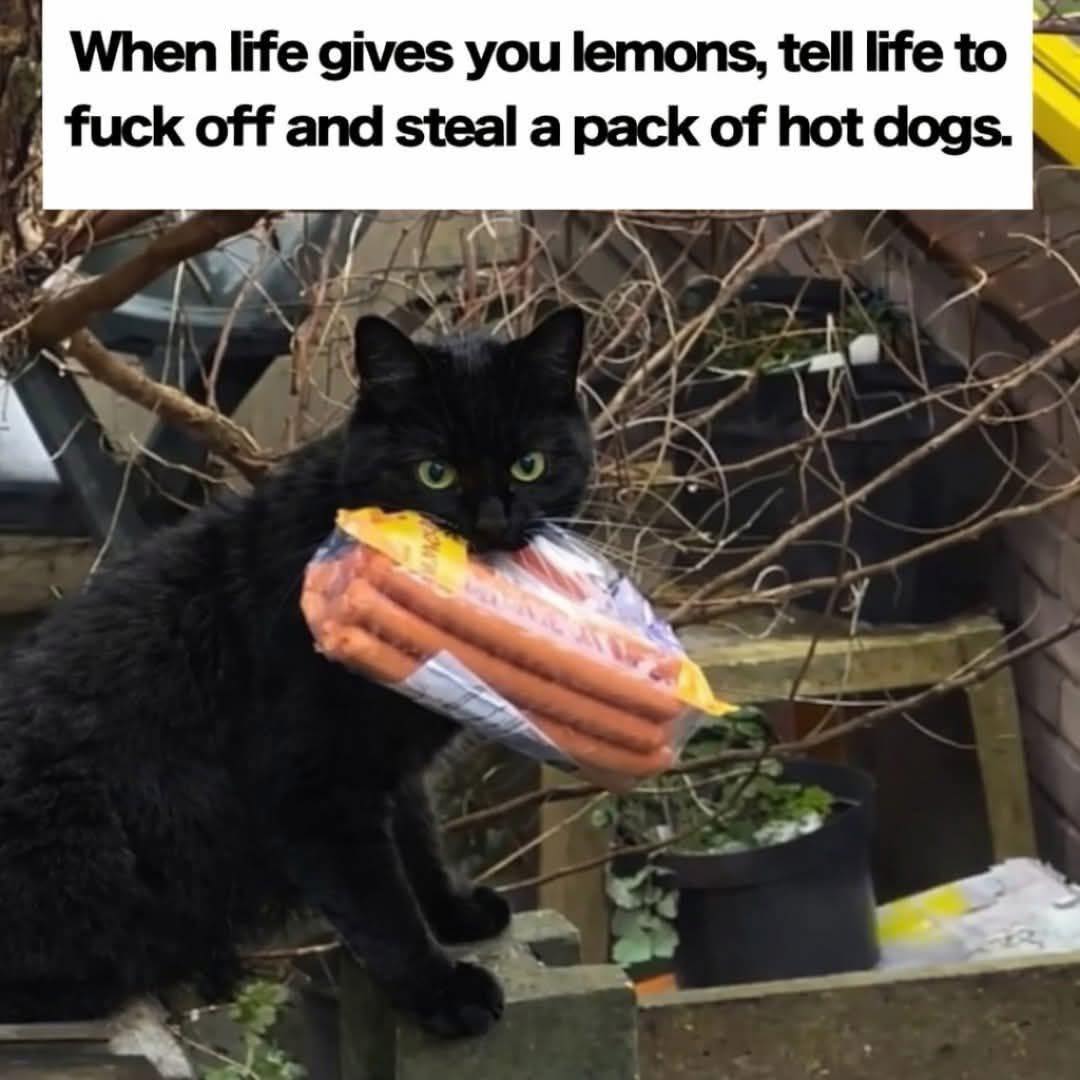
The caption reads: "When life gives you lemons, tell life to fuck off and steal a pack of hot dogs." In an anti-capitalist context, this joke implies that when economic hardship is forced upon you—represented by the "lemon" situation—the solution isn't to suffer in silence but to immediately grab whatever commercial food is available. The meme visualizes this rebellion as the cat aggressively taking a packaged good like a pack of hot dogs from the shelf, suggesting that one should just take what is being sold to everyone and enjoy it without complaint. It turns the standard advice about bad luck into a literal theft, implying that when life gives you nothing but struggle, you should just grab store-bought treats and live defiantly rather than waiting for what comes your way.
detailed-analysis (gemma3_27b-it-q8_0)
Okay, let's dissect this meme through the lens of Anti-Capitalism – Food.
Visual Description
The meme features a close-up image of a black cat clinging to a wooden structure (possibly a fence or railing) with a package of hot dogs firmly gripped in its jaws. The cat stares directly at the viewer with wide, determined eyes. The background is slightly blurred, showing foliage and other outdoor elements. The text overlay reads: "When life gives you lemons, tell it to f*ck off and steal a pack of hot dogs.” The meme’s aesthetic is a bit rough and casual – a quickly captured, “found” image. The image suggests determination and a rebellious spirit.
Marxist Conflict Theory
This meme is fundamentally rooted in a Marxist critique of capitalist systems, albeit in a humorous and condensed form.
- The “Lemons” as Exploitation: The "lemons" represent the hardships, the unfairness, and the systemic disadvantages imposed by capitalism. These could be low wages, precarious employment, lack of access to resources, or general alienation. Capitalism, under this view, gives us these lemons—it produces these conditions as a consequence of its inherent logic of profit maximization.
- Refusal of the Narrative: The traditional idiom, "When life gives you lemons, make lemonade," implies acceptance of and adaptation within the system. The meme rejects this. It doesn’t suggest making something “productive” or palatable from the adversity, but actively rebelling against the source of the adversity. The cat isn't asking for permission; it's taking what it needs.
- The Hot Dogs as Necessities: Hot dogs, within the context of anti-capitalist food discussion, can be viewed as a symbol of basic sustenance. They represent a readily available, if not particularly healthy, food source. Stealing them is a rejection of the requirement to pay for something fundamental to survival. The act subverts the logic of commodity exchange.
- Class Struggle: The cat, acting on instinct (or, anthropomorphically, on revolutionary principle), embodies a form of direct action against the capitalist order. It's a small-scale demonstration of resisting the constraints imposed by a system that prioritizes profit over people's basic needs.
- Alienation: This meme is a way to cope with alienation and powerlessness. Capitalist systems leave most people feeling as though their needs are not being met. The meme suggests that there is no reason to play by the rules of this system when the system does not play fair.
Critical Theory
Drawing on critical theory, we can see the meme challenging the dominant ideology that justifies the capitalist system.
- Deconstructing Ideology: The phrase "make lemonade" is a common piece of ideological conditioning. It reinforces the belief that individual effort and positive thinking are sufficient to overcome systemic problems. The meme’s rejection of this sentiment exposes the inadequacy of such a narrative in the face of profound inequality.
- Critique of Rationality: Capitalism relies on a notion of rational economic behavior, where individuals are expected to pursue their self-interest within the rules of the market. The cat's act of stealing is irrational from a capitalist perspective. It doesn’t operate on the logic of exchange or legal ownership; it's driven by a more basic need for sustenance. This irrationality challenges the foundations of capitalist rationality.
- Resistance as Expression: The meme is a form of cultural resistance. It's a way to express dissatisfaction with the system without necessarily engaging in direct political activism. It's a symbolic act that resonates with those who feel alienated and disenfranchised.
Postmodernism
While less central than the Marxist or Critical Theory angles, postmodern thought can inform our understanding of this meme.
- Rejection of Grand Narratives: The traditional narrative of “working hard and achieving success” is a grand narrative that capitalism relies on. The meme subverts this narrative by suggesting that sometimes, circumventing the system is necessary and even justifiable.
- Playfulness and Irony: The meme's humor and the unexpected image of a cat stealing hot dogs introduce an element of playfulness and irony. This challenges the seriousness and authority of dominant ideologies.
- Subjective Truth: The meme suggests that the "truth" of the situation isn’t about following rules or "playing fair," but about surviving and meeting one's basic needs. The cat’s action is a self-referential truth that exists outside of the established framework.
In conclusion: This meme, while lighthearted, is a potent expression of anti-capitalist sentiment. It uses humor and a relatable image to challenge the foundations of the capitalist system, offering a symbolic act of rebellion against a system perceived as exploitative and unjust. It’s a visual representation of choosing survival and need over adherence to a broken system.
simple-description (llama3.2-vision_11b)
This meme is a humorous commentary on the idea that when life gives you lemons, you should make something more than just a simple lemon-based product. The image features a cat holding a hot dog, with the text "When life gives you lemons, tell life to f**k off and steal a pack of hot dogs" above it. The meme is a satirical take on the classic "when life gives you lemons" phrase, with a humorous and irreverent twist.