First Seen
2024-10-20T01:59:38.188011+00:00
detailed-analysis (gemma3_27b-it-q8_0)
Okay, let's break down this meme from a primarily anti-capitalist perspective focusing on food, utilizing the requested theoretical frameworks where applicable.
Meme Breakdown: Cuban Grocery Store & Anti-Capitalism
Visual Description
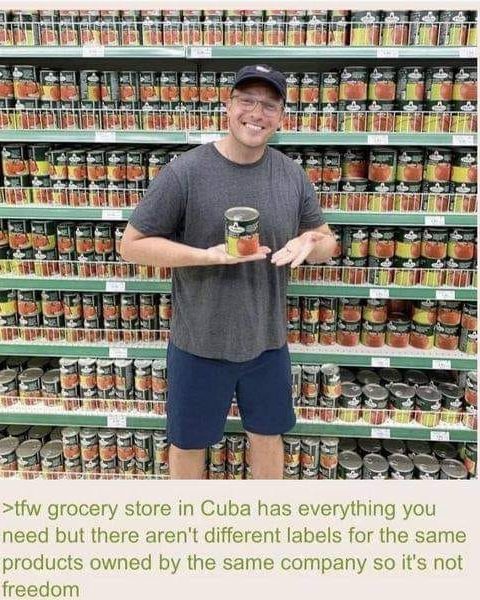
The image depicts a smiling, presumably Western tourist (based on appearance and demeanor) standing in a grocery store aisle in Cuba. The aisle is lined with shelves completely filled with canned tomato products, all appearing to be the same. However, the crucial point is that they are packaged under a multitude of different brand names and labels. The tourist is holding up a single can, presenting it as if offering it to the viewer. The caption states, “tfw grocery store in Cuba has everything you need but aren’t different labels for the same products owned by the same company so it’s not freedom.” “Tfw” is internet slang for “that feel when.”
Critical Theory
This meme sharply critiques the illusion of choice inherent in capitalist consumer culture. Critical Theory, drawing from the Frankfurt School, argues that systems of power (in this case, capitalism) often maintain control not through overt force, but through the manipulation of ideology and culture.
- The Culture Industry: The endless proliferation of brands and packaging (as seen in Western supermarkets) isn’t about offering genuine diversity or improving quality. It’s a tactic of the "culture industry" to create the appearance of choice, masking the underlying homogeneity of production and ownership. The meme points out that in Cuba, this façade is stripped away. You get the product you need, without the manufactured desires created by branding.
- Commodification: The sheer number of brands is an example of commodification taken to an extreme—everything becomes a product to be bought and sold, even difference itself. The meme suggests this is a type of unfreedom.
- False Consciousness: Critical Theory suggests that consumers under capitalism often operate under "false consciousness," believing they are making free choices when, in reality, their desires are shaped by the system itself. The meme is attempting to disrupt this false consciousness by revealing the underlying lack of genuine difference.
Marxist Conflict Theory
From a Marxist perspective, this meme illustrates a fundamental contradiction within capitalism: the concentration of ownership.
- Means of Production: The tomato products, the factories making them, the distribution networks—these are all "means of production." In capitalist systems, these are increasingly controlled by a small number of corporations. The meme implies that even if Cuban supermarkets have less variety, they aren’t subject to the same level of consolidated ownership as Western markets.
- Class Struggle: While subtle, the meme implies a critique of the power dynamics between the corporations and the consumer. The endless branding creates a feeling of empowerment (“I choose!”) while concealing the reality of corporate control.
- Alienation: Capitalism alienates workers from the products they create, and consumers from the true nature of those products. The meme points to a way this alienation could be lessened—by making the underlying sameness of production visible.
Foucauldian Genealogical Discourse Analysis
Michel Foucault’s work on power and discourse is relevant.
- Power/Knowledge: The meme argues that our understanding of “freedom” (in the consumer sense) is constructed through a specific discourse—a way of talking about, and understanding, the world. This discourse is deeply intertwined with capitalist power relations. Foucault would analyze how the idea of "choice" as freedom is a product of this discourse, used to legitimize capitalist control.
- Genealogy: A Foucauldian genealogy would trace the history of this discourse. How did "choice" become equated with freedom? What historical conditions enabled this association? The meme suggests that in Cuba, a different historical path (outside of the dominant capitalist narrative) resulted in a different way of understanding this concept.
- Discipline and Normalization: The hyper-branding in Western supermarkets is a form of disciplining the consumer – normalizing the idea that constant choice is both desirable and necessary.
Postmodernism
While less central than the other frameworks, postmodernism's focus on deconstruction could be applied.
- Grand Narratives: Capitalism relies on a “grand narrative” of progress, freedom, and individual empowerment. This meme deconstructs that narrative by showing that the apparent “freedom” offered by consumer choice is, in fact, a constructed illusion.
- Simulacra and Simulation: Jean Baudrillard’s concepts of simulacra and simulation are relevant. The brands themselves are becoming simulations of reality—they create a hyperreal experience of choice that doesn’t reflect any underlying substance.
In conclusion:
This meme, through its simple imagery and caption, serves as a powerful critique of late-stage capitalism. It challenges the idea that more choice equals more freedom, and suggests that genuine liberation might lie in dismantling the systems that manufacture this illusion of choice. It subtly points to a different system – the Cuban one – as a case study in how things might be different when the forces of unchecked corporate branding are diminished.
simple-description (llama3.2-vision_11b)
The meme is a satirical image of a person holding a can of food, with the text "I can buy this can of food for 1 dollar, but the factory that made it is owned by 3 different companies, and the farm that grew the tomatoes is owned by 2 others, and the can is made in a factory that's owned by 1 more company..." The image is a commentary on the absurdity of modern capitalism, where a single product can have multiple owners and manufacturers, highlighting the complexities of the global supply chain.
detailed-analysis (gemma3-27b-vision)
Okay, here's an analysis of the image and its accompanying text, broken down into the requested sections, with explanations of where these theoretical frameworks apply. Note that not every framework will be relevant or deeply applicable; I’ll explain when that's the case.
Image & Text Overview
The image depicts a man, presumably a tourist, standing in a Cuban grocery store aisle. He’s holding up a can of something (likely diced tomatoes) in front of a massive display of the same product. The accompanying text says, “tfw grocery store in Cuba has everything you need but different labels for the same products owned by the same company so it’s not freedom.” The "tfw" is internet slang for "that feel when." The message implies a critique of capitalist branding and the illusion of choice.
1. Visual Description
- Setting: A well-stocked grocery store aisle in Cuba. The shelves are full, which is notable given historical (and sometimes current) perceptions of scarcity in Cuba.
- Subject: A Caucasian man in athletic wear, appearing as a tourist or recent arrival. He is the focal point, and his presentation suggests comfort and privilege.
- Key Detail: The overwhelming quantity of identical products with seemingly different branding. This is the central visual message.
- Color & Tone: The image has a neutral, documentary-style tone. The colors are generally subdued and the lighting is standard grocery store lighting.
- Framing & Composition: The man is centered, which draws attention to him and, by extension, the cans he holds. The wall of cans forms a repetitive, almost overwhelming background.
2. Foucauldian Genealogical Discourse Analysis
This framework is highly relevant. Michel Foucault's work focuses on how power operates through discourse—the systems of knowledge and language that shape our understanding of the world.
- Discourse of Choice: The image and text directly challenge the discourse of consumer choice that is central to capitalist ideology. Capitalism presents a vast array of products as evidence of freedom and individuality. The picture reveals that this “choice” can be a constructed illusion – a carefully designed system of branding that masks underlying homogeneity.
- Power/Knowledge: The image implies that those controlling the branding (the company owning the products) have power through the creation and manipulation of knowledge (the perceived differences between brands). This power isn’t simply repressive, but productive – it produces the very idea of "choice" that it then exploits.
- Genealogy: A genealogical approach would ask how this system of branding evolved. How did companies come to rely so heavily on creating multiple brands for essentially the same product? Tracing the historical development of marketing and advertising would be crucial.
- Discipline and Control: The subtle suggestion is that even in a seemingly "free" market, consumers are disciplined by these branding strategies—we're conditioned to believe we’re making unique choices when we’re often simply selecting from a limited set of options controlled by a few powerful entities.
3. Critical Theory
Critical Theory, originating with the Frankfurt School, seeks to critique and challenge social structures and power dynamics. This image is ripe for this type of analysis.
- Ideology Critique: The image and text function as an ideology critique. They expose the ways in which capitalist ideology presents a false consciousness—a distorted understanding of reality that serves the interests of the ruling class.
- Commodification: The image highlights the process of commodification—turning everything, even basic necessities, into products to be bought and sold. The multiple brands are a symptom of this process—an attempt to maximize commodification by creating artificial scarcity and differentiation.
- Culture Industry: The scene resonates with the Frankfurt School's concept of the "culture industry"—the mass production of cultural goods designed to pacify and control the population. The branding is part of this—a superficial form of differentiation that distracts from underlying social inequalities.
- Alienation: While not explicit, the image hints at alienation. The abundance of identical products suggests a disconnection from the process of production—consumers are simply presented with finished goods without any understanding of how they were made.
4. Marxist Conflict Theory
This lens sees society as structured by class conflict, with the bourgeoisie (owners of the means of production) and the proletariat (workers) in constant struggle.
- Capitalist Exploitation: The image indirectly points to the exploitation inherent in capitalism. The company profits by creating artificial differentiation and maximizing sales, while the workers who produce the product receive a fraction of the value they create.
- Concentration of Capital: The fact that one company owns multiple brands demonstrates the concentration of capital—the tendency for wealth and power to become increasingly concentrated in the hands of a few.
- False Consciousness: Similar to Critical Theory, the image suggests that consumers are experiencing "false consciousness"—they are unaware of the exploitative structures that underlie their consumption. The illusion of choice prevents them from recognizing their true class interests.
- Commodification & Labor: This links to the concept that labor is itself a commodity under capitalism. The sheer amount of these products shows the scale of labor involved in their production, and the company benefits from this while the laborers may not.
5. Postmodernism
Postmodernism questions grand narratives and emphasizes the fluidity of meaning and the constructed nature of reality.
- Simulacra and Simulation: Jean Baudrillard’s concept of simulacra is relevant. The multiple brands can be seen as simulacra—copies without originals. They represent a level of simulation where the distinction between reality and representation has collapsed. The brands become more important than the actual product.
- Hyperreality: The image could suggest a state of hyperreality—a condition in which simulations have become more real than reality itself. Consumers are more concerned with brand image and perceived differences than with the actual quality or function of the product.
- Deconstruction of Meaning: Postmodernism would emphasize that the meaning of "choice" is not fixed or objective. The image deconstructs the idea of choice by revealing it as a constructed illusion.
- Relativism: The image would be viewed as evidence that there is no single "truth" about consumer choice. Meaning is relative and dependent on context.
6. Queer Feminist Intersectional Analysis
This framework is the least directly applicable, but can still offer some insights.
- Commodification of Bodies: Feminist theory often examines how capitalism commodifies bodies, particularly women’s bodies, through advertising and marketing. While not explicitly present in the image, the underlying commodification of all products can be linked to this broader critique.
- Labor Exploitation & Gender: The production of these goods often relies on exploited labor, and women are disproportionately represented in low-wage, precarious work. An intersectional analysis would highlight this connection.
- Intersectional Consumption: Access to consumer goods (even these deceptively branded ones) is not equal. Factors like race, class, gender, and location all shape consumption patterns. This isn't highlighted, but is always an underlying aspect.
I hope this breakdown is thorough and helpful! Let me know if you'd like me to elaborate on any of these sections or explore other theoretical frameworks.
simple-description (llama3.2-vision)
This meme is a photo of a man in a grocery store, holding up a can of beans with a label that says "Product of USA". The text above and below the image reads "When you realize the product of USA is actually made in Cuba". The image is humorous because it pokes fun at the idea that a product from the United States is actually made in Cuba, implying that the US is not as independent as it claims to be.