First Seen
2023-05-10T21:03:33+00:00
simple-description (llama3.2-vision_11b)
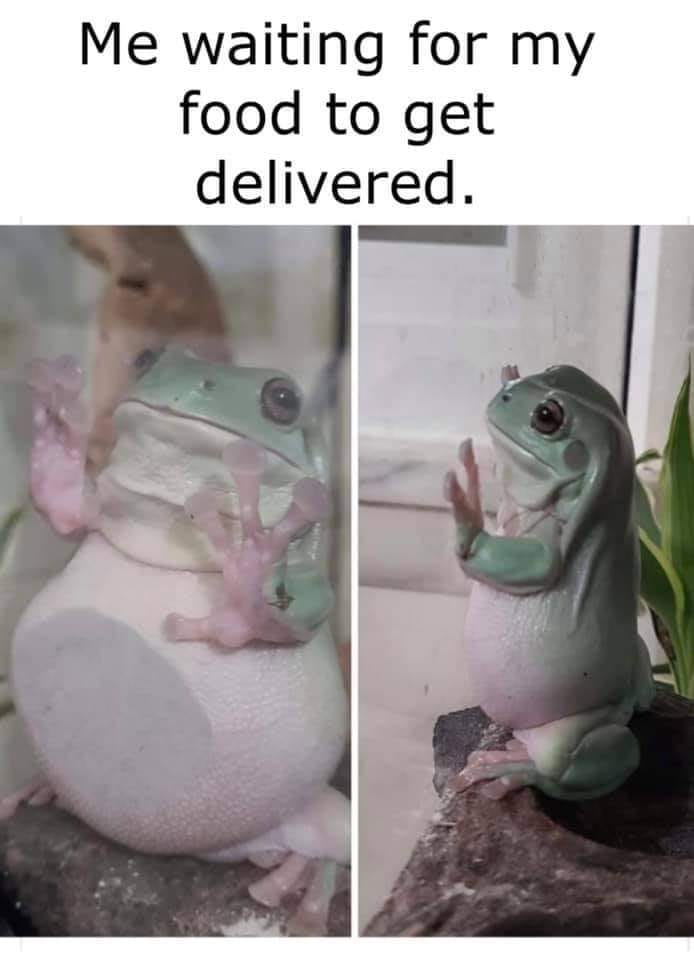
The meme features a cartoonish image of a frog with a bloated stomach, looking anxious and frustrated. The text above the image reads "Me waiting for my food to arrive." This meme is a relatable representation of the frustration and anticipation that comes with waiting for food delivery, particularly for those who have been waiting for a long time. The frog's exaggerated expression and bloated stomach serve as a humorous representation of the emotional state of someone who is eagerly waiting for their food to arrive.
detailed-analysis (gemma3-27b-vision)
Okay, here's an analysis of the image, broken down into the requested theoretical frameworks, as applicable. I'll note where a section doesn't quite fit, or is a stretch.
Visual Description
The image is a two-panel meme. The top panel shows a light green tree frog seemingly posed to pour a pink liquid (possibly a smoothie or similar beverage) into a rounded container. The frog has a focused, slightly strained expression. The lighting is soft, slightly blurred, giving a dreamy quality.
The bottom panel depicts the same frog, sitting upright on a dark rock, with its front paws clasped in front of its chest in what appears to be a meditative or expectant posture. The lighting is brighter here, highlighting the texture of the frog’s skin and the plant life behind it.
The text overlay reads: "Me waiting for my food to get delivered." The meme format clearly implies a relatable moment of anticipation.
Foucauldian Genealogical Discourse Analysis
This meme, despite its seemingly simple humor, can be seen through a Foucauldian lens as revealing the discourse of consumerism and delayed gratification. The frog's pose in both panels isn't simply about wanting food, but about the production of desire within a system of delivery.
- Discipline: The expectation of delivery is a product of modern logistical systems that discipline our consumption habits. We are conditioned to expect rapid fulfillment of our desires, creating a state of anxious anticipation when that fulfillment is delayed.
- Power/Knowledge: The platforms that facilitate food delivery (apps, services) hold power through their control of access to this gratification. This power is linked to the knowledge they possess about our preferences, location, and consumption patterns.
- Genealogy of Waiting: Historically, waiting for food was tied to processes of production (farming, hunting, cooking). Now, it’s linked to processes of logistics – systems of ordering, payment, and transport. This meme exposes the shift in the nature of our relationship to food and the new forms of dependency it has created.
The frog’s pose—both performing the act of "making" and then waiting for the result—highlights the absurdity of this mediated relationship to basic needs.
Critical Theory
This meme can be interpreted as a symptom of a culture of immediacy and commodification.
- Commodification of Time: The meme implies that even time itself is now a commodity. We are willing to pay a premium for the reduction of wait time. The frog’s expectation isn’t just for food, but for instant gratification.
- Alienation: The act of ordering food and having it delivered distances us from the process of food production. The meme highlights a sense of passivity and dependence on external systems. The frog is no longer actively involved in obtaining nourishment.
- Frankfurt School influences: The meme can be seen as evidence of the Frankfurt School’s critique of a culture industry that creates superficial desires and reinforces consumerism. The frog’s anticipation, framed as humorous, masks a deeper alienation from genuine need.
Marxist Conflict Theory
The meme touches on the capitalist mode of production and its effects on our daily lives.
- Labor & Value: Food delivery services rely on a system of wage labor. Delivery drivers are alienated from the fruits of their labor, and a portion of the value they create is extracted by the platform. While not explicit in the image, the infrastructure that allows this meme to relate to the audience is built on that reality.
- Class & Access: Access to food delivery is often limited by socioeconomic status. Those who can afford the convenience of delivery have a different experience of time and access to resources than those who cannot. The frog's comfortable expectation could be read as a reflection of privilege.
- Commodification of Needs: Food, a basic human need, is increasingly framed as a commodity to be bought and sold. The meme normalizes this commodification and contributes to the perpetuation of a system that prioritizes profit over need.
Postmodernism
The meme embodies several aspects of postmodern thought:
- Hyperreality: The image presents a stylized and exaggerated version of everyday life. The frog's dramatic poses and the humorous juxtaposition of images create a playful hyperreality.
- Simulation & Simulacra: The frog simulates the act of both preparing and anticipating food. The image is a representation of a representation—a meme about waiting for food, rather than a direct experience of hunger.
- Irony & Parody: The meme uses humor and irony to critique the culture of consumerism and the expectation of instant gratification.
Queer Feminist Intersectional Analysis
This is the trickiest fit. The meme, in and of itself, doesn’t inherently address issues of gender, sexuality, or intersectionality. However, a more nuanced reading could be made:
- Labor & Gender: Food delivery is often undertaken by marginalized workers, disproportionately women and people of color. The meme's seemingly harmless humor glosses over the realities of precarious labor and the gendered division of work.
- Care Work: Waiting for delivery, rather than preparing food oneself, shifts the burden of care work from the individual to external services. This can have implications for gender roles and the expectations placed on women as primary caregivers.
- Accessibility & Body Image: Access to food and delivery is not equally distributed. Concerns about body image, diet culture and access to healthy, affordable options intersect with social and economic factors. A critical analysis could highlight the unequal experiences of food access and the ways in which these experiences are shaped by intersecting identities.
It's important to remember that applying these theoretical frameworks to a simple meme is often a stretching exercise. However, doing so can reveal hidden layers of meaning and highlight the ways in which even seemingly innocuous cultural artifacts are embedded within complex social and political systems.
simple-description (llama3.2-vision)
This meme features two images of a frog with a worried expression, one looking out of a window and the other looking out of a window with a "help" gesture. The text at the top of the meme reads, "Me waiting for my food to be delivered." The meme is a humorous take on the frustration and anticipation of waiting for food to arrive at your doorstep.
tesseract-ocr
Me waiting for my food to get delivered. he La, Ear * - ; La Vs a 7 i a & “