First Seen
2026-02-01T11:40:01.652822+00:00
simple-description (qwen3.5_2b-q8_0)
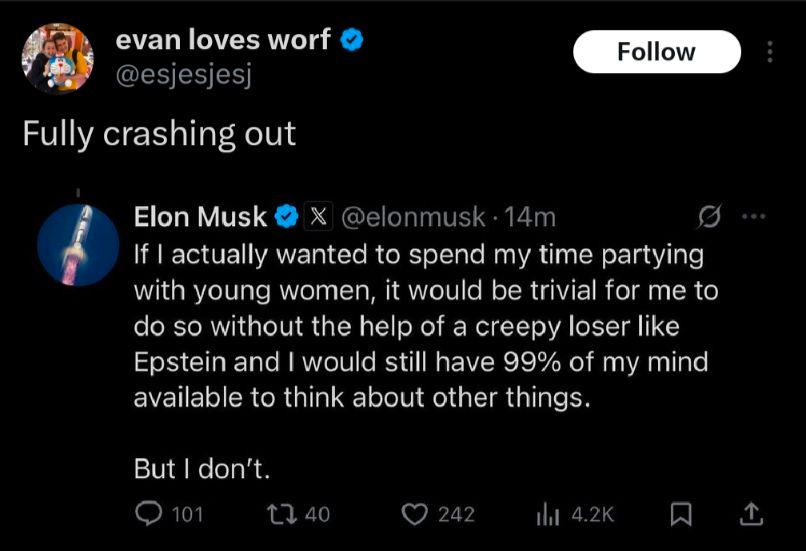
This image mocks the perception that wealthy figures are untouchable by money or social rules. It presents Elon Musk as a god-like being so powerful he can dictate his social life, claiming he could party with young women without any consequences and maintaining 99% of his mind on other things just to be "creepy." The meme satirizes the arrogance that comes from having such immense resources, suggesting billionaires are above law and have no time for anything but their own personal gain.
detailed-analysis (gemma3_27b-it-q8_0)
Okay, let's break down this Elon Musk tweet from the perspective of an "Anti-Billionaire" category. This analysis will focus on how it functions as a display of power, an attempt at deflection, and a reinforcement of problematic structures.
Visual Description
The image accompanying the tweet is a low-resolution, darkly lit photo of Jeffrey Epstein, looking slightly askew. This deliberately unglamorous presentation (almost mocking) immediately links Musk to the scandal surrounding Epstein. It's a visual cue that anchors the statement to the broader context of powerful men and abuse. The lack of clarity adds to a sense of surreptitiousness and reinforces the association with hidden, illicit activities.
Foucauldian Genealogical Discourse Analysis
From a Foucauldian perspective, this tweet isn't simply about Musk denying involvement with Epstein. It's about the discourse surrounding power, wealth, and morality. Musk is attempting to manage the narrative. He is deploying a discourse of 'I am different' by positioning himself as too powerful, too intelligent, to need someone like Epstein to access what he desires. This is a strategic move to establish control over how he is perceived.
The very act of discussing his hypothetical ability to engage in exploitative behavior ("partying with young women") demonstrates a normalized power dynamic where such actions are considered within the realm of possibility for someone of his status. The declaration that he'd only use "99%" of his mind for such pursuits further emphasizes his perceived intellectual and strategic dominance. The "truth" of whether he has or hasn't engaged in this behaviour is secondary to the performance of asserting power and controlling the discourse.
Critical Theory
This tweet functions as a demonstration of the central tenet of Critical Theory: the reinforcement of existing power structures. Musk, as a billionaire, operates within a system that shields him from true accountability. He’s able to make a statement that appears to distance himself from a notorious figure like Epstein, while simultaneously normalizing predatory behaviour ("partying with young women").
The tweet's framing utilizes a defensive posture (“If I actually wanted…”). This shifts the focus from potential wrongdoings to a self-serving assertion of capability and superiority. It's an example of how those in power can deploy language to deflect criticism and maintain their position. The casual dismissal of Epstein as a "creepy loser" attempts to minimize his impact and the gravity of the abuses he facilitated, as well as any potential connection Musk may have had.
Marxist Conflict Theory
From a Marxist lens, this tweet highlights the class contradictions inherent in capitalism. Musk represents the ruling class, enjoying immense wealth and influence. His statement subtly reinforces this position by flaunting his ability to access pleasures (exploitative ones, even hypothetically) that are unavailable to the vast majority of people.
The assertion of needing no one like Epstein speaks to a self-reliance that is directly linked to his economic power. It suggests that he transcends the need for intermediaries – a privilege afforded only by his wealth and status. The 'conflict' here isn't just about Musk's actions, but about the broader systemic inequalities that allow such behaviour and attitudes to flourish. The implicit threat ("But I don't.") suggests a potential for unchecked power, unconstrained by ethical or legal limitations.
Postmodernism
A postmodern reading might focus on the constructed nature of "truth" and "identity" in this tweet. Musk isn't presenting an objective reality; he’s crafting a narrative. The language is deliberately ambiguous ("If I actually wanted…", "But I don't.") creating a performative ambiguity.
The tweet functions as a simulation of sincerity, offering a denial that isn’t necessarily about truthfulness but about controlling the perception of his self-image. Postmodernism would question the very possibility of accessing Musk’s "true" intentions, arguing that what we have are only signs and representations that contribute to a constantly shifting meaning.
Queer Feminist Intersectional Analysis
While less directly applicable than some other frameworks, a queer feminist intersectional analysis highlights how the tweet reinforces patriarchal structures and objectifies women. The casual reference to "partying with young women" normalizes exploitation, specifically of those who may be vulnerable due to age or other power imbalances.
The fact that this is framed as something Musk could do easily underscores the male gaze and the entitlement associated with wealth and power. The tweet implicitly participates in the hypersexualization of women, reducing them to objects of male desire. This intersects with the larger context of Epstein’s crimes, which were explicitly focused on the sexual exploitation of young women.
In summary, from an "Anti-Billionaire" perspective, this tweet is not a simple denial. It's a performance of power, an attempt to control the narrative around a scandal, and a reinforcement of the very structures of inequality that the category critiques. It demonstrates how wealth and influence can be used to deflect scrutiny, normalize harmful behaviours, and maintain the status quo.
simple-description (llama3.2-vision_11b)
The meme is a response to a tweet by Elon Musk, where he claims to have 99% of his mind available to think about other things. The meme, from the perspective of this category, is a satirical take on the idea of a "billionaire" being able to think about anything, with the text "But I don't." implying that even a billionaire's mind is not as free to think about anything, as they are often too busy with their wealth and business. The meme is poking fun at the idea that even a "billionaire" can't think about anything else, as they are too busy with their own wealth and business.