First Seen
2026-02-26T01:03:40.893881+00:00
simple-description (qwen3.5_2b-q8_0)
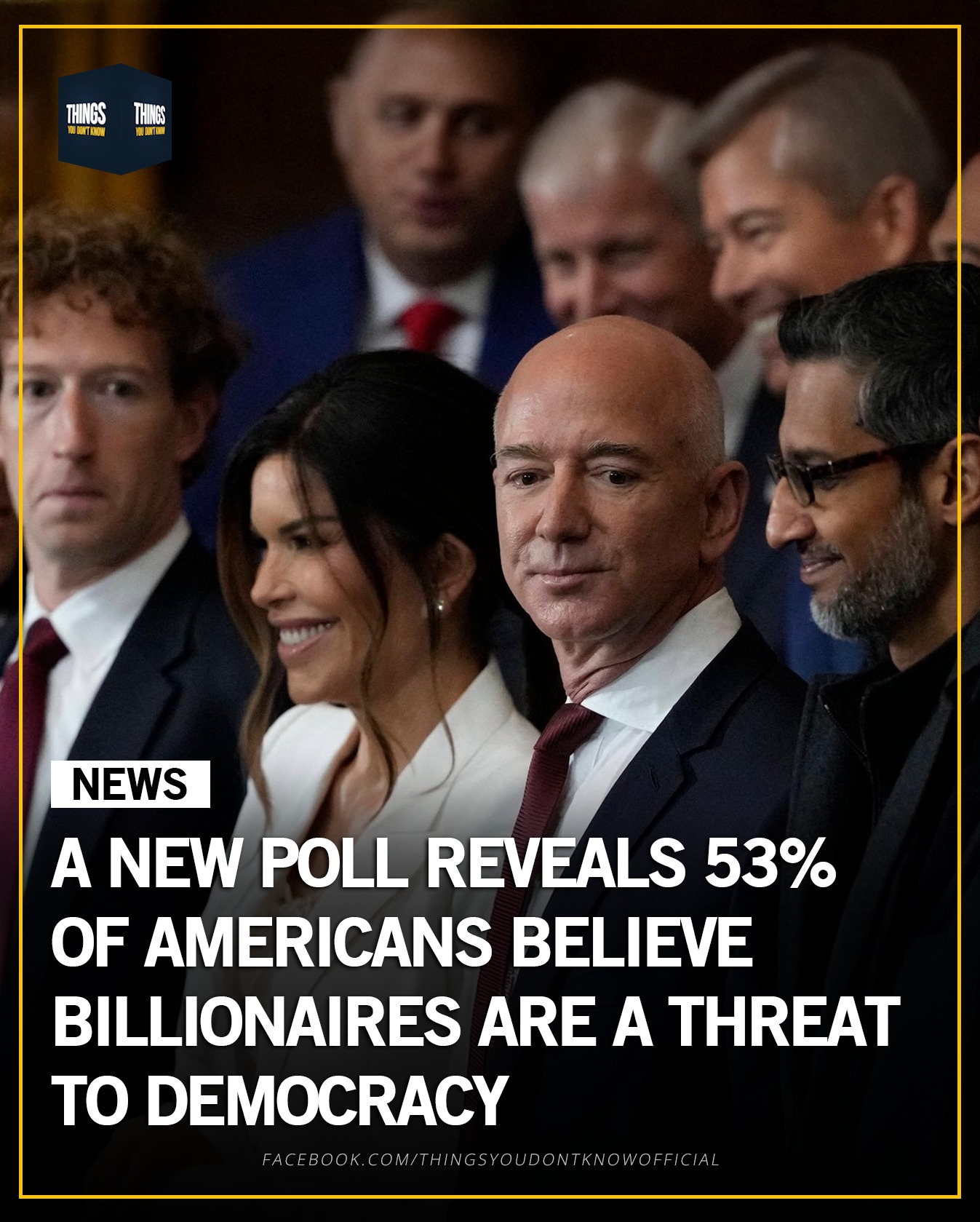
This anti-billionaire meme uses a photo of prominent wealthy figures like Jeff Bezos, Sundar Pichai, and Mark Zuckerberg as a visual representation of the "threat" mentioned in the text. The image supports the accompanying news headline that claims 53% of Americans believe these billionaires pose a significant danger to democracy by controlling vast amounts of power.
detailed-analysis (gemma3_27b-it-q8_0)
Okay, let's break down this meme from the perspective of an "Anti-Billionaire" category, applying relevant theoretical frameworks where applicable.
Meme Analysis: "53% of Americans Believe Billionaires Are a Threat to Democracy"
Visual Description
The image depicts a cluster of older, predominantly white men and a few women, seemingly observing someone (the focus is on a man in a suit with a slight smirk). The setting appears to be a hearing or formal event, likely within a governmental or legislative context. The overall feel is one of detached observation or perhaps thinly veiled contempt. The color scheme is dark, contributing to a feeling of seriousness and potential foreboding. The “NEWS” banner over the image clearly highlights the statistic regarding public perception of billionaires as a threat. This framing uses a simple visual of perceived power brokers to underscore the meme's core argument.
Critical Theory
This meme is deeply rooted in Critical Theory, particularly in the examination of power dynamics. Critical Theory suggests that societal structures are not neutral, but rather serve to maintain the dominance of specific groups. Here's how it applies:
- Challenge to Legitimacy: The meme directly challenges the legitimacy of concentrated wealth and its influence on democratic processes. The core argument—that billionaires are a threat—implies that their existence is inherently problematic and disrupts the ideal of a fair and equitable society.
- Critique of Rationality: The meme implies that the 'rational' system that allows for such immense wealth accumulation is flawed. It’s not a natural outcome of meritocracy, but the result of structural inequalities and exploitative practices.
- Ideology & False Consciousness: The meme's presentation as "news" serves to counteract dominant ideologies that normalize or even celebrate billionaire status. It aims to awaken a sense of “false consciousness” (a concept borrowed from Marxism—see below) by showing that a majority of people already recognize the problem.
- Deconstruction: From a critical perspective, the meme deconstructs the narrative of benevolent philanthropists or job creators that often accompanies the glorification of billionaires. It reveals the darker side of concentrated wealth—its potential to undermine democratic institutions.
Marxist Conflict Theory
This is arguably the most central framework for understanding this meme.
- Class Struggle: The meme represents a clear articulation of class struggle. Billionaires represent the capitalist class (the bourgeoisie in Marxist terms), while the 53% of Americans express a sentiment that aligns with the interests of the working class (the proletariat). The implied conflict is between those who control capital and those who are subject to its power.
- Capital Accumulation & Exploitation: Billionaire wealth is, from a Marxist perspective, a direct result of the exploitation of labor. The meme highlights the inherent tension between the accumulation of vast wealth by a few and the economic precarity experienced by many.
- State as a Tool of the Ruling Class: The visual context (a governmental hearing) subtly suggests that the state—which should ideally represent the interests of all citizens—is often captured by the ruling class (billionaires) and used to further their agenda.
- Revolutionary Potential: The statistic ("53%") points towards a growing consciousness of class interests and the potential for collective action (i.e., challenging the status quo and seeking systemic change).
Foucauldian Genealogical Discourse Analysis
Michel Foucault's work on power and discourse is also relevant:
- Power/Knowledge: Foucault argued that power and knowledge are inextricably linked. The meme challenges the dominant discourse surrounding wealth—the narratives that portray billionaires as essential to economic prosperity or philanthropic heroes. By framing them as a threat, it shifts the power/knowledge dynamic.
- Genealogy of the "Billionaire": A genealogical approach would examine how the category of the "billionaire" has been historically constructed. How did this figure come to be seen as exceptional and worthy of admiration? The meme implies that this construction is not natural, but a product of specific historical and social forces.
- Disciplinary Power: Billionaires, through lobbying, political donations, and media ownership, exert a form of "disciplinary power" by shaping the rules of the game and influencing societal norms. The meme exposes this influence.
Postmodernism
Postmodernism, while perhaps less central, also has some relevance:
- Deconstructing Grand Narratives: Postmodernism questions overarching, universal narratives (like "economic growth" or "meritocracy"). The meme implicitly challenges the idea that the current economic system is inherently just or beneficial to all.
- The Subjectivity of Truth: The meme acknowledges that perceptions of truth are influenced by power relations. The statistic is presented not as an objective fact but as evidence of a growing understanding of the potential harm caused by billionaire wealth.
In summary: This meme functions as a succinct statement of anti-billionaire sentiment, leveraging a statistic to highlight the perceived threat these individuals pose to democratic principles. It draws on Critical Theory and, especially, Marxist Conflict Theory to expose the power dynamics at play and suggest the need for systemic change. Foucauldian analysis helps us understand how the category of the "billionaire" is constructed and how power operates through discourse.
simple-description (llama3.2-vision_11b)
This meme is a satirical take on a news article that reports a new poll showing that 53% of Americans believe that billionaires are a threat to democracy. The meme is likely to be humorous and critical of the idea that a large percentage of people can be so easily influenced by the wealthy. The text in the image likely says "A new poll reveals 53% of Americans believe billionaires are a threat to democracy."