First Seen
2026-02-07T04:51:31.782606+00:00
simple-description (qwen3.5_2b-q8_0)
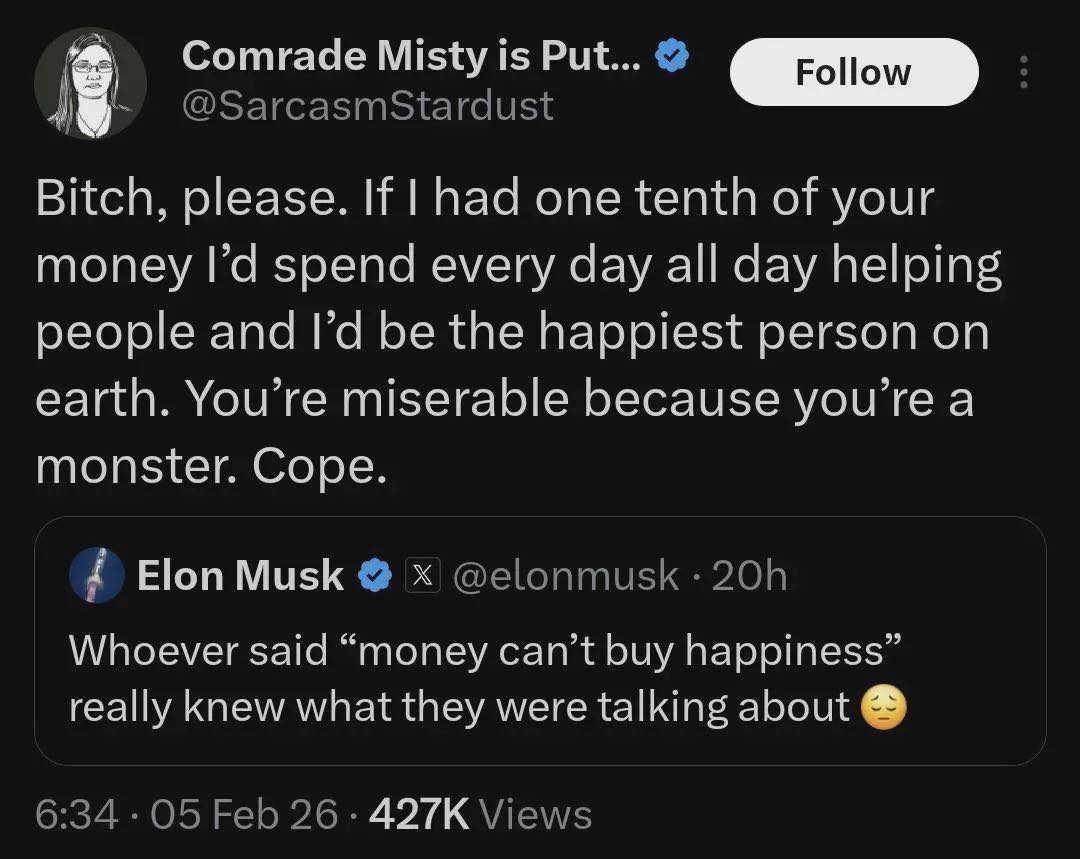
This meme serves as an "Anti-Billionaire" joke where Elon Musk mocks the wealthy user below him for believing that having money brings happiness. The comment implies that if he had just one-tenth of her money, she would spend it all day helping people and be happy, but instead, his massive wealth has made him miserable. His reply confirms this sentiment by saying, "Whoever said 'money can't buy happiness' really knew what they were talking about 😞."
detailed-analysis (gemma3_27b-it-q8_0)
Okay, let's break down this Twitter exchange through the lens of the "Anti-Billionaire" category, utilizing relevant theoretical frameworks. Here's an analysis, divided into sections as you requested, prioritizing those most directly applicable.
Visual Description
The image shows a screenshot of a Twitter exchange. The top tweet is from an account named "Comrade Misty put a curse on you," displaying an image of a person with black hair, sunglasses and a headscarf. The tweet is harshly worded, directly addressing someone (assumed to be Elon Musk based on the response) with accusations of being miserable and a "monster." It contrasts this with the claim that the tweeter would be exceptionally happy if they had even a small portion of the addressee's wealth and would use it to help others.
The response from Elon Musk is a sarcastic reply to the cliché "money can't buy happiness," stating that those who said it knew what they were talking about, followed by a grimacing face emoji.
The aesthetic is pointedly antagonistic, suggesting a conflict between perceived excess and social responsibility.
Marxist Conflict Theory
This exchange strongly exemplifies core themes of Marxist Conflict Theory. Here's how:
- Class Conflict: The entire dynamic centers on the inherent conflict between the bourgeoisie (represented by Musk, the ultra-wealthy capitalist) and potentially the proletariat (represented by "Comrade Misty," speaking on behalf of a broader working class/oppressed group). The tweeter implicitly accuses Musk of benefiting from a system built on exploitation and suffering.
- Alienation: The tweeter's claim that Musk is "miserable" points to a Marxist understanding of alienation. Marx argued that capitalism alienates workers from their labor, from each other, and even from their own potential. The accusation suggests Musk's wealth has not brought fulfillment, indicating alienation despite his material position. The underlying assumption is that true fulfillment comes from meaningful work and social contribution, not accumulation.
- Ideology and False Consciousness: Musk’s response, dismissively referencing “money can’t buy happiness,” can be viewed as a function of capitalist ideology. It’s a cliché used to deflect criticism about wealth inequality and justify the existing system, suggesting that individual happiness is independent of material conditions. “Comrade Misty” sees through this ideology, pointing to the moral failing of hoarding immense wealth while others suffer.
- Surplus Value: Although not explicitly stated, the source of Musk’s wealth is rooted in the extraction of surplus value from the labor of others. This tweet indirectly points to the exploitation inherent in the capitalist system.
Critical Theory
This exchange also resonates with Critical Theory, specifically concerning power dynamics and social critique:
- Critique of Instrumental Reason: The tweet implies a critique of the instrumental reason that drives capitalist accumulation. Musk's focus on wealth accumulation (instrumental) is presented as being at the expense of ethical and humane considerations.
- Power Imbalance: The very fact that Musk has the platform to respond to this kind of criticism, and the power to influence public discourse, highlights the vast power imbalance. The tweeter's statement is a challenge to that power.
- Social Pathology: Framing Musk as a "monster" suggests that extreme wealth accumulation corrupts and creates a social pathology. This ties into the Critical Theory concern with how social structures can contribute to the dehumanization of both the oppressed and the oppressor.
Foucauldian Genealogical Discourse Analysis
A Foucauldian reading centers on power/knowledge and the historical construction of norms.
- Discourse of Philanthropy vs. Accumulation: The exchange challenges the dominant discourse surrounding wealth. The conventional narrative often celebrates "self-made" billionaires and casts philanthropy as a positive outcome. "Comrade Misty" deconstructs this, arguing that the very act of having such wealth is morally problematic and that true happiness isn’t compatible with it.
- Construction of "Happiness": The debate over whether money can buy happiness isn’t just a personal question. It is a social construct. The tweeter is rejecting the capitalist construction of ‘happiness’ as being linked to material possession, and proposing an alternative – fulfillment through helping others.
- Power Dynamics in Speech: The direct, confrontational tone ("Bitch, please") is significant. It’s a deliberate disruption of the polite, deferential language typically used when addressing powerful figures. This challenges the established power structure through discourse.
Postmodernism
Postmodernist elements are less direct but present:
- Deconstruction of Grand Narratives: The challenge to Musk's wealth indirectly questions the "grand narrative" of capitalist progress and the idea that economic growth automatically leads to societal betterment.
- Rejection of Essential Truths: The sarcastic response from Musk reflects a postmodern skepticism about universal truths. His response suggests that happiness is subjective, dismissing the moral critique.
Queer Feminist Intersectional Analysis
While not immediately central, a Queer Feminist Intersectional analysis can add nuance:
- Intersection of Power & Privilege: Musk's position embodies multiple axes of privilege (wealth, gender (as a man in tech), whiteness – though not explicitly relevant in this exchange). "Comrade Misty" likely represents marginalized groups who experience systemic oppression.
- Challenging Dominant Masculinities: The critique of Musk as a "monster" can be interpreted as challenging the often-celebrated, hyper-masculine archetype of the powerful capitalist.
In Summary
From the "Anti-Billionaire" perspective, this exchange is a microcosm of a larger struggle against wealth inequality and the perceived moral failings of unchecked capitalism. It is a direct challenge to the power dynamics and ideologies that perpetuate these inequalities, framed through a lens of social justice, and utilizing critical theoretical frameworks to expose the system's inherent contradictions. The tweeter’s strong language is not merely rhetorical; it’s a deliberate act of resistance.
simple-description (llama3.2-vision_11b)
The meme is a Twitter post from "Sarcasm Stardust" that responds to Elon Musk's tweet about not buying happiness. The tweet reads: "Bitch, please. If I had one tenth of your money, I'd spend it every day helping people and be the happiest person on earth. You're miserable because you're a monster. Cope." The meme is a sarcastic response to Elon Musk's tweet about not buying happiness, implying that if he had a tenth of his money, he would use it to help people and be happy.