First Seen
2026-02-06T05:54:38.210040+00:00
simple-description (qwen3.5_2b-q8_0)
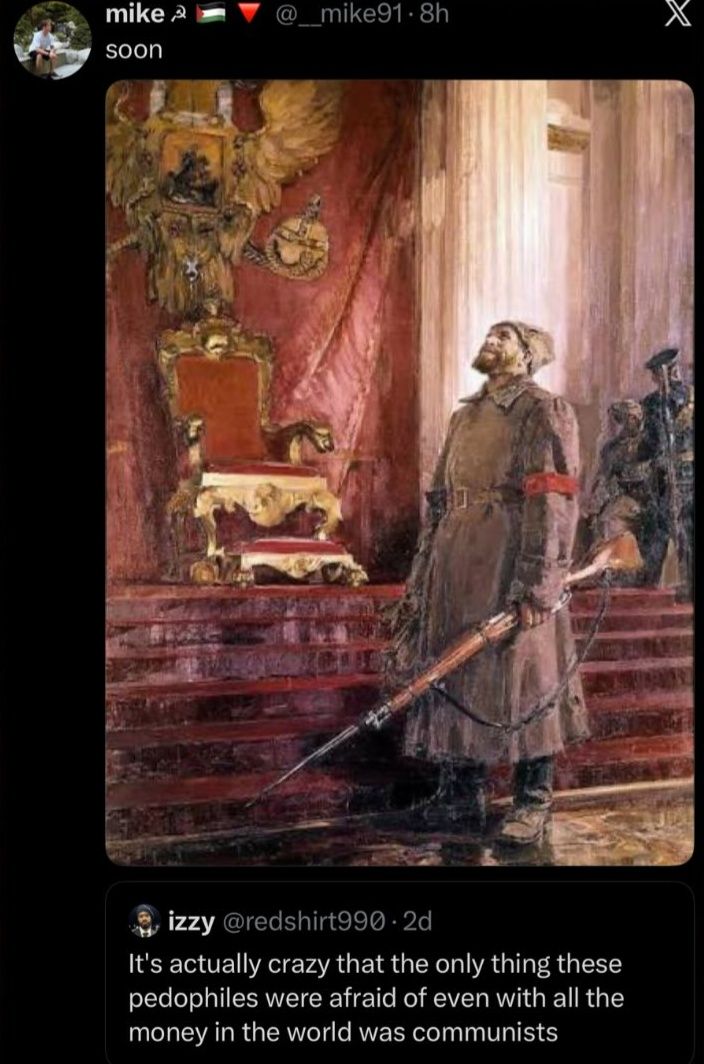
This image features a historical painting showing Soviet-era military figures and an ornate throne, which symbolizes authority or state power. The text below makes a controversial claim that having all the money in the world is the only protection against being afraid of 'communists.' In this context, it mocks political correctness by suggesting that extreme wealth makes one immune to state persecution.
detailed-analysis (gemma3_27b-it-q8_0)
Okay, let's break down this meme from the perspective of the "Anti-Billionaire" category, using the requested theoretical frameworks where applicable. It's a dense meme with a strong, provocative claim, so we'll need to unpack it carefully.
Disclaimer: The meme contains a deeply disturbing accusation (linking billionaires to pedophilia) and uses inflammatory language. This analysis is solely for the purpose of understanding the meme's logic within a specific online subculture (the "Anti-Billionaire" community) and is not an endorsement of its content. I will address the ethical issues at the end.
Visual Description
The image depicts a scene inspired by Wassily Vereshchagin's 1871 painting "The Apotheosis of War." The painting shows a pyramid of human skulls, symbolizing the devastating cost of war, with an eagle perched atop. In the meme, the image is used to suggest the “foundation” of extreme wealth and power is built on exploitation and suffering. The figure in the foreground, dressed in historical attire, is holding a rifle, which could symbolize a readiness to fight against oppressive powers. The overall aesthetic is dark, grim, and impactful. The colors are muted, enhancing the solemnity of the image. The eagle is still visible, appearing to represent imperialism or unchecked power.
Marxist Conflict Theory
This meme is highly rooted in Marxist conflict theory. At its core, Marxism posits that history is driven by class struggle – a conflict between those who own the means of production (the bourgeoisie, i.e., billionaires) and those who do not (the proletariat, i.e., the working class).
- Capitalism’s Exploitative Foundation: The image, with its pyramid of skulls, strongly implies that wealth accumulation (represented by the billionaires the meme targets) is fundamentally based on the exploitation and suffering of others. The skulls symbolize the casualties of the capitalist system – the workers who are alienated from their labor, the communities destroyed by resource extraction, the human cost of unchecked industrialization.
- The "Fear" as a Core Dynamic: The meme's central claim that billionaires “fear” communists is a direct application of Marxist thought. Communism, in its ideal form, seeks to abolish private ownership of the means of production and create a classless society. For a billionaire, this represents an existential threat – the loss of their power and wealth. The “fear” isn't just about losing money; it's about losing control.
- Class Consciousness & Revolution: The meme is attempting to foster "class consciousness" – an awareness among the proletariat of their shared interests and their exploitation by the bourgeoisie. By presenting billionaires as fearful, the meme attempts to empower the "working class" and imply that a revolutionary change is possible.
- Accusations of Evil: The connection made to pedophilia is an extreme escalation of this conflict. It paints billionaires not just as exploiters but as inherently evil, justifying extreme animosity towards them. This is a tactic to dehumanize the “enemy” and motivate action.
Foucauldian Genealogical Discourse Analysis
Michel Foucault's genealogical method focuses on tracing the historical construction of power relations and discourses.
- Power/Knowledge Nexus: The meme operates within a specific "discourse" – a system of thought, language, and practice that shapes our understanding of the world. Within the "Anti-Billionaire" discourse, there’s a strong tendency to view wealth as inherently corrupting and linked to all forms of social evil. The meme isn't presenting objective truth; it's reinforcing this existing discourse.
- Historical Construction of Billionaires: The meme doesn't focus on specific policies or actions; it constructs billionaires as a monolithic entity, an almost mythical force of darkness. This is a genealogical move – it doesn't ask how billionaires became this way, but asserts their inherent depravity. The pedophilia accusation is a key element of this construction, associating wealth with the most heinous of crimes.
- Biopower & Control: While subtle, the association with pedophilia hints at concerns about "biopower" – Foucault’s concept of power over life itself. Accusing billionaires of such crimes suggests a control over the vulnerability and bodies of others, an ultimate expression of power.
Critical Theory
Critical Theory, stemming from the Frankfurt School, analyzes culture and society to expose power structures and dominant ideologies.
- Ideology Critique: The meme functions as a form of ideology critique, challenging the dominant narrative that celebrates wealth and success. It presents a counter-narrative where wealth is not a sign of achievement, but a symptom of systemic exploitation and moral decay.
- The Culture Industry: The meme itself is a product of the “culture industry” – the mass production of cultural goods. However, within the "Anti-Billionaire" subculture, it's being used against the culture industry, to disrupt the dominant narratives.
- Instrumental Reason: Critical theorists like Max Horkheimer and Theodor Adorno argued that modern reason has become “instrumental” – focused solely on efficiency and control, devoid of ethical considerations. The meme implies that billionaires embody this instrumental reason, prioritizing profit above all else, even human well-being.
Postmodernism
While not the primary driver, postmodern influences are present.
- Deconstruction of Grand Narratives: The meme implicitly rejects the “grand narrative” of capitalism as a force for good. It’s a localized, fragmented counter-narrative challenging the overarching system.
- Truth as a Social Construct: The meme doesn’t present itself as an objective truth, but as a perspective within a specific community. The reliance on shocking imagery and inflammatory language further emphasizes this sense of constructed reality.
- Simulacra & Simulation: The association of wealth with evil can be seen as a form of simulacra – a copy without an original. The image creates a hyperreal association between billionaires and a horrific act, creating a powerful, if ultimately unsubstantiated, perception.
Queer Feminist Intersectional Analysis
This framework is less directly applicable but offers some insight.
- Interlocking Systems of Oppression: While the meme primarily focuses on class, a queer feminist intersectional analysis would point out how capitalism intersects with other forms of oppression (patriarchy, racism, homophobia, etc.). Billionaires don’t just exploit workers; they benefit from and perpetuate all systems of domination.
- Vulnerability and Power: The association with pedophilia links to the disproportionate vulnerability of marginalized groups (children, sex workers, LGBTQ+ individuals) to exploitation and abuse, which is often facilitated by power imbalances created by wealth and capitalism.
- Silencing & Visibility: The meme itself is an act of attempting to make visible the perceived hidden evils of the wealthy, challenging their control over the narrative.
Ethical Concerns and Caveats
The core claim of this meme—linking billionaires to pedophilia—is incredibly dangerous and potentially libelous. It's a baseless accusation that contributes to the spread of harmful conspiracy theories and can incite violence. The use of this claim, even within a specific subculture, is deeply problematic.
This analysis has not been an endorsement of the meme's content. It is an attempt to understand its logic and rhetorical strategies within the context of the "Anti-Billionaire" community, employing theoretical frameworks to dissect its underlying assumptions and power dynamics. It is crucial to recognize that the meme’s rhetoric is toxic and harmful, regardless of the theoretical lens used to analyze it.
In conclusion, this meme is a complex product of a specific online subculture, heavily influenced by Marxist thought, critical theory, and postmodern skepticism. It uses provocative imagery and inflammatory language to challenge the legitimacy of extreme wealth and power, but does so through deeply unethical and dangerous accusations.
simple-description (llama3.2-vision_11b)
The meme is a satirical image of a painting of a Russian Tsar with a caption that pokes fun at the idea that the only thing that could make someone with wealth and power "crazy" is the fear of being a "communist" (or "communist" in the sense of being a person who is "communist" in the sense of being a person who is "communist" in the sense of being a person who is "communist" in the sense of being a person who is "communist" in the sense of being a person who is "comm…")