First Seen
2026-01-18T06:07:53.758655+00:00
simple-description (qwen3.5_2b-q8_0)
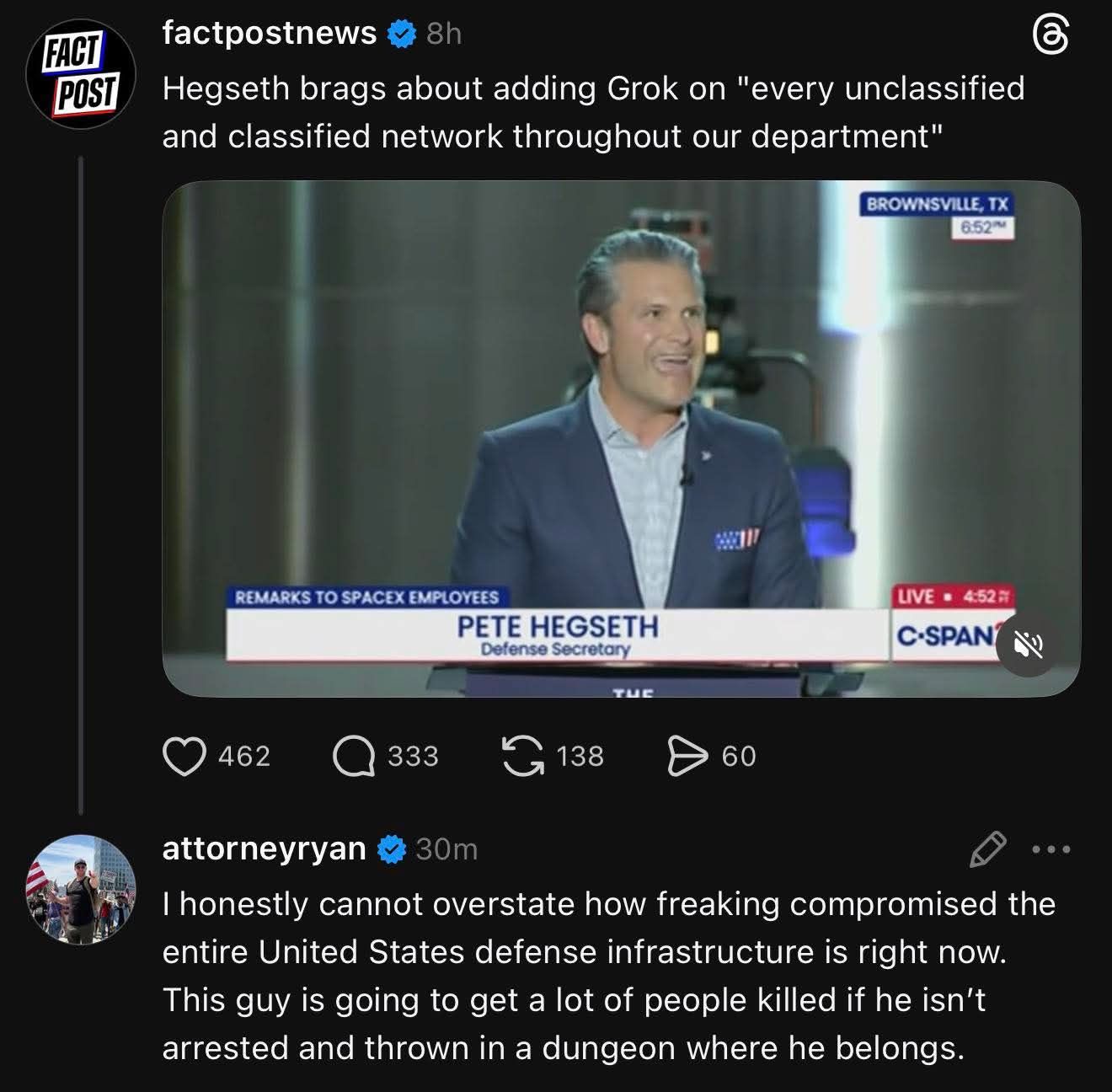
This image depicts a political rant accusing Defense Secretary Pete Hegseth of secretly installing an AI chatbot called Grok on every classified government network. The user argues that because Hegseth is a billionaire controlling major corporations, his presence has so completely compromised the United States' defense infrastructure, suggesting he should be arrested and thrown in a dungeon if he isn't caught.
detailed-analysis (gemma3_27b-it-q8_0)
Okay, let's break down this post through the lens of the "Anti-Billionaire" category, using the requested theoretical frameworks where applicable.
Context & Initial Understanding:
The post centers on Pete Hegseth, a conservative media personality and veteran, now serving as Defense Secretary. He's shown in a C-SPAN clip, bragging about integrating AI (specifically "Groq", an AI company) into "every unclassified and classified network" of the Department of Defense. The responding comment from "attorneyryan" is highly critical, suggesting this action is deeply dangerous and borderline criminal, capable of causing significant harm and demanding his imprisonment. The "Anti-Billionaire" category is relevant because Groq is backed by large venture capital funding, and the potential for tech billionaires to exert undue influence on government/military through contracts and technologies is a central concern within that perspective.
---
1. Visual Description
The image features Pete Hegseth in a professional setting, speaking at an event (identified as "Remarks to SpaceX employees"). He's dressed in a blue suit, smiling confidently. The C-SPAN logo is prominently displayed, lending an air of officialdom. This visual is key: Hegseth projects authority and competence. The backdrop is relatively neutral but indicates a connection to a leading tech company, SpaceX.
In the context of the anti-billionaire perspective: The image visually reinforces the way in which powerful individuals (like Hegseth, and by extension the billionaires behind tech companies like Groq and SpaceX) are able to seamlessly integrate into positions of power and control within the government and military. His confident demeanor contrasts sharply with the alarm expressed in the comment, creating a tension that highlights the perceived threat.
---
2. Marxist Conflict Theory
This is the most immediately applicable framework. The post speaks directly to power dynamics inherent in Marxist thought.
- Class Struggle: The situation can be interpreted as a manifestation of class struggle. The commentor suggests Hegseth is acting in the interests of the capitalist class (the billionaire investors in Groq and SpaceX) at the expense of the working class and broader public. The implementation of AI in defense networks, driven by profit motives, is perceived as a threat to societal well-being.
- Ideological Control: Hegseth's confident declaration can be seen as part of an ideological effort to normalize and legitimize the increasing influence of corporations (and their owners) in the military-industrial complex. The "bragging" implies a belief in the inherent goodness/necessity of this integration, despite the potential risks.
- Exploitation: The use of advanced, likely expensive, technology within the defense system might divert resources away from essential social programs, illustrating a pattern of exploitation where public funds are prioritized for private profit.
The comment's aggressive language ("compromised," "killed," "arrested") reflects a heightened sense of alarm and a perceived escalation in the exploitation of the masses by the capitalist elite.
---
3. Foucauldian Genealogical Discourse Analysis
Foucault’s work centers on power/knowledge relations.
- Discourse of Security: Hegseth’s statement operates within a discourse of national security. He frames the integration of AI as a positive step, implicitly appealing to fears and anxieties surrounding threats to the nation. This discourse normalizes increased surveillance, technological control, and military spending.
- Genealogy of Power: Tracing the "genealogy" of this situation would reveal how the relationship between the military, tech companies, and venture capital has evolved over time. This evolution has created a system where private interests have increasingly shaped the nature of warfare and defense. The post suggests that this historical development has reached a dangerous point.
- Panopticism: The integration of AI into every network could be seen as a move toward a panoptic system of surveillance and control, where individuals are potentially monitored and regulated on a massive scale.
The critical comment challenges the dominant discourse of security, portraying Hegseth’s actions not as protective, but as recklessly endangering the public.
---
4. Critical Theory
Critical Theory, rooted in the Frankfurt School, aims to dismantle ideologies and expose the structures of domination.
- Instrumental Reason: Hegseth’s focus on technical efficiency (integrating AI into networks) represents an example of “instrumental reason”—logic directed solely toward achieving a goal (in this case, enhanced military capabilities) without regard for ethical considerations or broader social consequences.
- Culture Industry: The link to SpaceX and the overall presentation of Hegseth as a confident authority figure potentially reflect a broader "culture industry" at work. This industry produces narratives that normalize and celebrate the power of corporations and technological advancement, even when those forces are harmful.
- Commodification of Security: The integration of AI driven by profit becomes a commodification of security, transforming it into a product to be bought and sold rather than a public good.
The commenter’s vehement response is a rejection of this instrumental rationality and an attempt to expose the underlying power dynamics at play.
---
5. Postmodernism
Postmodernism emphasizes the relativity of truth and the deconstruction of grand narratives.
- Metanarratives: The claim that technological progress inevitably leads to greater security or prosperity is a metanarrative. The commenter fundamentally rejects this narrative, arguing that Hegseth's actions are not contributing to a better future but actively endangering it.
- Simulacra and Simulation: The very image of Hegseth speaking with confidence could be seen as a "simulacrum"—a copy without an original. His authoritative presentation is divorced from the potential real-world consequences of his actions.
- Fragmentation of Reality: The commentor's urgent warning about impending catastrophe reflects a sense of fragmentation and instability.
---
6. Queer Feminist Intersectional Analysis
While not the primary focus, a queer feminist perspective can add nuance.
- Power & Control: The post highlights how power and control are wielded, not just along class lines, but in ways that can exacerbate existing inequalities. The deployment of AI-driven surveillance technology has the potential to disproportionately target marginalized communities.
- Military-Industrial Complex & Patriarchy: The military-industrial complex is often deeply embedded in patriarchal structures. The aggressive, assertive tone of Hegseth’s statement and the potential for escalating conflict reflect a culture of domination that is often associated with patriarchal values.
---
In Conclusion:
From the "Anti-Billionaire" lens, this post is a stark illustration of how wealthy individuals and corporations are gaining increasing control over vital sectors of society, with potentially devastating consequences. The comment highlights the urgent need for accountability and a challenge to the dominance of capitalist interests in the realm of national security. The theoretical frameworks above provide tools to unpack the power dynamics, ideological underpinnings, and potential harms associated with this situation.
simple-description (llama3.2-vision_11b)
The meme is a screenshot of a tweet from "Attorney Ryan" (a pseudonymous Twitter account) responding to a news article about a billionaire's comment on the US military's budget. The tweet is a satirical response to the news article, using the "Attorney" persona to mock the comment and the context of the news.