First Seen
2025-10-08T18:13:27.871320+00:00
simple-description (qwen3.5_2b-q8_0)
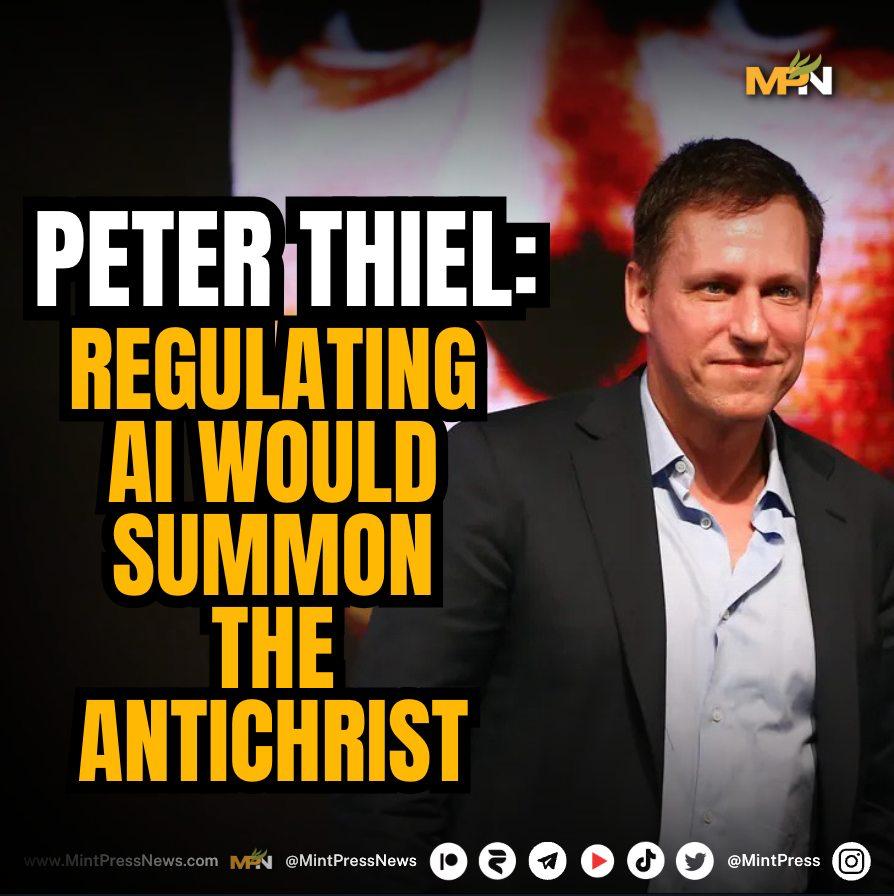
This meme uses the persona of Peter Thiel, a wealthy tech investor famous for his high-stakes investments like PayPal and Tesla, to satirize the idea that billionaires are deeply concerned with AI's morality. The headline suggests he believes unrestricted artificial intelligence is so dangerous it might summon the "Antichrist," implying that even the highest net-worth individuals feel compelled to regulate technology to prevent it from becoming spiritually evil or unmanageable.
detailed-analysis (gemma3_27b-it-q8_0)
Okay, let's break down this meme from the perspective of the "Anti-Billionaire" category, leveraging relevant theoretical frameworks where applicable.
Overall Context: The meme is a highly charged statement from MintPressNews positioned within an "Anti-Billionaire" context, indicating a critical stance toward wealthy individuals and their influence. The core argument attacks Peter Thiel’s stance against AI regulation, framing it as something so extreme it has demonic (literally, summoning the antichrist) implications. This is not meant as a literal statement but a hyperbolic rhetorical device.
---
1. Visual Description
The image features a portrait of Peter Thiel, a prominent venture capitalist and conservative political activist. He's presented in a standard professional headshot, dressed in a dark suit with a slight smirk. The background is blurred, with red lighting creating a subtly ominous atmosphere. The text is large, bold, and prominently positioned, immediately drawing attention to the provocative claim. The MintPressNews branding is present, visually linking the statement to the news outlet's overall anti-establishment ideology. The image and text combine to create a dramatic, impactful visual statement.
---
2. Foucauldian Genealogical Discourse Analysis
From a Foucaultian perspective, this meme can be seen as contributing to a discourse on power, technology, and the control of the future.
- Power/Knowledge: Thiel represents a specific form of power – economic and technological – that shapes our understanding of the world. His opposition to AI regulation isn’t presented as a neutral opinion but as an act wielding immense power to direct the development (or lack thereof) of a technology with significant societal consequences.
- Genealogy: The meme hints at a historical lineage of anxieties around technological progress and control. The invocation of the "Antichrist" taps into a long history of fearing the disruptive potential of new technologies, framing AI regulation as a moral imperative rather than a technical or economic debate. This ties into anxieties about the concentration of power.
- Discursive Formation: The meme is intervening in the ongoing discourse about AI, attempting to redefine the terms of the debate. It re-frames opposition to regulation not as prudence or a defense of innovation, but as an active, dangerous force potentially aligned with apocalyptic outcomes.
---
3. Critical Theory
This meme aligns strongly with tenets of Critical Theory, especially the Frankfurt School.
- Ideology Critique: The meme critiques the ideological underpinnings of Thiel's position. It implies that Thiel's defense of unregulated AI isn’t rooted in rational economic arguments but serves to protect the interests of a ruling class (billionaires) who benefit from the concentration of power. The "Antichrist" metaphor suggests the underlying drive is not progress, but domination.
- Instrumental Reason: Critical Theorists like Horkheimer and Adorno warned against "instrumental reason" – the application of rationality solely for the sake of efficiency and control, divorced from ethical considerations. This meme suggests Thiel's stance embodies this instrumental reason, prioritizing technological advancement at the expense of societal well-being.
- Culture Industry: The meme itself can be seen as part of the counter-culture industry, using provocative imagery and rhetoric to challenge the dominant narratives propagated by those in power. MintPressNews is actively constructing a counter-narrative about technology and wealth.
---
4. Marxist Conflict Theory
From a Marxist perspective, the meme illustrates class struggle and the inherent contradictions of capitalism.
- Class Antagonism: Thiel, as a billionaire, represents the capitalist class. His opposition to AI regulation is portrayed as serving the interests of this class, allowing them to further consolidate their wealth and power through technological dominance.
- False Consciousness: The meme implies that those who support Thiel's position are suffering from "false consciousness" – unaware of how their views are shaped by the ideological structures of capitalism and ultimately serve the interests of the ruling class.
- Alienation: The idea of unchecked AI development potentially leading to dystopian outcomes can be interpreted as reflecting the Marxist concept of alienation, where humans become estranged from their own creations and lose control over their own destiny.
---
5. Postmodernism
While the meme isn’t purely postmodern, some aspects resonate with postmodern thought.
- Deconstruction: The meme deconstructs the conventional framing of the AI regulation debate. It challenges the idea of Thiel's position as a rational, neutral stance and instead exposes its underlying ideological motivations.
- Hyperreality: The invocation of the "Antichrist" pushes the meme into the realm of hyperreality, where the distinction between reality and simulation becomes blurred. The exaggeration is deliberate, meant to shock and challenge conventional thinking.
- Grand Narratives: The meme implicitly critiques the grand narrative of technological progress as inherently beneficial. It suggests that technology is not a neutral force but is shaped by power structures and can have destructive consequences.
---
In conclusion:
The meme is a strongly worded, politically charged statement within the "Anti-Billionaire" framework. It draws upon several theoretical lenses to portray Peter Thiel’s opposition to AI regulation as a dangerous act of power consolidation, suggesting it serves the interests of a ruling class and potentially leads to apocalyptic outcomes. The hyperbolic language, while not intended literally, serves to mobilize opposition and challenge the dominant narratives surrounding technology and wealth. MintPressNews is actively framing this issue as part of a broader struggle against economic and political inequality.
simple-description (llama3.2-vision_11b)
The meme is a photo of Peter Thiel, a billionaire and co-founder of PayPal, with the text "Peter Thiel: Regulating AI would summon the Antichrist" overlaid. The image implies that Thiel is so opposed to regulating AI that he would even invoke the biblical figure of the Antichrist, suggesting that he believes such regulation would be catastrophic.