First Seen
2026-01-05T01:57:41.419502+00:00
simple-description (qwen3.5_2b-q8_0)
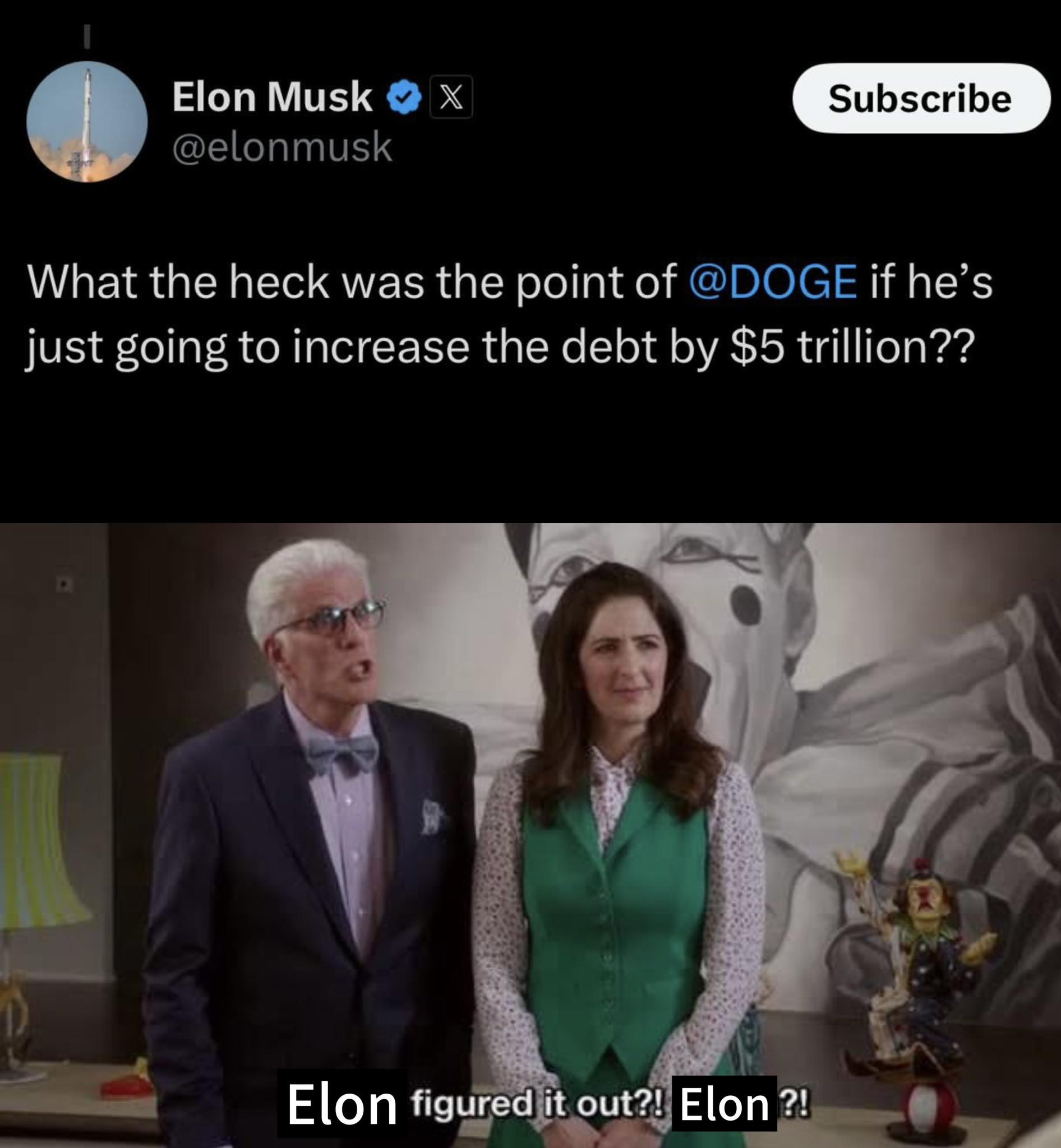
This meme combines a tweet from Elon Musk—arguing that Dogecoin was foolish—with a clip from The Office. For someone who cannot see it, this implies that despite his comments on financial debt, Musk actually has a secret strategy for making money that looks crazy to everyone else but he knows exactly what he's doing.
detailed-analysis (gemma3_27b-it-q8_0)
Okay, let's break down this meme from the perspective of the "Anti-Billionaire" category, employing the requested theoretical lenses where applicable.
Overall Summary:
The meme satirizes Elon Musk’s purchase of Twitter (now X) and the significant debt taken on to finance it. It questions the purpose of his involvement with Dogecoin (DOGE) – a cryptocurrency he has promoted – if the ultimate outcome is a massive increase in financial debt for the platform. It uses a scene from the TV show Parks and Recreation to convey a sense of bewildered realization that Musk’s actions are illogical or self-serving, ultimately benefitting only himself while potentially harming the platform and its users. The meme frames Musk as out of touch and acting without genuine concern for the consequences of his actions.
1. Visual Description
The meme features a screenshot from Parks and Recreation depicting April Ludgate and Ron Swanson looking at each other with expressions of shocked realization. Below the image is text that reads "Elon figured it out?! Elon?!" The image is juxtaposed with a tweet from Elon Musk’s verified Twitter account (now X) asking “What the heck was the point of @DOGE if he’s just going to increase the debt by $5 trillion??”
The visual choice is crucial. Parks and Recreation is generally seen as a positive, optimistic show. Ludgate and Swanson, while eccentric, are characters known for their independence and skepticism toward authority. Their bewildered expressions serve to highlight the absurdity of Musk's actions, suggesting a universal sense of confusion and frustration among those watching.
2. Marxist Conflict Theory
This meme operates powerfully within a Marxist framework. The core of Marxist thought centers on class struggle – the conflict between those who own the means of production (the bourgeoisie) and those who labor under them (the proletariat).
- Concentration of Capital: Musk represents the ultra-wealthy bourgeoisie. His actions, like taking on massive debt for a social media platform, demonstrate the ability of the capitalist class to gamble with enormous sums of money without facing the same consequences as the average person.
- Exploitation & Alienation: The $5 trillion (an exaggeration, but making a point) debt doesn't fall on Musk personally. It burdens the company, potentially leading to layoffs, decreased services, or higher prices for users (the “proletariat” in this context). This exemplifies the exploitation inherent in the capitalist system—profits are privatized, but risks are socialized. Users feel alienated from a platform increasingly shaped by the whims of a single, wealthy owner.
- False Consciousness: The promotion of DOGE can be seen as a distraction, a way to maintain “false consciousness” among users. It presents the illusion of participatory benefit through a cryptocurrency, while the underlying structure of power remains unchanged. The question in the tweet itself, seemingly posed by Musk, is ironic. It highlights the contradiction of promoting an alternative financial system (DOGE) while simultaneously accruing vast debt under the existing system.
- Critique of Capitalism: The meme is a critique of late-stage capitalism, where wealth accumulation and individual ambition (Musk’s) seem to supersede any concern for societal well-being or sustainable business practices.
3. Critical Theory
Critical Theory builds on Marxism, adding layers of cultural and ideological analysis. Here's how the meme fits:
- Ideology & Hegemony: Musk's public persona and the narratives he creates around his companies (Tesla, SpaceX, X) contribute to a dominant ideology that glorifies innovation, disruption, and individual entrepreneurship. This ideology serves to legitimize vast wealth accumulation and minimize scrutiny of its consequences. The meme challenges this hegemony by exposing the disconnect between the image of a visionary innovator and the reality of a risky, debt-laden venture.
- Commodification of Culture: The use of DOGE, a meme-based cryptocurrency, as a tool within Musk’s business strategy illustrates the commodification of internet culture. A previously decentralized, playful community symbol is co-opted for profit, losing its original meaning and becoming another instrument of capitalist exchange.
- Power Dynamics: The meme highlights the asymmetrical power dynamics at play. Musk has the platform (literally, now X) and resources to influence public opinion and financial markets, while ordinary users have little recourse.
4. Postmodernism
Postmodernism, though more subtle here, contributes to the meme's critique.
- Simulacra and Simulation: Musk’s actions could be seen as a simulation of value. The image he projects, the hype around DOGE, and the promise of a revolutionary platform create a simulated reality that masks underlying instability and debt. There’s a sense that the “real” is obscured by the “hyperreal.”
- Deconstruction of Authority: The meme deconstructs the authority traditionally associated with figures like CEOs and innovators. By presenting Musk as bewildered by his own actions, it undermines his credibility and challenges the notion of a rational, guiding intelligence behind the operation.
- Irony and Pastiche: The use of a sitcom still image to critique a tech billionaire is a form of pastiche—mixing different cultural elements in a way that highlights their incongruity. The irony inherent in Musk’s tweet further emphasizes the absurdity of the situation.
5. Foucauldian Genealogical Discourse Analysis
(This is the most complex application, but relevant)
Foucault examines how power operates through discourse – how language and knowledge construct our understanding of reality.
- Discourses of Innovation/Disruption: Musk actively participates in and shapes discourses around innovation, disruption, and the "future." These discourses normalize risk-taking and the pursuit of exponential growth, even at the expense of stability.
- Genealogy of Debt: A genealogical analysis could trace the historical development of debt as a tool of control and power. Musk’s leveraging of debt isn’t an anomaly; it’s part of a longer historical pattern of financialization and the concentration of wealth.
- Power/Knowledge Nexus: Musk's wealth gives him the power to define what constitutes "success" and "innovation." The meme challenges this power by revealing the potential negative consequences of his actions, disrupting the dominant narrative.
- Biopower: X (formerly Twitter) is a platform that shapes public discourse and therefore influences the collective "life" of a society. Musk’s control over this platform, financed by massive debt, represents a form of biopower – the exercise of power over the biological and social life of populations.
In conclusion, this meme functions as a pointed critique of billionaire culture, the inherent contradictions of capitalism, and the illusion of control within a rapidly changing digital landscape. It skillfully utilizes humor and pop culture references to expose the potentially damaging consequences of unchecked wealth and power, resonating strongly within the "Anti-Billionaire" context.
simple-description (llama3.2-vision_11b)
The meme is a humorous take on the anti-billionaire movement, specifically targeting the likes of Elon Musk and other wealthy individuals. The image is a screenshot of a tweet from Elon Musk, where he is responding to a question about his plans to increase the debt by $5 trillion, and he responds with a joke about "Doge" (a reference to the internet meme "Doge" that was popular in the early 2010s). The meme is a play on words, using the "Doge" meme to make a joke about the absurdity of the question and the context of the conversation.