First Seen
2025-06-13T21:25:05.271179+00:00
detailed-analysis (gemma3_27b-it-q8_0)
Okay, let's dissect this image and the accompanying text through the lens of an "Anti-Billionaire" category, using the requested theoretical frameworks where applicable. Given the content, several frameworks will be useful.
Image Description
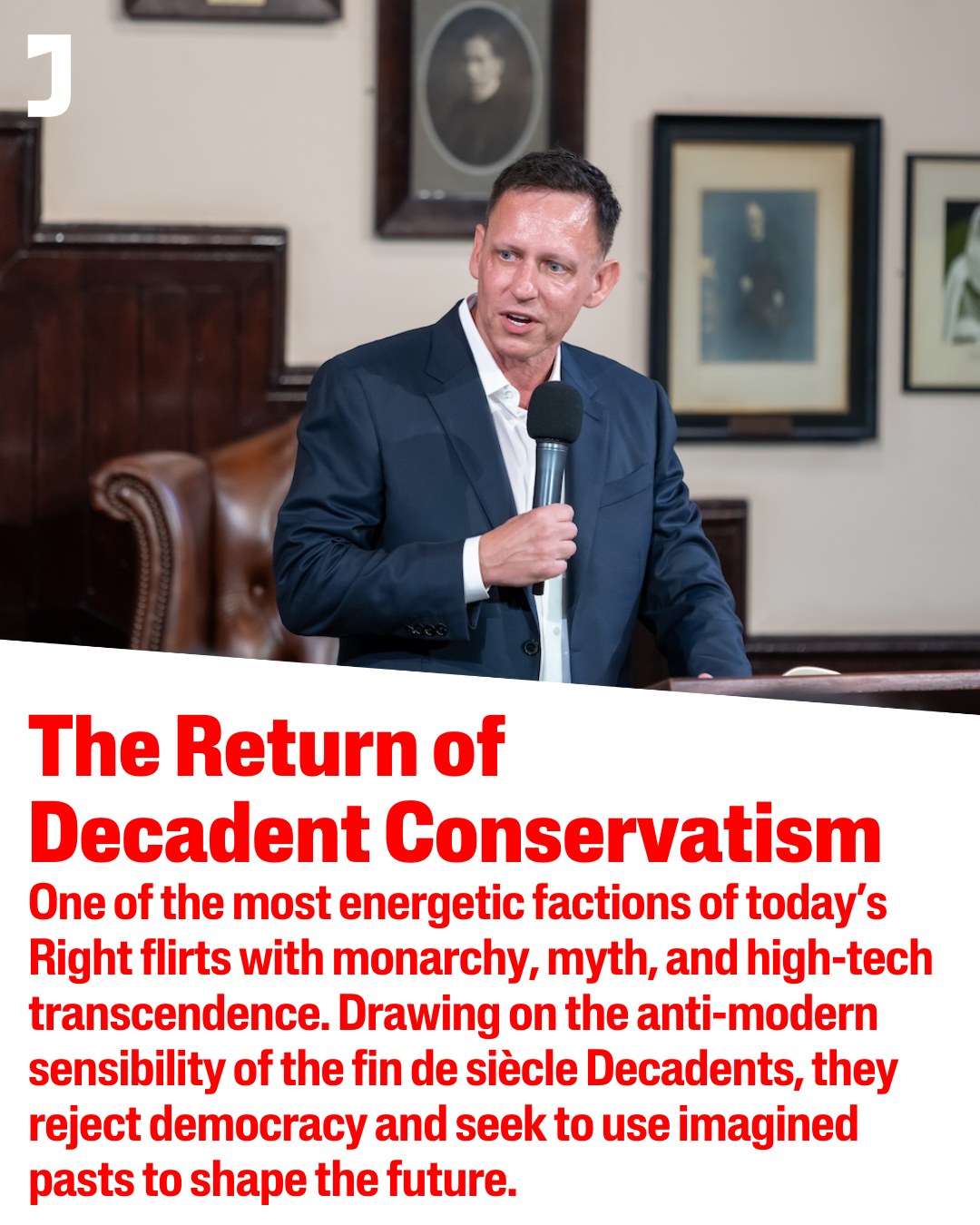
The image features Peter Thiel, a prominent venture capitalist and tech billionaire, appearing in a formal setting – a leather chair against a dark wood paneled wall with framed portraits behind him. He's dressed in a navy suit, looking directly at the viewer with a slight smirk. His body language is confident, almost assertive. The overall aesthetic conveys a sense of established wealth, power, and a certain calculated composure. The composition positions him as a figure of authority and prominence.
---
Foucauldian Genealogical Discourse Analysis
From an anti-billionaire perspective, Thiel is a crucial node in a discursive network that has normalized and legitimized extreme wealth accumulation and the erosion of democratic principles. Foucault's genealogical approach looks at how power operates through discourses, not just through top-down imposition.
- Discourse of "Decadent Conservatism": The text labels this ideology as "Decadent Conservatism." Genealogically, this isn't a natural conservatism, but a constructed one. It emerges from specific historical conditions, namely, the failures of neoliberalism to deliver broadly shared prosperity and the anxieties of an elite who fear losing their position. This discourse reframes social anxieties as a need for hierarchical order and a return to "imagined pasts."
- Power/Knowledge: Thiel's wealth is power, and it's used to fund and promote this discourse. Think tanks, media outlets, and political candidates are supported, disseminating this ideology and shaping public understanding. He isn’t simply a benefactor; he’s actively producing and circulating knowledge that legitimizes his position.
- Biopower: The idea of “high-tech transcendence” hints at a biopolitical project. The belief in technologies (like longevity research Thiel funds) that can extend life and enhance abilities is inherently hierarchical. It suggests a future where access to these technologies is stratified, benefiting only those who can afford them – reinforcing the power of the wealthy over the bodies and lives of others.
---
Critical Theory (Frankfurt School)
The image and text fit neatly into the concerns of the Frankfurt School, particularly its critique of the "culture industry" and the "authoritarian personality."
- Culture Industry: The discourse of "Decadent Conservatism" can be viewed as a product of the culture industry – a manufactured ideology designed to distract and control. The appeal to "myth" and "imagined pasts" is a form of manufactured consent, providing emotional resonance to conceal the material interests driving the ideology.
- Authoritarian Personality: Thiel’s confident demeanor and the ideology's rejection of democracy point to potential links with authoritarian tendencies. Critical theorists would argue that this ideology appeals to individuals who crave order, certainty, and strong leadership – often at the expense of individual freedoms.
- Instrumental Reason: The focus on “high-tech transcendence” exemplifies instrumental reason – a focus on efficiency and control that disregards ethical and social considerations. Technology isn’t used to improve the human condition for all, but to enhance the power and privilege of a select few.
---
Marxist Conflict Theory
From a Marxist perspective, this image and ideology are a clear manifestation of class struggle.
- Ruling Class Ideology: "Decadent Conservatism" is a form of ruling class ideology that seeks to maintain and reinforce the existing power structure. It justifies inequality by appealing to tradition, authority, and the supposed inherent superiority of certain groups.
- False Consciousness: The appeal to “myth” and “imagined pasts” is a tool to create false consciousness among the working class, obscuring the real sources of their exploitation.
- Capital Accumulation: Thiel’s wealth is a direct result of capital accumulation under capitalism. His support for ideologies that undermine democracy is a way to protect his economic interests and prevent challenges to the system that allows him to accumulate wealth. The rejection of democracy isn’t about genuine philosophical convictions; it’s about preserving the conditions for continued profit maximization.
- Material Conditions: The lavish setting and Thiel’s appearance are symbolic of the material conditions that enable his worldview. He exists within a system that actively creates and protects this disparity.
---
Postmodernism
While seemingly counterintuitive, postmodern thought can shed light on this phenomenon.
- Rejection of Meta-Narratives: The rejection of democracy itself is a rejection of a key Enlightenment meta-narrative. Postmodernism deconstructs grand narratives and emphasizes the constructed nature of truth. Thiel's camp actively constructs alternative narratives rooted in idealized pasts and technocratic futures.
- Simulacra and Simulation: The “imagined pasts” are, in a sense, simulations—copies without originals. This aligns with Baudrillard’s concept of simulacra, where signs no longer refer to reality but to other signs, creating a hyperreality. The appeal to tradition isn't about genuine tradition, but a manufactured image of tradition.
- Power and Discourse (again): Postmodernism, like Foucault, emphasizes the relationship between power and discourse. Thiel’s wealth allows him to control and shape the dominant discourses, creating a reality that serves his interests.
---
Overall (Anti-Billionaire Perspective)
From the “Anti-Billionaire” perspective, this image is a potent symbol of everything that is wrong with contemporary society. It represents the corrosive influence of extreme wealth on politics, culture, and the very foundations of democracy. The ideology presented isn’t a genuine expression of belief; it’s a strategic effort to maintain and expand the power of a small elite at the expense of the many. Thiel is not a visionary; he is a symptom of a deeply flawed system. The image serves as a call to action, urging viewers to challenge the power of the wealthy and dismantle the structures that perpetuate inequality.
Let me know if you'd like me to elaborate on any of these points or explore additional theoretical angles!
simple-description (llama3.2-vision_11b)
The meme features an image of Elon Musk, with the caption "The Return of Decadent Conservatism" in bold red text. The text below the image reads: "One of the most energetic factions of today's Right flirts with monarchy, myth, and high-tech transcendence. Drawing on the anti-modern sensibility of the fin de siècle Decadents, they reject democracy and seek to use imagined pasts to shape the future." The meme is a commentary on the rise of conservative ideologies and the use of historical and cultural references to shape the future.
detailed-analysis (gemma3-27b-vision)
Okay, here's an analysis of the image and accompanying text, broken down into sections relevant to the theoretical frameworks you requested. I'll indicate where a section isn't applicable.
Image Description
The image is a medium close-up shot of a man in a dark suit sitting at a table. He is slightly turned to the left, looking intensely toward something outside of the frame. He appears to be speaking. His expression is serious and resolute. Behind him are several framed portraits, likely of historical figures (appearing to be prominent men from the past). The background is dimly lit, suggesting an indoor setting – perhaps a library or formal study. The aesthetic is classic, even ornate, emphasizing tradition and historical weight. A red banner across the bottom of the image includes text concerning "Decadent Conservatism".
---
Foucauldian Genealogical Discourse Analysis
The title "The Return of Decadent Conservatism" itself is a starting point for a Foucauldian analysis. The phrase "return" immediately signals a discourse that isn't entirely new. It implies that this form of conservatism has existed previously and is now being re-activated.
- Discourse & Power: The discourse of "Decadent Conservatism" functions as a mechanism of power. It seeks to legitimize a particular political ideology by associating it with historical precedents and a constructed narrative of decline (the "decadence"). It posits a problem (modernity, democracy) and proposes a solution rooted in the past.
- Archaeology of Knowledge: An archaeological investigation into the concept of "decadence" would reveal its complex and shifting meaning throughout history. It originally held negative connotations, meaning decline. Here, it's reclaimed and repositioned as a source of strength, implicitly suggesting that a rejection of modernity is necessary for renewal.
- Genealogy: Tracing the genealogy of this ideology would involve examining the historical figures whose portraits are displayed in the background. These figures would serve as authorities upon which this "Decadent Conservatism" bases its claims, legitimizing it through a constructed lineage.
- Subjectivation: This discourse positions individuals within a specific power relation. Those who adhere to "Decadent Conservatism" are encouraged to see themselves as custodians of a lost past, resisting the perceived corrosive influences of modernity.
---
Critical Theory
From a Critical Theory perspective (drawing on thinkers like Adorno and Horkheimer), the rhetoric surrounding "Decadent Conservatism" is highly suspect.
- Instrumental Reason: The emphasis on reclaiming the past can be interpreted as a rejection of Enlightenment rationality and progress. It presents a nostalgic fantasy rather than a genuine engagement with societal problems.
- Culture Industry: The creation of a coherent narrative around "Decadent Conservatism" (linking it to mythology, high-tech, and a selective interpretation of the past) resembles the creation of a branded ideology, manipulating cultural symbols to achieve political ends.
- Domination: By idealizing the past, this ideology implicitly reinforces existing power structures and hierarchies. The selection of "historical figures" for the background imagery signifies an elevation of certain (likely male, privileged) voices and a silencing of others.
- False Consciousness: The appeal to myth and transcendence may serve to distract from material realities and inequalities. It presents a seductive but ultimately illusory solution to the problems of modernity.
---
Marxist Conflict Theory
From a Marxist perspective, "Decadent Conservatism" represents an ideology aimed at maintaining the status quo and protecting the interests of the ruling class.
- Ideology as False Consciousness: The appeal to tradition, myth, and a glorified past serves to obscure the material conditions that create inequality. It deflects attention from the conflicts arising from class struggle.
- Class Conflict: The desire to reject democracy – as stated in the text – inherently aligns with the interests of those who benefit from existing power structures. Democracy, while imperfect, offers a platform for the oppressed to challenge the ruling class.
- Hegemony: The construction of "Decadent Conservatism" as a coherent ideology is an attempt to establish cultural hegemony. It seeks to normalize and legitimize a particular worldview that supports the interests of the dominant class.
- Control of Means of Production: The rejection of modernism and embrace of "high-tech" potentially represents an attempt to control the means of production through advanced technology, preserving the power of the ruling class.
---
Postmodernism
A postmodern analysis would focus on the deconstruction of grand narratives and the fluidity of meaning.
- Rejection of Metanarratives: The attempt to construct a "Decadent Conservatism" as a coherent ideology can be seen as a rejection of postmodern skepticism toward grand narratives (like progress, reason, etc.).
- Pastiche and Simulation: The blending of "monarchy, myth, and high-tech" can be interpreted as a form of pastiche – a playful but ultimately superficial imitation of different styles and eras.
- Deconstruction of History: The emphasis on "imagined pasts" suggests that history is not a fixed or objective truth, but a constructed narrative that can be manipulated for political purposes.
- Hyperreality: The emphasis on myth and imagined pasts is representative of hyperreality, where simulations and representations become more real than the actual reality.
---
Queer Feminist Intersectional Analysis
From this perspective, this ideology presents several clear concerns.
- Reinforcement of Patriarchy: The portraits in the background appear to predominantly represent men, reinforcing a patriarchal worldview. "Imagined pasts" are often selectively constructed to exclude the experiences and contributions of women and other marginalized groups.
- Exclusionary Ideology: An ideology that rejects democracy and embraces tradition is likely to be inherently exclusionary, marginalizing those who do not fit within its narrow definition of the "ideal" citizen.
- Intersectional Oppression: The ideology is likely to reinforce existing patterns of intersectional oppression (based on gender, race, class, sexuality, etc.).
- Reproductive Rights: It is likely that this ideology would seek to restrict the reproductive rights of women, furthering gender inequality.
---
Hopefully, this comprehensive analysis provides a good starting point for understanding the image and its accompanying text through various critical lenses.
simple-description (llama3.2-vision)
The meme features a photo of a man in a suit, likely a politician or public figure, speaking into a microphone. The text at the top reads "The Return of Decadent Conservatism" and the bottom text is a quote from an article on the topic, but the main point of the meme is a satirical commentary on the resurgence of conservative ideology. The quote is not provided, but it's likely a humorous or ironic take on the return of a specific type of conservative ideology.