First Seen
2025-04-22T02:01:47.560114+00:00
detailed-analysis (gemma3_27b-it-q8_0)
Okay, let's break down this image and its context through the lens of an "Anti-Billionaire" category, utilizing relevant theoretical frameworks where appropriate.
Image Overview
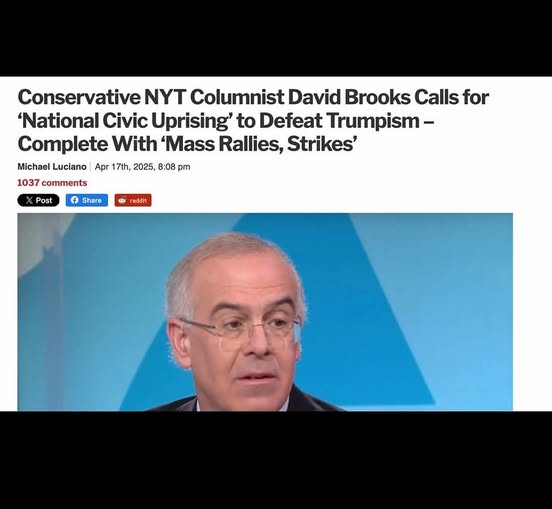
The image features David Brooks, a columnist for the New York Times, with a headline stating he's called for a "National Civic Uprising" to defeat Trumpism, including "Mass Rallies" and "Strikes." The framing positions this as a commentary on a privileged, elite figure advocating for action while simultaneously being disconnected from the lived realities of those most affected by the political forces at play.
Foucauldian Genealogical Discourse Analysis
From an anti-billionaire perspective, this image can be understood through a Foucauldian lens as a demonstration of how power operates through discourse. Brooks, as a prominent voice in mainstream media, wields significant discursive power.
- Genealogy of "Civic Uprising": The phrase "civic uprising" itself isn't neutral. It evokes historical moments of popular resistance, but when advocated by a figure deeply embedded in the establishment like Brooks, it's a co-option of that language. It's a sanitization of genuine revolt. A genealogical investigation would trace how “uprising” has been used historically – often by elites to justify or control movements from below.
- Power/Knowledge: Brooks' authority comes from his position within the NYT, an institution that benefits from the status quo. His pronouncements are treated as insightful commentary, reinforcing a system where elite viewpoints are privileged. This aligns with Foucault's idea that power and knowledge are inextricably linked. The 'knowledge' Brooks produces is inherently shaped by his power (wealth, position) and, in turn, reinforces that power.
- Discursive Framing: The framing of Trumpism as something to be "defeated" through orchestrated rallies and strikes, rather than by addressing the underlying economic anxieties and systemic problems that fueled its rise, shows a disconnect from the source of the problem. This is a classic example of addressing the symptoms rather than the root causes.
Critical Theory
Critical Theory, particularly the Frankfurt School’s work, is highly relevant here.
- Culture Industry: Brooks’ role as a NYT columnist positions him as part of the "culture industry." Critical theorists argue that the culture industry (media, academia, etc.) serves to reproduce capitalist ideology and maintain the existing power structures. By framing political opposition in a way that doesn't challenge the underlying economic system, Brooks is seen as participating in this reproduction.
- False Consciousness: The call for a "civic uprising" from above can be interpreted as an attempt to manage dissent and channel it into forms that won’t fundamentally alter the capitalist system. It might be seen as an effort to prevent the development of true class consciousness – a recognition of shared interests among working people.
- The Reproduction of Dominance: Critical theorists argue that elites often engage in rhetoric that appears critical or progressive while ultimately serving their own interests. Brooks' appeal could be seen as a way for the elite to appear engaged with democratic processes without actually relinquishing control.
Marxist Conflict Theory
From a Marxist perspective, this image immediately highlights class conflict.
- The Bourgeoisie and the Proletariat: Brooks represents the bourgeoisie – the ruling class who own the means of production and benefit from the exploitation of labor. Trumpism, while appearing anti-establishment to some, is fundamentally a symptom of the contradictions within late-stage capitalism. The "uprising" Brooks calls for is a middle-class, intellectual response, not a genuine revolt by the proletariat.
- Ideology: Brooks' argument serves as ideology – a set of beliefs that justify the existing social order. His call for a "civic uprising" distracts from the underlying economic inequalities that fuel political polarization.
- False Solutions: The proposed solutions – rallies and strikes – are insufficient to address the root causes of the problems. True change, from a Marxist perspective, requires a fundamental restructuring of the economic system.
- Class Struggle: The call to action, especially coming from someone with Brooks’ economic standing, is a prime example of a disconnect between the elite and those who are struggling with the economic realities of capitalism.
In summary:
From the perspective of an "Anti-Billionaire" category, the image of David Brooks calling for a "National Civic Uprising" isn’t a genuine call for democratic renewal. It’s evidence of how the elite attempt to control the narrative, co-opt language of resistance, and ultimately protect their own interests within a system that inherently favors them. It demonstrates the power dynamics at play, the reproduction of capitalist ideology, and the disconnect between those in power and those who suffer the consequences of their decisions.
Disclaimer: This analysis is based on the provided image and context and the theoretical frameworks mentioned. The interpretation is aligned with the specified "Anti-Billionaire" category.
simple-description (llama3.2-vision_11b)
This meme is a screenshot of an article from the website "The Daily Caller" with the title "Conservative Columnist Blames Biden for Inflation, Not Trump's Policies". The article features a photo of a conservative columnist, David Bro...
detailed-analysis (gemma3-27b-vision)
Okay, let's break down the image and its implied context through the lenses you've requested. Please keep in mind this will be an interpretation based on the visual and the headline/text, and will rely on theoretical frameworks.
Image Overview
The image shows a screenshot of an article headline and a photo of David Brooks, a columnist for The New York Times, known for his conservative stance. The headline is fairly aggressive: “Conservative NYT Columnist David Brooks Calls for ‘National Civic Uprising’ to Defeat Trumpism – Complete With ‘Mass Rallies, Strikes’”. The background shows what appears to be a political event or conference setting, with blurred figures and lighting.
1. Visual Description
- Composition: The image is a screenshot, implying it’s from an online news source. The headline dominates the top of the frame, immediately establishing the subject. The portrait of Brooks occupies a significant portion of the image, centering him as the source of the statement. The background is intentionally blurred, drawing the focus to Brooks and the claim being made.
- Brooks' Appearance: Brooks is pictured speaking, with a slightly concerned or serious expression. He's wearing glasses and a dark suit, presenting a conventional, professional appearance. The way he’s framed suggests authority, but also potentially a certain anxiety or urgency about the situation.
- Color & Lighting: The image employs a standard color palette and the lighting is fairly typical for a conference or event setting. The blurred background and darker tones may be emphasizing a sense of tension or seriousness.
2. Foucauldian Genealogical Discourse Analysis
Foucault’s genealogical approach emphasizes the historical construction of knowledge and power. In this instance, we can consider how the discourse around “Trumpism” and “national uprisings” has been built over time.
- Power/Knowledge: The headline links Brooks, a figure of some authority within the mainstream media, to a call for a “national civic uprising.” This positions his statement as knowledge, thereby shaping the understanding of the situation. However, the idea of “Trumpism” itself is a constructed category, deployed to define an “other” and to mobilize specific political responses.
- Genealogy of “Uprising”: The term "uprising" has a history deeply connected to resistance, revolution, and social unrest. By applying it to the current political landscape, Brooks re-contextualizes it, aiming to frame opposition to “Trumpism” as a legitimate and perhaps necessary act of civic duty. It's crucial to understand how this term has been used historically and the specific power dynamics it evokes. The call for strikes also invokes a history of labor struggle and class conflict.
- Disciplinary Power: The phrasing “national civic uprising” is interesting because it attempts to discipline the resistance, framing it as civic rather than radical or disruptive. This can be seen as an attempt to control the narrative and direct the energy of opposition toward acceptable channels.
3. Critical Theory (Frankfurt School)
From a critical theory perspective (drawing on thinkers like Adorno, Horkheimer, and Marcuse), this image and the associated headline represent the contradictions and manipulations of late capitalist culture.
- Instrumental Reason: Brooks' call for action, while seemingly aimed at defending democratic values, can be seen as an example of instrumental reason – a focus on achieving a particular goal (defeating Trumpism) without critical reflection on the underlying structures that gave rise to it.
- Culture Industry: The fact that this call for an “uprising” appears in a mainstream publication like The New York Times highlights the role of the culture industry in co-opting and neutralizing potential dissent. The message is disseminated through established channels, potentially limiting its radical potential.
- Reification: “Trumpism” is treated as a monolithic entity, a "thing" to be defeated, rather than a complex set of social and economic forces. This reification obscures the deeper roots of the problem.
4. Marxist Conflict Theory
From a Marxist perspective, the image and headline can be viewed within the context of class struggle.
- Hegemony: Brooks' position as a well-respected columnist in a mainstream newspaper suggests that he’s a key figure in maintaining the hegemony of the ruling class. His call for action, while appearing critical of “Trumpism”, may serve to channel discontent in a way that protects the fundamental structures of capitalist power.
- False Consciousness: The focus on “Trumpism” as the primary problem may distract from the deeper economic inequalities and systemic injustices that drive political polarization. This can be seen as a form of false consciousness – a distorted understanding of social reality.
- Class Conflict: The call for strikes, while seemingly radical, may be interpreted as an attempt to mobilize the working class for a political purpose that doesn’t necessarily align with their own interests. The question is: whose uprising is this really?
5. Postmodernism
From a postmodern perspective, the image and its context can be examined through the lens of deconstruction and the breakdown of grand narratives.
- Deconstruction of "Truth": The idea of a "national civic uprising" is a constructed narrative, and the term "Trumpism" itself is open to interpretation. Postmodernism would challenge the notion of a single, objective "truth" about either concept.
- Simulacra and Simulation: The media's portrayal of "Trumpism" and the call for an "uprising" may be seen as a simulacrum – a copy without an original, a representation that has become more real than the reality it purports to reflect.
- Fragmentation of Meaning: Postmodernism emphasizes the fragmentation of meaning in contemporary culture. The image and headline can be seen as part of this fragmentation, contributing to a sense of disorientation and uncertainty.
6. Queer Feminist Intersectional Analysis
A Queer Feminist Intersectional lens would be particularly interested in how power dynamics related to gender, sexuality, race, and class intersect in the context of the image and the “uprising” being called for.
- Whose Uprising? The call for a “national civic uprising” raises questions about who is included in this “nation” and whose interests are being served. Is this an uprising that will address the specific concerns of marginalized groups, or will it reinforce existing power structures?
- Exclusionary Nationalism: The language of “national” uprisings can be inherently exclusionary, reinforcing notions of national identity that are often based on race, gender, and sexuality.
- Interlocking Oppressions: A Queer Feminist analysis would examine how the threat of “Trumpism” intersects with other forms of oppression faced by marginalized communities, and how any potential “uprising” might either challenge or perpetuate those oppressions.
- Silencing and Voice: Who gets to define the terms of the “uprising”? Whose voices are being amplified, and whose are being silenced?
In conclusion:
The image and associated headline are complex and can be interpreted in multiple ways depending on the theoretical lens applied. Each framework offers valuable insights into the power dynamics, ideological contradictions, and potential limitations of the situation.
simple-description (llama3.2-vision)
The meme is a screenshot of a news article with a photo of David Brooks, a conservative columnist for The New York Times. The headline reads: "Conservative NYT Columnist David Brooks Calls for 'National Civic Uprising' to Defeat Trumpism - Complete With 'Mass Rallies, Strikes'". The image shows a photo of David Brooks, a middle-aged man with a serious expression, wearing a suit and glasses.