First Seen
2025-03-08T01:29:20.954188+00:00
detailed-analysis (gemma3_27b-it-q8_0)
Okay, let's break down this meme from the perspective of the "Anti-Billionaire" category, leaning into the requested theoretical frameworks where applicable.
Meme Breakdown: Anti-Billionaire Perspective
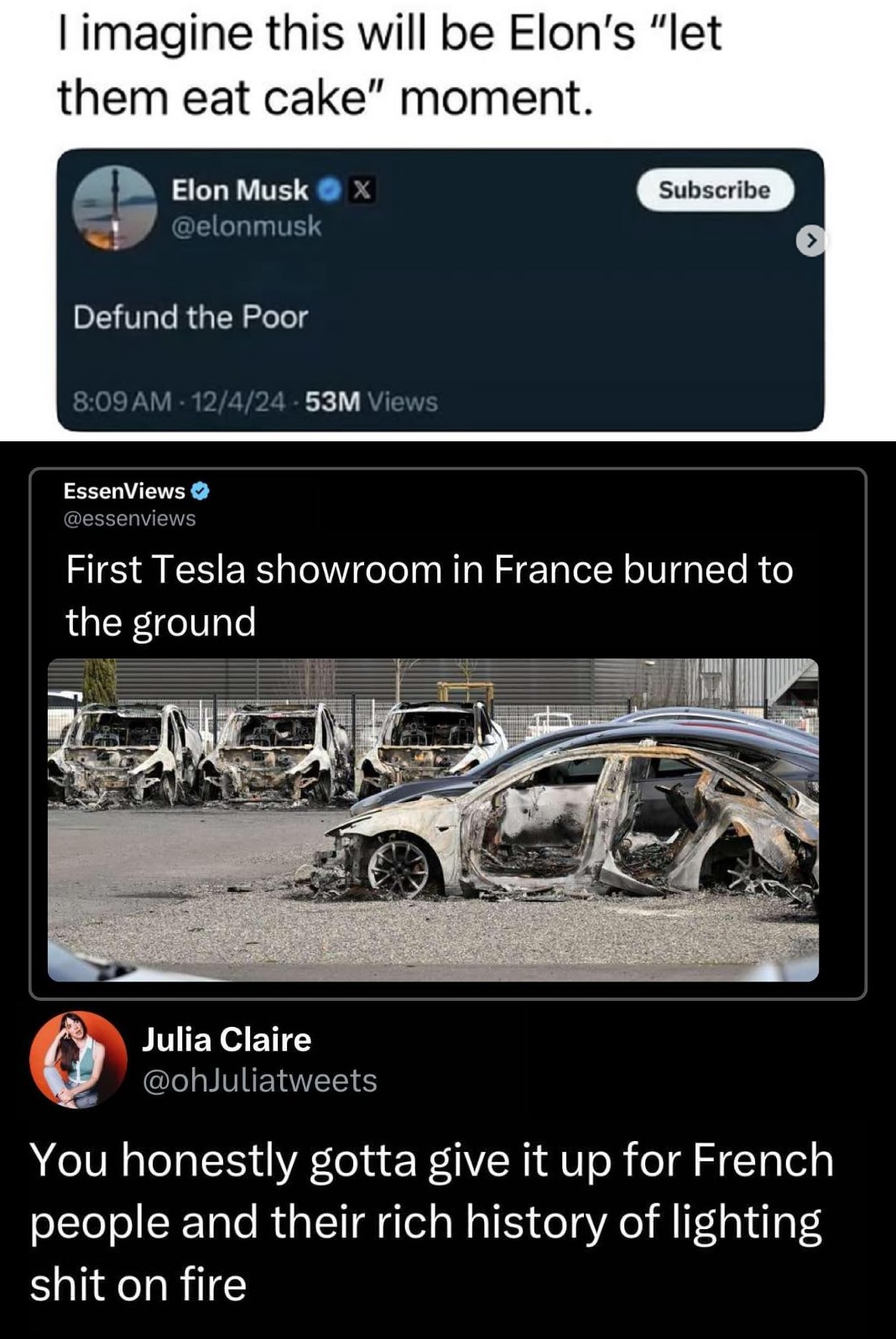
This meme is a potent piece of anti-billionaire rhetoric, playing on historical allusion and contemporary class resentment. It’s less about the specific event (a Tesla showroom burning) and more about the symbolic significance and the reaction to it, particularly as framed by figures like Elon Musk and commentators.
Visual Description
The meme's visual centerpiece is a photograph of a severely damaged Tesla showroom, appearing completely burnt out. Cars within the showroom are visibly charred. This imagery immediately evokes destruction and loss. This destruction is contrasted against the text, which frames this as a trivial matter for the ultra-wealthy.
Foucauldian Genealogical Discourse Analysis
This meme is deeply engaged in a discourse around power and resistance. Michel Foucault's concept of genealogy is relevant here. We aren't seeing a spontaneous act of destruction, but rather a continuation of a history of resistance to power structures. Julia Claire explicitly invokes this history with the mention of “French people and their rich history of lighting shit on fire.”
Foucault would point out that the act of burning the Tesla showroom isn’t inherently meaningful. Its meaning is constructed through the discourse surrounding it. The initial tweet draws on the historical association between the French revolution and the act of burning things as an expression of radical resistance. The 'burning' becomes a symbolic language, a challenge to established order.
The meme’s critique of Musk focuses on the power dynamics at play—Musk’s perceived disconnect from the realities of ordinary people, and his casual dismissal of those realities. The meme actively challenges the power to define what is 'acceptable' protest or response to inequality.
Critical Theory
From a Critical Theory perspective (drawing on the Frankfurt School and thinkers like Adorno and Horkheimer), this meme critiques the “culture industry” and its role in perpetuating capitalist ideology. Tesla, as a symbol of technological advancement and luxury associated with a charismatic billionaire, is part of that culture industry.
The burning of the showroom is a rejection of that culture. It’s a refusal to participate in the spectacle of consumption and wealth. The 'burning' is a destabilizing force, disrupting the illusion of harmonious consumerism and exposing the underlying tensions of a class-divided society.
The meme’s ironic framing—Musk's potential "Let them eat cake" moment— directly references Marie Antoinette and the dismissive attitude of the aristocracy towards the suffering of the masses. It draws a parallel between the historical injustices of the ancien régime and the current concentration of wealth in the hands of individuals like Musk.
Marxist Conflict Theory
This meme is deeply rooted in Marxist Conflict Theory. The burning of the Tesla showroom can be interpreted as an expression of class struggle. The act is a material response to the perceived exploitation and alienation inherent in the capitalist system.
Musk, as a representative of the owning class (the bourgeoisie), embodies the accumulation of capital at the expense of the working class (the proletariat). The showroom, a physical manifestation of Musk’s wealth and power, becomes a target for those who feel marginalized and disenfranchised.
The meme highlights the inherent contradictions within capitalism: the creation of vast wealth alongside widespread poverty and inequality. The “Let them eat cake” parallel underscores the perceived indifference of the wealthy to the struggles of the less fortunate. The comment on the French historical context can be interpreted as a sign of simmering discontent that could lead to significant change in the current system.
Postmodernism
A postmodern reading might emphasize the meme's deconstruction of grand narratives. It challenges the idea of progress, innovation, and the benevolent role of technology (represented by Tesla).
The image of the burned-out showroom is a disruption, a fragmentation of the narrative of sleek, sustainable, and desirable consumer goods. The meme acknowledges that meaning is fluid and context-dependent. The act of burning is not necessarily "wrong" or "destructive" in an absolute sense, but is assigned meaning through social and historical forces.
The meme's ironic tone and use of historical allusion point to a rejection of totalizing ideologies and a celebration of localized, subversive resistance.
In Conclusion
This meme is a charged statement reflecting the growing anger directed toward billionaires and the systemic inequalities they embody. By invoking historical parallels and leveraging theoretical frameworks like Marxism, Critical Theory, and Foucault’s genealogy, it aims to provoke thought and inspire resistance against perceived injustice. It's not simply a celebration of destruction, but a symbolic act of defiance against concentrated wealth and power.
simple-description (llama3.2-vision_11b)
The meme is a screenshot of Elon Musk's Twitter account, where he tweets "I'm going to make sure the poor are fed, and the rich are dying" in response to a joke about him eating a cake with the poor. The meme is a humorous take on the idea that the wealthy are not being held accountable for their actions, and the poor are being forced to live in poverty. The tweet is a satirical commentary on the wealth inequality in the US.
detailed-analysis (gemma3-27b-vision)
Okay, here's an analysis of the image and associated text, broken down into sections as you requested. I'll indicate where a section doesn't apply. Note that these theoretical lenses are interpretive, and different readings are possible.
Visual Description
The image displays a scene inside a burned-out Tesla showroom. The interior is heavily damaged; charred remains of vehicles are visible, with significant fire damage to walls and fixtures. Smoke lingers in the air. People can be seen in the background, seemingly observing the damage, though their expressions are not clearly visible. The lighting is dim and dramatic due to the aftermath of the fire. The overall impression is one of destruction and loss.
Marxist Conflict Theory
This image and the associated text strongly lend themselves to a Marxist interpretation.
- Class Conflict: The central framing of the situation through the “Let them eat cake” analogy – a phrase famously (though likely apocryphally) attributed to Marie Antoinette – immediately draws a parallel to the vast socioeconomic disparities. Elon Musk, a symbol of extreme wealth and capitalist accumulation, is perceived as detached from the struggles of the working class. The burning of the Tesla showroom is presented as a symbolic act of resistance against this perceived indifference.
- Commodity Fetishism & Capital Destruction: The Tesla showroom represents the culmination of capitalist production and consumer desire. Destroying it can be seen as an attack on the commodified world, a rejection of consumer culture, and a challenge to the logic of capital. It’s not just the object (the car) that's targeted, but the system of production, distribution, and consumption that it represents.
- Revolutionary Potential: The text, specifically “lighting shit on fire,” implies a more active, potentially revolutionary response to class inequality. It suggests a rejection of peaceful protest and a willingness to disrupt the established order. The fire can be interpreted as a symbolic act of defiance, a reclaiming of agency by those who feel marginalized and oppressed.
Postmodernism
Postmodern thought offers an interesting lens through which to view this scenario.
- Rejection of Grand Narratives: The imagery challenges the “grand narrative” of technological progress and economic growth. The burned showroom disrupts the seamless story of innovation and wealth creation, exposing the underlying tensions and contradictions.
- Simulacra & Hyperreality: The Tesla showroom itself, as a carefully constructed space of consumer desire, can be seen as a simulacrum—a copy without an original. The destruction of this simulated environment highlights the artificiality and constructedness of modern life.
- Deconstruction of Meaning: The “Let them eat cake” analogy itself is a classic example of deconstruction, re-framing the context of Musk’s statements and exposing the power dynamics at play.
Critical Theory
Critical Theory, particularly rooted in the Frankfurt School, provides a strong interpretive framework.
- Critique of Instrumental Reason: The Tesla showroom and its associated technology can be viewed as examples of instrumental reason—a focus on efficiency and control that often comes at the expense of human values. The destruction of the showroom challenges this logic, suggesting that there are limits to technological progress and the pursuit of profit.
- Culture Industry & Resistance: Tesla, as a brand, is part of the culture industry—a system that produces and disseminates standardized cultural products. The act of arson can be seen as a form of resistance against this homogenization, a rejection of the values and ideologies that the culture industry promotes.
- The Damage to a symbol: The symbolic damage done to a symbol of late stage capitalism like a Tesla showroom can be seen as a form of protest.
Foucauldian Genealogical Discourse Analysis
A Foucauldian approach emphasizes the historical construction of power relations.
- Power/Knowledge: The situation can be analyzed through the lens of power/knowledge. The burning of the showroom is not simply an act of destruction, but a disruption of the discourses of power that surround wealth, technology, and class. It challenges the narratives that legitimize inequality and the dominance of certain groups.
- Genealogy of Protest: Tracing the "genealogy" of this specific act of protest (the arson) would involve examining the historical conditions and discursive formations that have led to it. This includes looking at the history of class conflict, anti-capitalist movements, and the specific discourses surrounding Tesla and Elon Musk.
- Discipline and Control: The Tesla showroom, as a site of consumption and surveillance, can be seen as a manifestation of disciplinary power. The act of burning it down can be interpreted as a rejection of this control, an assertion of autonomy, and a disruption of the normalized systems of surveillance and regulation.
Queer Feminist Intersectional Analysis
While less directly applicable than some of the other frameworks, an intersectional perspective can still offer insights:
- Systems of Oppression: An intersectional lens would examine how the economic and class inequalities at play intersect with other forms of oppression, such as those based on gender, race, sexuality, and ability. The burning of the showroom could be seen as a response to a broader system of domination that affects multiple marginalized groups.
- Disruption of Norms: The act of arson, as a transgression of legal and social norms, can be seen as a radical act of resistance that challenges the established power structures. This is particularly relevant from a queer feminist perspective, which often embraces disruption and challenges to traditional norms.
- Disproportionate Impact: An intersectional analysis would look at how the economic crisis impacts marginalized communities, making their lives increasingly precarious and increasing the potential for radical acts of resistance.
Important Considerations:
- Moral Judgment: These theoretical frameworks are analytical tools, and do not necessarily endorse or condemn the act of arson.
- Context: The interpretation of this image and text is highly dependent on the specific context in which it is presented and the intentions of those who share it.
I hope this breakdown is helpful! Let me know if you would like me to elaborate on any specific aspect of these analyses.
simple-description (llama3.2-vision)
This meme is a humorous comparison between two vastly different tweets. The first tweet, from Elon Musk, is a sarcastic comment about the state of the economy, saying "Defund the Poor". The second tweet is a response from a user named "Julia" who is responding to a news article about a devastating fire that destroyed a Tesla showroom in France, saying "You honestly gotta give it up for the French people and their rich history of lighting things on fire".