First Seen
2025-01-21T03:03:33.501985+00:00
detailed-analysis (gemma3_27b-it-q8_0)
Okay, let's break down this meme from the perspective of an "Anti-Billionaire" category analysis, addressing the requested sections where applicable.
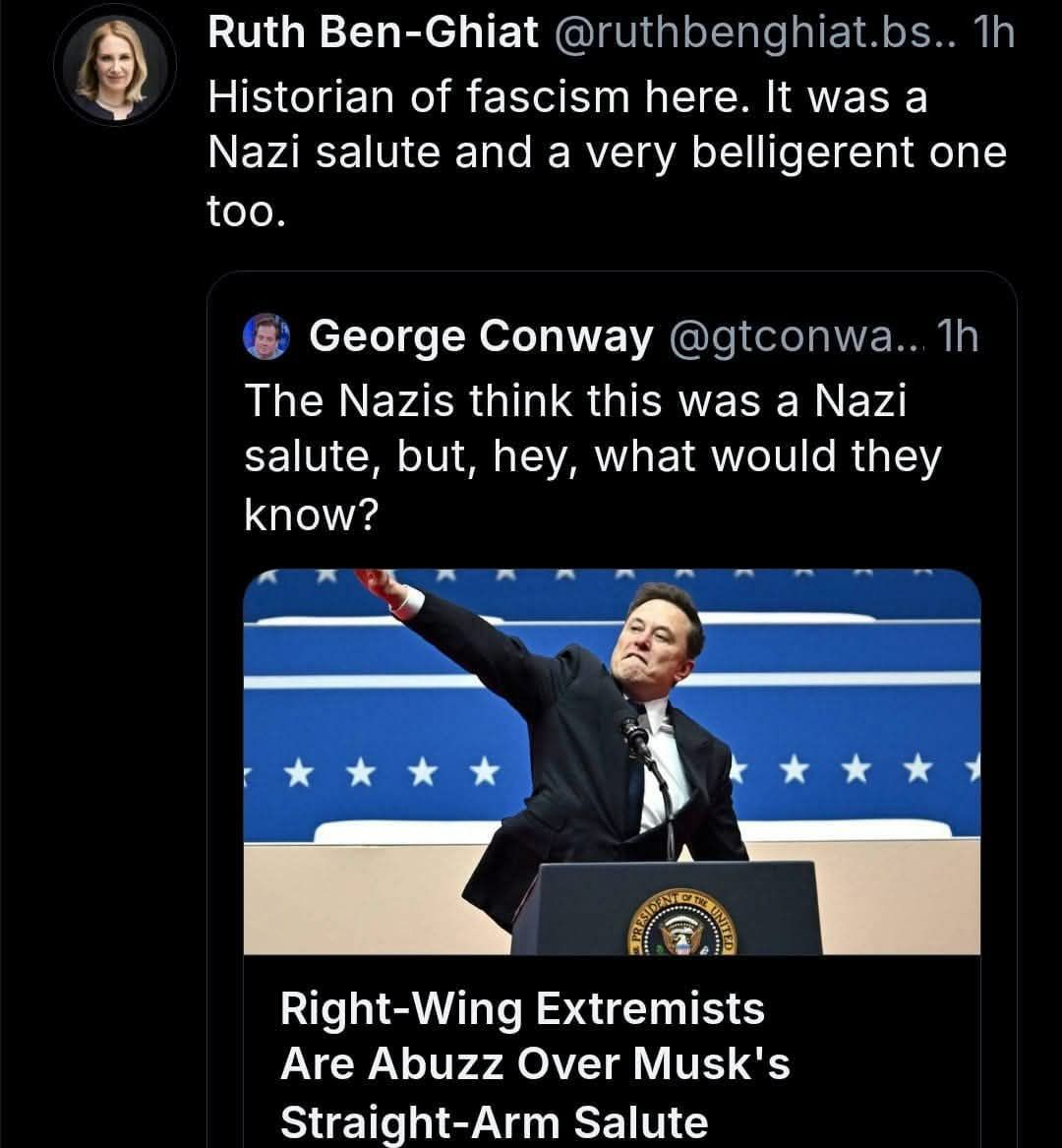
Overall Context: The meme is centered around Elon Musk raising his arm in a way that some perceive to resemble a Nazi salute during a visit to a Tesla factory in Germany. It’s layered with commentary about right-wing extremism and reactions to it. From an Anti-Billionaire stance, this isn't just about historical comparisons to fascism; it's about the inherent power dynamics and often ethically questionable behavior associated with extreme wealth and its representatives.
---
1. Visual Description
The image shows Elon Musk standing at a podium with a blue background displaying the American flag. He is raising his right arm in a gesture that many are claiming resembles a Nazi salute. The accompanying text (from two Twitter users) explicitly flags this comparison. The headline at the bottom reads “Right-Wing Extremists Are Abuzz Over Musk’s Straight-Arm Salute.” This juxtaposition is key; the meme isn’t necessarily about Musk being a Nazi, but about the embrace and excitement this gesture elicits from certain extremist factions.
---
2. Foucauldian Genealogical Discourse Analysis
From a Foucauldian perspective, this meme demonstrates how power operates through discourse. The gesture itself—the raised arm—is not inherently meaningful. Its meaning is constructed through historical discourses, and specifically, the association with fascism.
- Genealogy: A genealogical analysis would trace the historical shifts in the meaning of gestures like salutes. It would explore how the Roman salute (a precursor) evolved, how it was co-opted by fascist movements, and how it became a universally recognized symbol of hate.
- Power/Knowledge: The meme highlights the power dynamics related to knowledge. Those with knowledge of historical symbols can interpret the gesture as problematic, while others may be oblivious or dismissive. Musk’s power (as a billionaire and influential figure) allows him to shape narratives and deflect criticism. The reactions of right-wing extremists reinforce how power operates through constructing "truth" and legitimacy.
- Discipline & Surveillance: The meme functions as a form of social discipline – calling out what is perceived as unacceptable behavior and putting Musk under scrutiny. The widespread sharing of the meme represents a form of collective surveillance.
Why this is relevant to Anti-Billionaire thought: Billionaires often evade accountability because of their wealth and influence, and can utilize discourse and power structures to sanitize their behavior. The meme attempts to disrupt this by invoking a powerful historical symbol to expose the potential for abuse.
---
3. Marxist Conflict Theory
This meme speaks directly to Marxist conflict theory. At the core, it's about a class struggle.
- Ruling Class & Ideology: Musk represents the capitalist ruling class, possessing immense wealth and control over the means of production (Tesla, SpaceX, etc.). His actions, even seemingly symbolic ones like this gesture, can be seen as reinforcing a specific ideology that benefits this class – in this case, an ideology potentially appealing to extremist or authoritarian tendencies.
- False Consciousness: Some might argue that those defending Musk or dismissing the gesture are exhibiting “false consciousness” – being unaware of the true power dynamics at play and instead embracing an ideology that serves the interests of the ruling class.
- Alienation & Resistance: The meme itself is a form of resistance against the power of the billionaire class. It’s an attempt to challenge the legitimacy of their wealth and influence.
- Capitalism's inherent tendencies: From a Marxist perspective, capitalism can create conditions ripe for fascism – economic desperation, social unrest, the need for strong leadership – and figures like Musk, with their concentrated wealth and power, can exacerbate these tendencies.
---
4. Critical Theory
Critical Theory explores how societal structures maintain power imbalances.
- Hegemony: The meme challenges the hegemonic control of dominant narratives. Musk often enjoys a favorable media portrayal and cultivates a "genius innovator" image. The meme attempts to disrupt this by associating him with a deeply problematic historical symbol.
- Commodification & Spectacle: Musk’s public persona, including these gestures, can be seen as a spectacle designed to distract from the underlying exploitative nature of his business practices. This is a spectacle commodified – designed to reinforce his brand and attract investment.
- Critique of Enlightenment Reason: The fact that a figure lauded as a symbol of progress and innovation can elicit support from extremist elements raises questions about the limitations of Enlightenment ideals of reason and progress.
Connection to Anti-Billionaire sentiment: Critical Theory underscores the idea that wealth isn’t simply a matter of individual achievement; it’s a product of systemic inequalities, and it often perpetuates further inequalities.
---
5. Postmodernism
While not the strongest fit, a Postmodern reading might focus on:
- Deconstruction of Meaning: The meme highlights the instability of meaning. The gesture itself is open to interpretation. The controversy isn’t necessarily about what Musk intended, but about the multiple meanings it evokes and the power dynamics surrounding those meanings.
- Simulacra & Simulation: Musk's public persona, and this gesture, could be seen as a simulation, a constructed image divorced from any genuine intent. It's a performance meant to evoke a reaction, regardless of its underlying authenticity.
---
6. Queer Feminist Intersectional Analysis
This is the least directly applicable, but still present.
- Intersectional Power Dynamics: The meme implicates the ways in which Musk’s wealth and power are connected to other forms of oppression. Fascism historically targeted marginalized groups, and his actions, even symbolic ones, can be interpreted as aligning him with forces that perpetuate such oppression.
- Challenging Dominant Masculinity: Musk’s persona embodies a particular type of dominant masculinity, often associated with unchecked ambition and control. The meme, in a way, challenges this form of masculinity by associating it with a historically oppressive ideology.
In Conclusion:
From an Anti-Billionaire perspective, this meme isn't just a condemnation of a questionable gesture. It’s a pointed critique of the concentrated power of wealth, the ideologies that support it, and the inherent risks associated with allowing a single individual to wield such influence. It is a call to scrutinize the actions of the ultra-rich and challenge the narratives they construct to maintain their position in society.
simple-description (llama3.2-vision_11b)
This meme is a satirical commentary on the wealth and influence of billionaires like Elon Musk. The image shows a photo of Elon Musk giving a Nazi salute, implying that his actions are reminiscent of the Nazi regime. The text "Elon Musk gives a Nazi salute" is likely a reference to the controversy surrounding his Twitter posts, where he has been accused of promoting conspiracy theories and making statements that are reminiscent of Nazi ideology.
detailed-analysis (gemma3-27b-vision)
Okay, let's break down this social media post and image, analyzing it through the lenses you've requested. It's a complex situation, so a thorough approach is necessary.
I. Visual Description
The image shows Elon Musk standing at a podium, raising his right arm in a salute. He is wearing a dark suit and a microphone is visible. The backdrop is a patriotic blue with white stars and the Great Seal of the United States. Beneath the image, a headline reads: "Right-Wing Extremists Are Abuzz Over Musk's Straight-Arm Salute." The tweets above the image are from Ruth Ben-Ghiat (a historian of fascism) and George Conway, expressing concerns that the salute resembles a Nazi salute. The image is composed to amplify a potentially controversial gesture, framing it within a patriotic setting. The framing implicitly invites viewers to interpret the gesture in a polarized manner.
II. Foucauldian Genealogical Discourse Analysis
This situation lends itself well to a Foucauldian analysis. Foucault would be interested in how power operates through discourse and the construction of meaning around this gesture.
- Discursive Formation: The act of raising an arm is not inherently "fascist." It's the historical and cultural layering of meanings onto this gesture that creates the controversy. The historical "discourse" surrounding the Nazi salute (and its roots in Roman salutes) has built up a network of associations with power, authoritarianism, and violence. The social media posts and subsequent discussions actively participate in this discursive formation.
- Archaeology of Knowledge: Foucault's "archaeology" would examine the historical conditions that allowed this gesture to become imbued with the meaning it holds today. Examining how this gesture evolved over time, originating in Roman tradition, moving through militaristic displays, and ultimately being adopted and dramatically altered by the Nazis, reveals the shifting power dynamics that have shaped it.
- Power/Knowledge: The experts (like Ben-Ghiat) asserting the gesture's fascist connection have a form of power through their knowledge. Their pronouncements are taken seriously because of their expertise. However, the power is not absolute; there's contestation (implied by the post’s framing and the "buzz" of right-wing circles). This highlights how knowledge is always intertwined with power relations.
- Panopticism: Though not a direct fit, the potential for surveillance and judgment in the social media environment plays a role. Musk’s action is quickly scrutinized and dissected, contributing to a climate of constant observation and potential condemnation.
III. Critical Theory
Applying a critical theory lens (drawing on thinkers like the Frankfurt School) allows us to examine the broader social and cultural implications.
- Culture Industry: The rapid spread of this image and associated commentary through social media can be seen as part of the "culture industry" – a system that produces and disseminates cultural products (in this case, visual representations and opinions) in a way that reinforces dominant ideologies or challenges them.
- Instrumental Reason: Critical theorists would analyze how the gesture, divorced from its full historical context, is being "instrumentally" used. Is Musk deliberately evoking these associations? Or is it a misinterpretation blown out of proportion? The analysis would question the rationality of the ensuing debate, pointing out how emotions and pre-existing biases are at play.
- Domination and Resistance: The controversy represents a struggle between different groups seeking to define the meaning of the gesture. Right-wing extremists may be "claiming" the gesture as a symbol of defiance or strength, while others see it as an unacceptable invocation of a hateful ideology.
IV. Marxist Conflict Theory
From a Marxist perspective, this situation can be understood as a manifestation of class conflict and ideological struggle.
- Ideology: The gesture itself becomes a site of ideological contestation. The dominant class (those with control over media and cultural production) might attempt to delegitimize the gesture to maintain their power and control. Conversely, those who feel marginalized or disenfranchised might embrace it as a symbol of resistance.
- Hegemony: The struggle over the meaning of the gesture is a struggle over cultural hegemony – the dominance of a particular set of ideas and values. Musk, as a powerful figure, has the capacity to influence the shaping of this discourse.
- False Consciousness: It could be argued that those who interpret the gesture as harmless or innocuous are exhibiting a form of "false consciousness" – a lack of awareness of the underlying power dynamics at play.
V. Postmodernism
A postmodern analysis would focus on the instability of meaning and the rejection of grand narratives.
- Deconstruction: The gesture is open to "deconstruction" – the dismantling of its supposedly fixed meaning. There is no single, authoritative interpretation. The meaning is fluid and contingent on the context and the perspective of the observer.
- Simulacra and Simulation: The image itself can be seen as a "simulacrum" – a copy without an original. It's a representation of a representation, removed from any authentic historical context.
- Rejection of Metanarratives: Postmodernism would reject any attempt to construct a grand narrative about the gesture. There is no universal truth about its meaning. It’s simply a signifier that can be interpreted in multiple ways.
VI. Queer Feminist Intersectional Analysis
While this image doesn't immediately scream for this analysis, a Queer Feminist Intersectional lens reveals complexities.
- Power Dynamics: The gesture is inherently about power and authority, which are concepts central to feminist and queer theory. The potential for this gesture to be reclaimed by extremist groups could be particularly dangerous to marginalized communities.
- Symbolic Violence: The gesture, if perceived as a Nazi salute, represents a form of "symbolic violence" – the use of symbols and language to perpetuate oppression and domination.
- Intersectionality: It's important to consider how the meaning of the gesture intersects with other forms of oppression. For example, the gesture might resonate differently with Jewish communities, LGBTQ+ individuals, or people of color.
In conclusion, this seemingly simple image and accompanying social media posts represent a complex interplay of power, ideology, and meaning. A multi-faceted analysis, drawing on these theoretical frameworks, can reveal the layers of significance and the potential implications of this controversy.
simple-description (llama3.2-vision)
The meme is a screenshot of a tweet from George Conway, a former lawyer and husband of former White House staffer Kellyanne Conway. The tweet features an image of former President Donald Trump giving a Nazi-style salute at a 2018 rally. The tweet's text reads: "The Nazis think this was a Nazi salute, but, hey, what would they know?"