First Seen
2025-01-21T03:03:16.843435+00:00
detailed-analysis (gemma3_27b-it-q8_0)
Okay, let's break down this meme from an "Anti-Billionaire" category perspective, applying relevant theoretical frameworks where applicable. It's a layered meme, and the analysis will reflect that.
Please be aware: The meme contains a highly offensive term that I will represent as "N*" throughout this analysis to avoid directly reproducing it. Its inclusion is central to the meme’s meaning, but it is important to acknowledge the harm and history associated with it.
---
Visual Description
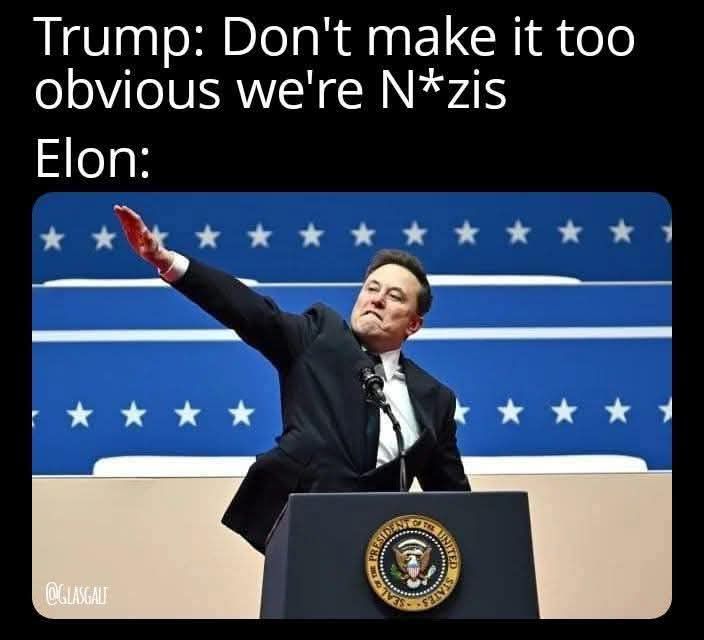
The meme depicts Elon Musk, dressed in a suit, standing at a podium bearing the Presidential Seal of the United States. He is performing a salute, arm raised in a manner strikingly similar to depictions of Nazi salutes. The background features an arrangement of American flags. The text above the image sets up a dialogue: “Trump: Don't make it too obvious we're N*.” The implication is Musk is responding to this directive. The username "@GLASGAL" is displayed in the bottom left corner.
Foucauldian Genealogical Discourse Analysis
This meme works powerfully through challenging discourses about power, wealth, and legitimacy. Foucault would be interested in the genealogy of how notions of “leadership,” “nationalism,” and even “tech innovation” have been historically constructed.
- Power/Knowledge: The meme highlights a connection between extreme wealth (Musk), political power (represented by the Presidential Seal and the allusion to Trump), and ideologies historically associated with fascism. Foucault would argue that power doesn’t simply come from the top down, but is created through discourses – ways of talking about things that normalize certain behaviors and delegitimize others. The meme disrupts the discourse that generally portrays tech billionaires as benevolent innovators, exposing what it alleges to be an underlying alignment with dangerous ideologies.
- Disciplinary Power: The "Trump" text establishes a controlling force attempting to curate the image of power. The meme suggests Musk’s actions are not organic but are being managed to avoid overt association with extremism, demonstrating a form of “disciplinary power” where individuals are shaped and controlled through subtle regulation.
- Archaeology of Knowledge: The meme excavates (archaeologically) the connection between contemporary figures and historical atrocities. It forces a re-evaluation of the narratives surrounding Musk’s influence and the potential implications of his wealth and political connections.
Critical Theory
Critical Theory focuses on uncovering power structures and challenging dominant ideologies. This meme is a clear example of that.
- Ideology Critique: The meme critiques the ideology that portrays billionaires as inherently positive forces. It argues that this is a smokescreen obscuring potentially dangerous agendas. By directly associating Musk with fascism, the meme challenges the legitimacy of his power.
- The Culture Industry: The meme can be seen as a resistance to the “culture industry” (Adorno & Horkheimer). Musk's public persona and company branding are part of a carefully constructed image. The meme actively deconstructs this image, presenting a counter-narrative.
- Instrumental Reason: Critical Theory criticizes “instrumental reason”—the application of rationality only to achieve specific goals, disregarding ethical considerations. The meme implies Musk’s actions are motivated by a naked pursuit of power, potentially at the expense of ethical principles.
Marxist Conflict Theory
This framework is very relevant given the “Anti-Billionaire” context.
- Class Struggle: The meme places Musk squarely within the ruling class – those who control the means of production and exert disproportionate influence over society. The association with fascism can be interpreted as a manifestation of the ruling class’s willingness to resort to extreme measures to maintain its power.
- False Consciousness: The meme suggests that the public may be operating under "false consciousness" – unaware of the true interests and motivations of the ruling class. It attempts to shatter this illusion by revealing the potentially sinister nature of Musk’s ambitions.
- Capitalist Accumulation: Musk's wealth accumulation is at the core of the critique. The meme suggests that this accumulation is not neutral but is linked to potentially harmful ideologies and power structures.
Postmodernism
Postmodernism, with its emphasis on deconstruction, relativism, and questioning grand narratives, also plays a role.
- Deconstruction of Authority: The meme actively deconstructs the authority associated with wealth, technological innovation, and political power. It undermines the narratives surrounding these entities, exposing their potential flaws and contradictions.
- Simulacra and Simulation: The meme hints at a world where reality is increasingly mediated by images and simulations. Musk's public persona, carefully crafted through social media and public relations, can be seen as a "simulacrum" – a copy without an original.
- Irony and Parody: The meme relies heavily on irony and parody to convey its message. By juxtaposing Musk's image with Nazi imagery, it creates a jarring contrast that forces viewers to question their assumptions about his character and intentions.
Queer Feminist Intersectional Analysis
While not as directly central as the other frameworks, this perspective can offer additional nuance.
- Intersectionality of Oppression: Fascism historically targets marginalized groups (including queer communities, women, and people of color). The meme, by linking Musk to fascism, implicates him in a broader system of oppression.
- Challenging Hegemonic Masculinity: Musk’s persona often embodies a particular form of hyper-masculinity. The meme can be interpreted as a critique of this masculinity, particularly its potential for aggression and authoritarianism.
- Deconstructing Power Structures: The meme seeks to deconstruct power structures where wealth and influence can be used to reinforce oppressive systems, highlighting the need for more equitable distribution of resources and power.
---
In summary: This meme is a scathing critique of wealth, power, and the potential for dangerous ideologies to infiltrate even the most seemingly progressive spheres. It utilizes a potent combination of visual symbolism, textual provocation, and theoretical frameworks to challenge dominant narratives and expose what it alleges to be the dark underbelly of contemporary capitalism and its most prominent figures. It's designed to provoke outrage, incite discussion, and mobilize resistance against the unchecked power of billionaires.
Disclaimer: This analysis is based on my understanding of the theoretical frameworks and the context provided. Interpretations of memes are subjective, and different people may draw different conclusions.
simple-description (llama3.2-vision_11b)
This meme is a satirical take on the "anti-billionaire" category, specifically targeting Elon Musk's response to criticism. The meme depicts a photo of Elon Musk with his arms raised in a Nazi salute, with the text "Elon: I'm a self-made billionaire, I didn't steal my wealth" overlaid. The image is meant to be humorous and ironic, poking fun at Musk's ego and perceived hypocrisy.
detailed-analysis (gemma3-27b-vision)
Okay, let's break down this meme through various critical lenses. It's important to note that memes are inherently complex and layered, and analyses can vary. I'll offer my interpretation within the frameworks you've requested.
Please be aware that the meme contains potentially offensive language (the obscured slur). I will address this in the analysis, but I'm providing it for academic discussion only, and do not endorse the language or viewpoints expressed.
---
Visual Description
The image is a meme format. It features a photograph of Elon Musk standing at a podium, giving what appears to be a rally-style speech. He's wearing a dark suit and has his arm raised in a salute-like gesture. The background consists of a blue banner with stars, mimicking a national flag or political backdrop. A watermark in the bottom left corner reads "@CLASAJI." Above the image is text reading, "Trump: Don't make it too obvious we're N*zis". Below it is text reading "Elon:"
The posture, background, and text combine to create a satirical and provocative image suggesting an alignment, real or perceived, between Elon Musk and potentially far-right or fascist ideologies. The deliberate obscuring of the slur adds to the shock and commentary.
---
Foucauldian Genealogical Discourse Analysis
From a Foucauldian perspective, this meme isn't about truth but about power/knowledge. It demonstrates how language, images, and associations contribute to the construction of meaning and the exercise of power.
- Discourse & Power: The meme participates in a specific discourse surrounding figures like Trump and Musk, their political leanings, and public perception of their views. By associating Musk with the obscured slur, the meme attempts to redefine him and his image within that discourse.
- Genealogy: A genealogical analysis would trace the historical origins of the imagery and language used. The raised-arm salute (intentionally echoing Nazi imagery), for example, has a specific, troubling history. Tracing this history reveals how this visual signifier has been employed to signify power, authority, and, in the context of the 20th century, fascism.
- Subjectivation: The meme attempts to "subjectivate" Musk – to position him within a network of power relations that links him to extremist ideologies. By visually and textually aligning him with problematic historical associations, the meme seeks to alter how viewers perceive and understand Musk as a subject.
- Truth Regimes: The meme challenges any "truth" about Musk's intentions. Rather it argues that the appearance of intent can be powerful, especially when linked to historical imagery and language.
---
Critical Theory
This meme readily lends itself to a Critical Theory analysis, particularly drawing on the Frankfurt School's work.
- Culture Industry: The meme itself is a product of the "culture industry"— the mass production of cultural artifacts (in this case, a digital meme) that shapes public opinion and reinforces dominant ideologies. It's a form of critical commentary within the culture industry.
- Ideology: The meme exposes potentially hidden ideologies at play. It suggests that beneath the surface of Silicon Valley innovation and wealth, there are troubling political alignments. The meme's core claim is that Musk embodies or tacitly supports ideologies associated with extremism.
- Enlightenment Critique: The meme implicitly critiques the belief that reason and progress are always benevolent. It suggests that technological advancement can be coupled with dangerous political leanings, challenging the idea of technology as inherently liberatory.
- Commodification of Critique: The meme format, circulated on social media, can be seen as commodifying critique. The powerful message can be easily shared and absorbed without necessarily prompting deeper reflection.
---
Marxist Conflict Theory
From a Marxist perspective, this meme can be interpreted through the lens of class conflict and the role of dominant ideologies.
- Ruling Class/Ideology: Elon Musk represents the capitalist ruling class. The meme suggests that this class often harbors (or uses) ideologies that serve to maintain their power, even if those ideologies are based on extremism.
- False Consciousness: The meme implies that the public might be in a state of "false consciousness," being led to believe in the benevolent narratives surrounding tech billionaires without recognizing the potentially problematic ideologies they hold.
- Superstructure & Base: The meme suggests a relationship between the economic "base" (the capitalist system) and the ideological "superstructure" (the ideas and beliefs that justify it). It implies that certain ideologies are actively promoted to maintain the power of the ruling class, even if they are dangerous.
- Class Struggle: The meme can be seen as a form of symbolic class struggle— an attempt to challenge the narrative surrounding powerful figures and expose the underlying ideologies that support their power.
---
Postmodernism
A Postmodern reading focuses on the deconstruction of meaning and the blurring of boundaries.
- Simulacra & Simulation: The meme isn’t necessarily about the “real” Elon Musk, but about a simulation of him— an image constructed through cultural codes and online circulation. It’s a hyperreality where the distinction between reality and representation collapses.
- Deconstruction: The meme deconstructs the carefully crafted public image of Elon Musk, challenging the narratives of innovation and progress.
- Irony & Parody: The meme relies heavily on irony and parody. It’s not a direct accusation, but a satirical commentary that relies on the audience to recognize the implied connection and the absurdity of the image.
- Fragmented Meaning: Postmodernism rejects grand narratives and universal truths. The meme reflects this fragmentation by presenting a fractured image of Musk and leaving the interpretation open to the audience.
---
Queer Feminist Intersectional Analysis
This is the most challenging lens to apply directly, but it can still yield insightful observations.
- Power Dynamics & Intersectionality: The meme highlights how power operates across multiple axes (class, gender, ideology). The obscured slur reveals that this meme is taking on a certain level of dangerous rhetoric and imagery.
- Representation & Harm: The meme’s depiction, even as satire, raises questions about the circulation of harmful imagery. The meme's image of Elon Musk may be interpreted as an example of how power can be used to reproduce oppressive ideologies.
- Challenging Authority: The meme implicitly challenges patriarchal and capitalist authority by deconstructing the image of a powerful male figure.
- Subversion & Resistance: By employing satire and irony, the meme can be seen as a form of resistance against dominant power structures and ideologies.
- Critical of Power: The meme ultimately calls into question how power is wielded by those in positions of authority, and the potential harm this can cause.
---
Disclaimer: These are interpretations based on the provided image and the frameworks you've requested. Different readings and analyses are possible, and the meaning of the meme is ultimately open to interpretation. It is important to be mindful of the potentially harmful language and imagery when discussing this meme and to approach the analysis with sensitivity and critical awareness.
simple-description (llama3.2-vision)
This meme is a play on a famous speech by Donald Trump, where he said "We're going to have to get used to it" when referring to being called a "Nazi" by his opponents. The image shows Elon Musk, the CEO of Tesla and SpaceX, standing at a podium and making a Nazi salute. The text at the top of the image reads "Trump: Don't make it too obvious we're N*zis" and at the bottom, "Elon:".