First Seen
2024-10-14T22:20:31.939977+00:00
detailed-analysis (gemma3_27b-it-q8_0)
Okay, here's an analysis of the meme "Elon Musk Promises ‘Robotaxi’ Will Be 10 Times More Racist Than Average Taxi Driver" through the lens of the "Anti-Billionaire" category, broken down into applicable theoretical frameworks.
Meme Analysis: "Robotaxi Racism" – An Anti-Billionaire Perspective
Visual Description
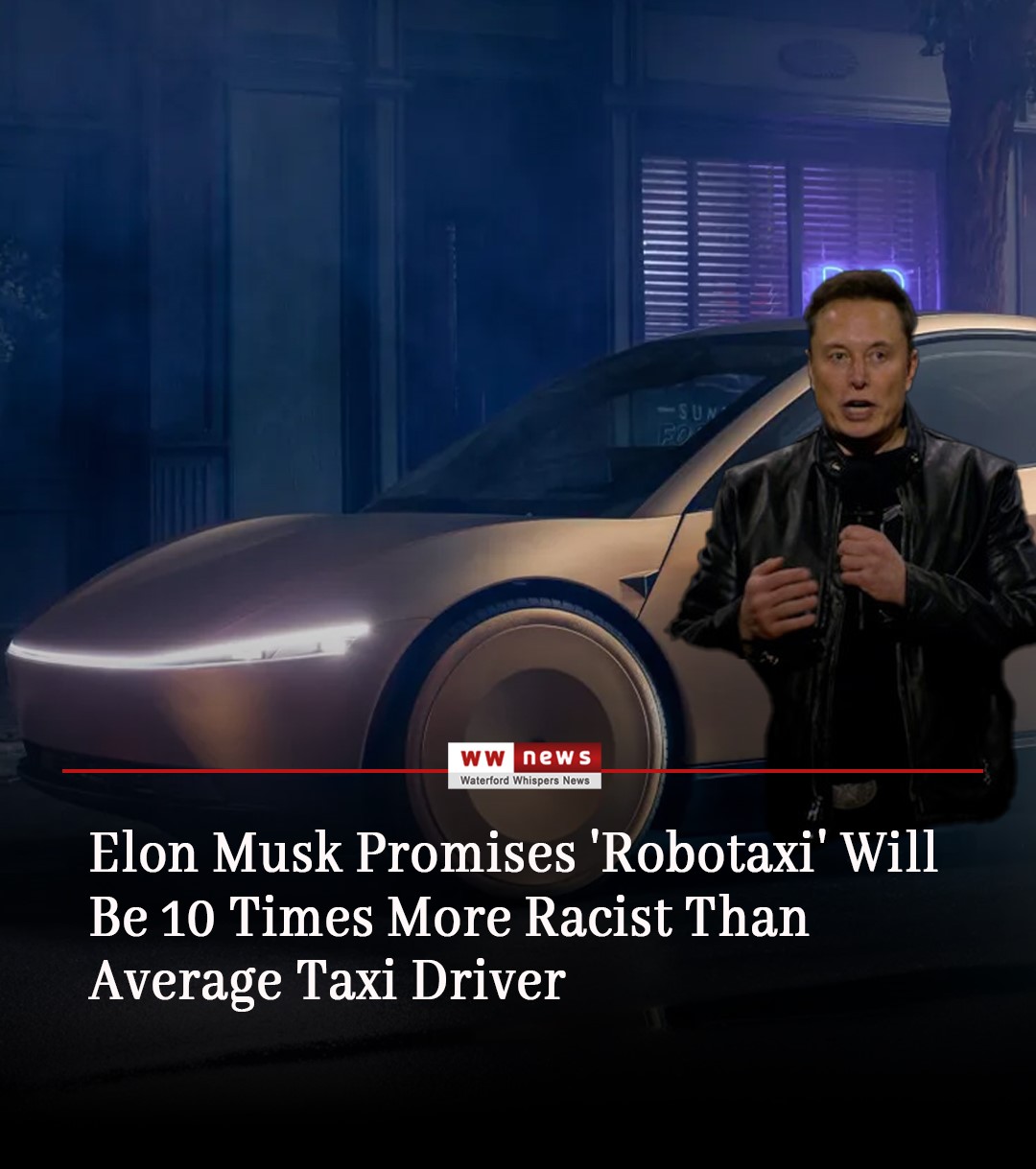
The image shows Elon Musk standing in front of a partially obscured Tesla vehicle, likely a prototype of the 'Robotaxi'. The vehicle's headlights are glowing, and the backdrop appears to be a city street at night. Musk is pictured in a fairly neutral pose, gesturing with his hands. The overall aesthetic is sleek and futuristic, but the framing suggests something ominous lurking beneath the surface of technological advancement. The headline text, prominently displayed, is the key message and provides the cynical framing. The logo "WW news" is likely a satire source.
Critical Theory
This meme powerfully utilizes critical theory to expose the inherent power structures embedded within technological "innovation" championed by billionaires like Elon Musk. The core argument rests on the idea that technology isn't neutral; it reflects and amplifies the biases of its creators and the systems within which it's developed.
- The Illusion of Objectivity: Musk presents the Robotaxi as a rational, efficient system – a "solution" to transportation. Critical theory would deconstruct this claim. The meme reveals the potential for algorithmic bias—algorithms, despite appearing objective, are coded by humans who hold inherent biases. The claim of being "10 times more racist" is deliberately hyperbolic, but it points to the very real danger of automating existing prejudices.
- Ideology and Technology: The meme critiques the ideology of "technological solutionism" – the belief that technology can fix social problems. It argues that, without addressing the underlying systemic issues of racism, technology will merely reproduce and even amplify these inequalities. The meme frames the Robotaxi not as progress but as a technologically-advanced method of enacting/perpetuating discrimination.
- Critique of Authority: Musk embodies the authority of the tech mogul. This meme actively discredits that authority. It implies that his pursuit of innovation is not about serving society but about consolidating power, even if it means exacerbating social injustices.
Marxist Conflict Theory
From a Marxist perspective, the meme highlights the conflict between the capitalist class (represented by Musk and other tech billionaires) and the working class/marginalized communities.
- Commodification of Labor: The Robotaxi, intended to replace human taxi drivers, represents the commodification of labor and the displacement of workers in the name of profit. This meme subtly suggests that even the "optimized" labor of automation will still reflect and reinforce existing class and racial inequalities. The promise of efficiency comes at the cost of livelihoods, and the algorithms powering the system may discriminate against potential riders.
- Control of the Means of Production: Musk's control over the development and deployment of this technology allows him to shape the system in a way that benefits his own interests (profit, control) rather than the interests of those who will be affected by it. The meme questions who really benefits from this "innovation."
- Reinforcement of Power Structures: The statement implies that the Robotaxi will perpetuate racial biases, effectively solidifying the existing power dynamics. The meme underscores that, in a capitalist system, technological advancement often serves to reinforce, rather than challenge, existing social hierarchies.
Foucauldian Genealogical Discourse Analysis
This framework helps unpack how the discourse surrounding technology enables such outcomes.
- Power/Knowledge: Foucault argued that power and knowledge are intertwined. The very act of defining and categorizing things (like 'race' or 'safe driving profiles') within the Robotaxi's programming creates power dynamics. The algorithms become instruments of power, reinforcing established categories and potentially discriminating based on them. Musk, as the architect of this system, wields this power.
- Discursive Construction of Reality: The meme disrupts the "naturalized" discourse around technological progress. It challenges the narrative that technology is inherently good or neutral. Instead, it exposes the ways in which it is socially constructed—and therefore, subject to critique and change. The very act of saying the Robotaxi will be more racist than a human driver questions the legitimacy of the system before it even exists.
- Biopower: The Robotaxi’s programming has the potential to exert control over people's movements and access to resources, operating as a form of "biopower" – control over life and bodies through technological means. This resonates with concerns about surveillance, data privacy, and algorithmic governance.
In Conclusion (From an Anti-Billionaire Stance)
The meme isn’t just making a joke; it's a critique of the unchecked power of billionaires, the myth of technological neutrality, and the potential for technology to exacerbate existing social inequalities. It serves as a warning: without careful consideration of the ethical and social implications, "innovation" can easily become a tool for oppression. The meme's cynicism is deliberate; it's a rejection of the utopian vision often sold by tech companies and a call for greater accountability and democratic control over technology. It’s a clear expression of distrust toward the intentions of figures like Elon Musk, and a rejection of the idea that wealth equates to social benefit.
simple-description (llama3.2-vision_11b)
The meme is a humorous comparison between the Tesla CEO's promise of a $25,000 electric car, the Tesla Cybertruck, and the price of a single ride in a taxi. The meme states "Tesla's $25k electric car will be 10 times cheaper than Uber".
detailed-analysis (gemma3-27b-vision)
Okay, let's break down this image and its provocative text through the lens of several theoretical frameworks. Be warned that this is a complex image, and these frameworks can lead to multiple interpretations. I'll indicate where a particular framework is less relevant.
1. Visual Description
The image presents a sleek, futuristic vehicle—likely a Tesla or a prototype—illuminated by a pink glow, prominently displayed in the foreground. The background appears to be a nighttime urban setting, possibly a city street, with blurred lights suggesting movement.
To the right of the vehicle stands Elon Musk, dressed in a black leather jacket, gesturing dramatically with a clenched fist. The lighting is staged to create a high-contrast, dramatic effect emphasizing Musk’s presence.
Superimposed on the image is text in bold white lettering against a red banner labeled "WW News" (Waterford Whispers News - it's a satire site) proclaiming: "Elon Musk Promises 'Robotaxi' Will Be 10 Times More Racist Than Average Taxi Driver." The typography is designed to be eye-catching and attention-grabbing.
The overall aesthetic suggests a blend of technological innovation and slightly unsettling spectacle. The contrast between the futuristic vehicle and the deliberately provocative statement creates a sense of irony and tension.
2. Foucauldian Genealogical Discourse Analysis
This image is ripe for a Foucauldian analysis. The claim made in the text—that the "Robotaxi" will be more racist than a human taxi driver—is not a statement about an existing reality but a construction of discourse.
- Power/Knowledge: The statement links technology (the Robotaxi) with the concept of race and racism, framing them as inextricably linked. This demonstrates how power structures shape what we understand as knowledge. The claim isn’t that AI is inherently racist, but that the systems being built will reflect and potentially amplify existing societal biases.
- Discipline & Surveillance: The 'Robotaxi' embodies a panoptic form of surveillance. Unlike a human driver, it’s implied that the robotaxi will relentlessly collect data, potentially used to categorize, profile, and discriminate.
- Genealogy: The genealogy of racism isn't a linear progression toward an “end point,” but a complex web of shifting discourses and power relations. The image points to how these relations will be re-encoded and potentially automated within the Robotaxi.
- Discourse and Subjectivity: The text implies that even "neutral" technology is always embedded within a specific socio-historical context and can actively shape subjectivities. It asks: how will a ‘Robotaxi’ contribute to the construction of racial identities and biases?
3. Critical Theory (Frankfurt School)
The image and claim evoke the core concerns of Critical Theory.
- Instrumental Reason: The Robotaxi can be seen as a symbol of the unchecked application of instrumental reason – the pursuit of efficiency and technological progress without regard for ethical considerations. The promise of a "better" taxi service (efficiency, automation) masks a potentially harmful outcome (systematic racism).
- Culture Industry: The image can be viewed as a product of the culture industry, manufacturing not just a product but also an ideology. It’s not just about transportation; it's about reinforcing existing power structures and social inequalities through technological means.
- Commodification: The image points to a future where even something as basic as transportation is subject to the logic of commodification and control.
- Domination: The text can be interpreted as a demonstration of the continued pursuit of domination – in this case, technological domination that perpetuates racial hierarchies.
4. Marxist Conflict Theory
From a Marxist perspective, this image highlights the exploitation and control inherent in technological advancement.
- Capital and Technology: The Robotaxi represents an investment of capital aimed at increasing efficiency and profit, potentially at the expense of marginalized groups. The claim of increased racism suggests that this efficiency is achieved through the reinforcement of existing power dynamics.
- Class Conflict: The technology could exacerbate existing class conflicts by potentially displacing human drivers.
- Ideology: The image can be seen as a manifestation of dominant ideology – the idea that technological progress is inherently good, even if it perpetuates social inequalities.
- Alienation: The "Robotaxi" further alienates people from the act of service – it removes human interaction and substitutes it with an impersonal, automated process.
5. Postmodernism
Postmodernism finds resonance in the image’s ironic and self-referential nature.
- Simulacra and Simulation: The image arguably represents a simulacrum – a copy without an original. The "Robotaxi" isn't a neutral entity but a constructed representation, shaped by biases and ideologies.
- Deconstruction: The provocative statement deconstructs the idea of objective technology, exposing the inherent subjectivity embedded in even the most advanced systems.
- Irony and Parody: The claim is inherently ironic, highlighting the absurdity of automating prejudice. It suggests that technological progress doesn't necessarily lead to social progress.
- Rejection of Grand Narratives: The image challenges the grand narrative of technological progress as a universal good.
6. Queer Feminist Intersectional Analysis
This is the least direct fit, but potential connections exist.
- Systems of Oppression: Intersectionality emphasizes how various forms of oppression (racism, sexism, classism, etc.) are interconnected. The image implicitly suggests that the "Robotaxi" will amplify existing systems of racial oppression, and it's plausible that these would intersect with other forms of marginalization.
- Technology and Control: Feminist scholars have explored how technology can be used to control and regulate bodies. The "Robotaxi" represents a form of surveillance and control that could disproportionately affect marginalized groups.
- De-Centering the Norm: The statement challenges the idea of a “neutral” or “objective” system, reminding us that all technologies are shaped by specific power dynamics. This resonates with queer and feminist efforts to de-center dominant norms.
Important Note: This image is satirical. The publication ("Waterford Whispers News") is a known satire site. However, this doesn't diminish the value of analyzing it through these theoretical lenses. The satire works because it taps into real anxieties about technology, power, and social inequality. It can be a starting point for deeper critical reflection.
simple-description (llama3.2-vision)
The meme is a photo of Elon Musk standing in front of a car, with a quote overlaid on top. The quote reads: "Elon Musk promises 'Robotaxi' will be 10 times more racist than the average taxi driver." The image is likely a joke or satire, using a well-known figure to make a humorous or ironic statement about the potential for a self-driving taxi service to be more racist than a human driver.